49 works in this view — arrow keys or swipe to move between them.
Dance in Art
Pia Ricci
Unknown artist
- Collection:
- Prints depicting dance
- Source:
- New York Public Library
- Rights:
- Public domain — free to use, share and adapt.
- Recorded as:
- Public Domain
This print is primary evidence of the cult of the Romantic prima ballerina and the visual culture surrounding mid-19th-century ballet. It shows how female dancers were presented and consumed as public figures—in formal dress, off-stage, as named individuals whose fame warranted commercial reproduction. The quality of the engraving and the costume detail also document the aesthetic ideals and technical costume construction of the period.
What you are looking at
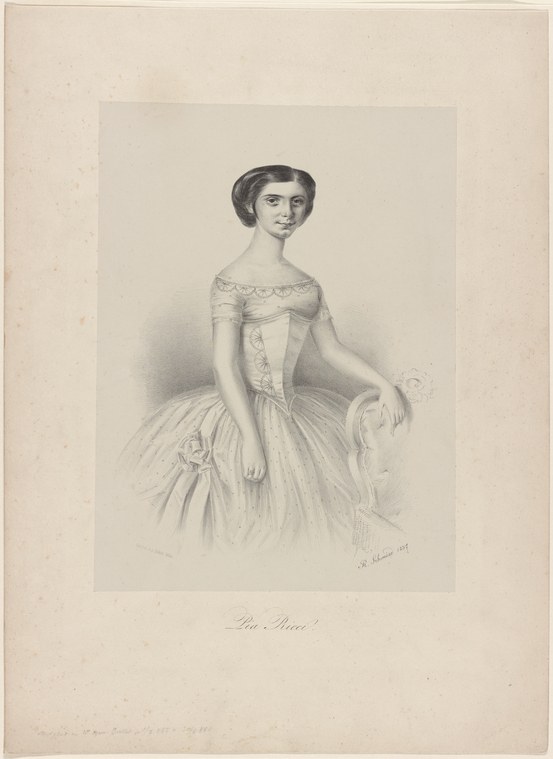
A young woman in a full-length Romantic-era ballgown stands in three-quarter view against a plain background. She wears an off-shoulder dress with a fitted bodice ornamented with delicate embroidery or beading, and a voluminous skirt of layered, gauzy fabric that falls to her ankles. The skirt is caught in gentle folds and rendered with careful attention to the play of light through translucent material. Her hair is arranged in the fashionable style of the 1840s–50s, parted in the center and swept back smoothly. Her posture is upright and dignified, with one arm relaxed at her side and the other gently curved, as if she has paused mid-movement or is about to extend it in greeting or dance. The composition is intimate and focused: the figure occupies most of the picture plane, and the neutral background throws all emphasis onto her dress and bearing. The technique is a refined pencil or engraved rendering, with fine hatching and tonal gradation creating volume in the skirt and the subtle modeling of her face and neck.
The dancing
A single standing female figure in a relaxed but composed posture. Her weight appears evenly distributed, her shoulders back and squared, with no indication of extreme turnout or lifted port de bras. The arm position—one down, one gently curved—suggests the moment between motions rather than a dynamic pose. There is no visible footwork, heel placement, or balletic articulation of the foot; the lower legs are concealed by the volume of skirt. The overall frame is that of a young woman in formal dress rather than a dancer in technical execution.
The dance depicted
This is likely a portrait of a Romantic ballet dancer, rendered as a formal engraved print rather than a scene of performance. The off-shoulder corsage and voluminous tulle skirt are consistent with the costume of a prima ballerina of the 1840s–50s—the era of *La Sylphide* and *Giselle*. The title 'Pia Ricci' and the holding of the print in a collection of dance imagery suggests this is a named dancer, probably Italian, portrayed in her stage costume or in the formal attire of a celebrated performer. The pose is not a caught moment of virtuosity but rather a studio portrait: the dancer presented as an object of admiration in her costume, in a static, dignified stance. This was a common format for reproducing images of celebrated dancers for distribution and collection.
How it was made
This is an engraving or steel engraving, executed in fine black line and tonal hatching on white paper. The technique allows for high detail in the rendering of fabric—the diaphanous layering of the skirt is achieved through careful use of fine parallel lines and the preservation of white paper for highlights. The medium was ideal for wide circulation: engravings could be printed in large editions and bound into books or collected as individual sheets, making them an economical way to distribute images of famous performers to a broad public. The refinement of the line work and the attention to the costume suggest this was a commercial enterprise, likely published in London, Paris, or another major European theater center.
About this work
This is a formal engraved portrait of a named dancer—Pia Ricci—rendered in her stage costume of the Romantic ballet era, roughly 1840–50. The work is not a narrative scene or a representation of choreography, but rather a celebrity portrait in the mode of theater-related printmaking of the period. Such prints served as a form of fan material and visual record of the stars of European ballet, circulated to audiences who could not attend performances or wished to collect images of their favorite dancers. The image belongs in a dance collection because it documents both the costume conventions of the period and the cultural practice of circulating images of named performers.
How to look at it
Attend to the rendering of the skirt: the artist has used the constraints of engraving technique to suggest translucency and movement through careful placement of line. Note the costume detail—the off-shoulder neckline with its ornamental trim, the fitted bodice, the construction of the skirt in layers—which is the visual grammar of Romantic ballet. The pose is deliberately static and frontal, presenting the dancer as an idealized figure for contemplation rather than as a moment of action. This stillness is itself telling: the print format and the formal presentation transform the dancer into a collected object, a portrait to be framed or bound into an album.
The period
This engraving dates to the height of the Romantic ballet movement, when ballets such as *La Sylphide* (1832) and *Giselle* (1841) had established the off-shoulder white tulle costume as the visual signature of the form. The 1840s and 1850s saw an explosion of printed dance imagery—both as theatrical advertisements and as collectible prints for fans and the general public. The engraving medium was the standard technology for theatrical portraiture before photography; the shift to photographic reproduction of dancers occurred gradually from the 1860s onward. This print sits at the end of that engraving era, when named dancers like Pia Ricci were already international celebrities whose likenesses could be sold as separate commodities.
Where it lives
Held in the New York Public Library's collection of prints depicting dance. The work is catalogued under the title 'Pia Ricci' with no recorded artist, date, or medium in the existing record.
Dance in this work
Questions about this work
Was Pia Ricci a real dancer?
The title and the holding of this print in a dance collection suggests yes, but the catalogue record does not provide biographical details. The name is consistent with an Italian-born dancer of the mid-19th century, as Italian dancers were prominent in European ballet of this period. Without additional archival work, we cannot confirm her dates, her principal roles, or the theaters where she performed.
How was this print made and distributed?
This is an engraving—a process in which an image is cut into a metal plate and then printed from that plate. A single plate could produce hundreds or thousands of prints. Such prints were sold individually at the theater, bound into periodicals about theater and dance, or collected in albums by fans. They were cheaper and easier to distribute than original paintings, making them the dominant form of dance imagery in the 19th century before photography.
Why is the dancer posed so still if this is a dance image?
This is a portrait of the dancer in her costume, not a representation of choreography or technique. The formal, static pose emphasizes her status as a celebrated performer and allows the viewer to admire her costume and bearing. It is closer to a celebrity photograph than to a representation of movement—the dancer is presented as an object of aesthetic admiration rather than as an athlete in action.
What does the costume tell us?
The off-shoulder neckline, fitted bodice, and multilayered tulle skirt are the hallmarks of Romantic ballet costume, established in the 1830s and dominant through the mid-century. The costume was designed to suggest weightlessness and ethereal femininity. The care with which the artist has rendered the translucent layers of the skirt shows how important the costume was to the visual identity of the form.
More dance artwork





