49 works in this view — arrow keys or swipe to move between them.
Dance in Art
Paris exposition
Unknown artist
- Collection:
- Prints depicting dance
- Source:
- New York Public Library
- Rights:
- Public domain — free to use, share and adapt.
- Recorded as:
- Public Domain
This work captures a pivotal moment when European dance was consciously reviving and reinterpreting classical subject matter through modern movement and design. It documents the intersection of classical scholarship, theatrical innovation, and visual art in the early 20th century—a convergence that shaped the development of modern dance and ballet. For dance historians, it provides evidence of what classical or mythological subjects looked like in performance and costume of the period, and how artists visualized the body's emotional and expressive capacity in such roles.
What you are looking at
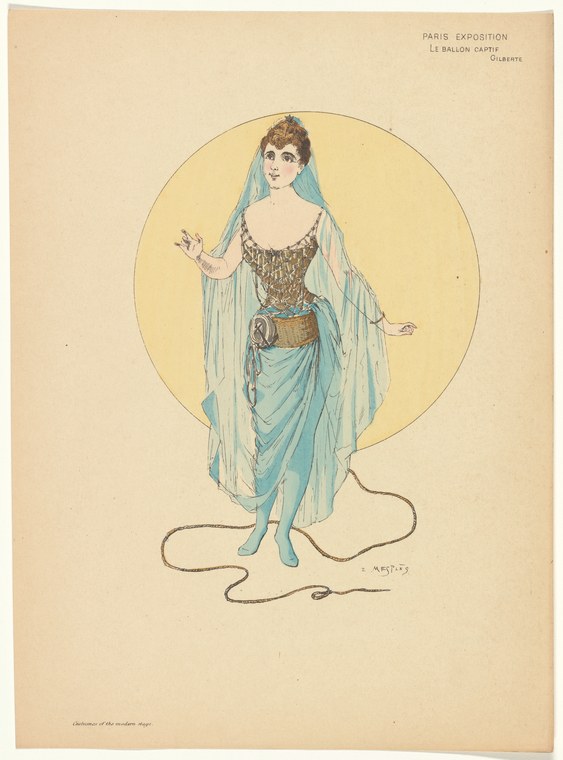
A single female figure stands against a luminous yellow circular backdrop, posed in a languid, contemplative stance. She wears a draped chiton or classical tunic in earth tones with an ornate jeweled breastplate, her shoulders bare. A flowing blue-green veil falls from her head to her feet, creating an elegant diagonal line across her body. Her left arm is raised in a graceful gesture, fingers splayed expressively, while her right arm hangs at her side. She wears blue-green leg wrappings or boots. At her feet lies a coiled rope or serpent rendered in dark outline, its head visible at the bottom of the composition. The overall effect is theatrical and allegorical, suggesting a classical or mythological subject rendered in a late 19th- or early 20th-century aesthetic.
The dancing
A single dancer stands in a relaxed contrapposto stance with her weight on one leg, the other leg straight but unweighted. Her torso is upright and open to the viewer. The raised left arm curves expressively upward with fingers extended and separated, a gesture suggesting either invocation, surprise, or emotional release—the kind of arm work associated with interpretive or classical theatrical dance of the period. Her head is turned slightly, gaze directed outward. The pose reads as a moment of stillness or transition rather than dynamic movement, emphasizing grace and emotional content over athletic technique.
The dance depicted
This appears to represent classical or Greco-Roman inspired theatrical dance as reimagined through late 19th-century aesthetics, most likely Romantic or early modern theatrical performance rather than historical recreation. The classical drapery, mythological props (the serpent), and theatrical presentation suggest the influence of interpretive or classical ballet of the period. The figure's pose and gesture are consistent with the expressive, elongated arm movements and contemplative bearing associated with Romantic ballet or the classical revivals popular in European theatre around the turn of the 20th century. Without inscription or clearer context, the specific role and narrative cannot be firmly identified, but the work documents the period's fascination with classical subjects translated into contemporary dance vocabulary.
How it was made
This is a hand-colored line drawing or lithograph, identifiable by the delicate linear work defining the figure and the thin, controlled outlines throughout. The yellow background is applied in a flat wash, while the colored drapery—blues, greens, and earth tones—are added as transparent or semi-opaque overlays over the printed line. The technique allowed for reproductive circulation and suggested a design for theatrical costume or a commercial artwork meant for collectors of theatrical imagery. The refinement of the draftsmanship and the subdued color palette indicate a work of some artistic ambition, produced at a moment when illustrated theater programs, prints, and souvenir images were collected as art objects in their own right.
About this work
This drawing documents a moment in European theatrical performance at the turn of the 20th century, when Romantic and classical subjects were reimagined through contemporary dance and design practice. The work commemorates the 1900 Paris Exposition, where such theatrical entertainments and artistic innovations were celebrated as markers of cultural modernity. It preserves not a historical dance but a contemporary interpretation of the classical past—a form of artistic quotation typical of Symbolist and Art Nouveau aesthetics. The figure's costume, pose, and the refined drawing technique all point to a high-culture theatrical context, likely ballet or an allied form of interpretive dance.
How to look at it
Attend to the figure's arm and hand position: the raised, open gesture with separated fingers is the key to understanding how the artist conceived of classical movement. This is not static—it is a moment of emotional or expressive release, a vocabulary developed by Romantic dancers and the early modern movement. Notice also how the veil is rendered as an active element, creating a diagonal line that mirrors and extends the body's movement. The circular backdrop isolates the figure, making her the sole focus and suggesting a spotlight or theatrical focus. The serpent at her feet may be symbolic (perhaps alluding to a specific mythological narrative like the Python or a serpent goddess), but it also anchors the figure in a dramatic moment rather than a neutral pose.
The artist
The artist is not recorded in the catalogue. The work bears a signature (visible as a small mark near the lower figure), but it is not legible in reproduction. The drawing style—refined draftsmanship, theatrical subject, Art Nouveau sensibility—is consistent with the work of European illustrators and theater designers of the 1900 Paris Exposition era. The artist may have been a theater costume designer, a commercial illustrator, or a painter documenting a specific performance or performer.
The period
The Paris Exposition of 1900 was a major showcase for theatrical innovation and artistic vision across Europe. Romantic ballet and classical revivals were at their height, with dancers like Anna Pavlova and others performing roles based on Greco-Roman mythology and classical literature. Simultaneously, the Art Nouveau movement was reshaping design aesthetics across all media, emphasizing graceful lines, theatrical presentation, and the unity of all the arts. This drawing sits at the intersection of these currents—classical content expressed through contemporary movement and visual design. The work also documents the period's fascination with collecting and circulating theatrical imagery as fine art, a practice that made performance accessible to audiences who could not attend live performances.
Where it lives
The work comes from the New York Public Library's collection of prints depicting dance, a collection assembled over decades to document the history of theatrical dance through visual media. The inscription "PARIS EXPOSITION / LE BALLON CAPTIF / GILBERTA" at the top right indicates that this was part of the Library's documentation of the 1900 Paris Exposition and possibly commemorates a specific performer or production titled "Le Ballon Captif" (The Captive Balloon), though that title's connection to the figure's dance role is not immediately clear.
Dance in this work
Questions about this work
What is the rope or serpent at the figure's feet?
It may be a symbolic prop connected to a specific mythological or allegorical role, or it could represent part of the stage apparatus or costume element. Without more context about the performance or role, its precise meaning cannot be determined, but it suggests that this figure occupies a specific dramatic narrative rather than being a generic 'classical dancer.'
Is this documenting an actual performance from the 1900 Paris Exposition?
Most likely yes. The inscription indicates a connection to the Exposition and may reference a specific performer or production. However, this is a stylized artistic rendering rather than a documentary image, so it shows how the artist interpreted and idealized the performance rather than a literal record of movement or costume.
What kind of dance is this?
This appears to be classical theatrical dance or ballet as reimagined in the Romantic and early modern idiom—using classical or mythological subjects but performed with the movement vocabulary of late 19th-century theater. It is not historical Greek dance, but rather a contemporary artistic response to classical themes.
More dance artwork





