49 works in this view — arrow keys or swipe to move between them.
Dance in Art
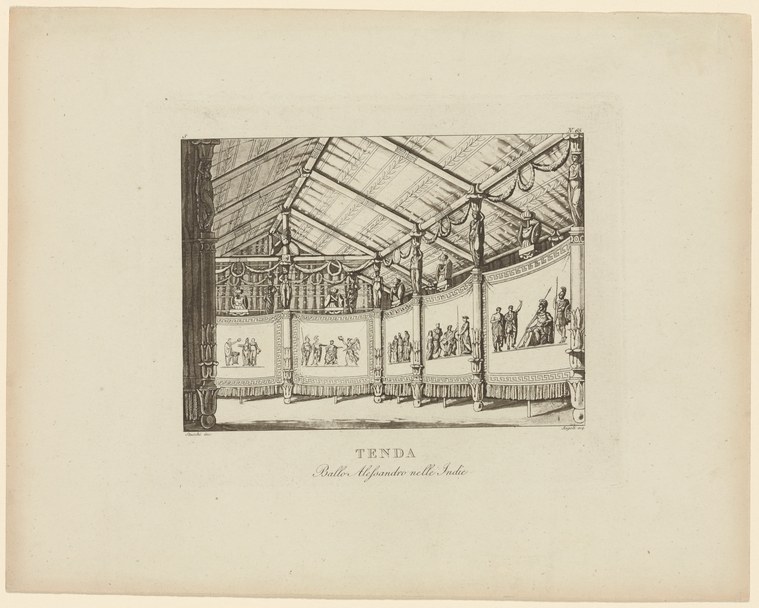
Tenda. Ballo Alessandro nelle Indie: Stucchi inc. Angeli acq. [after a set design by Sanquirico]
Unknown artist
- Collection:
- Prints depicting dance
- Source:
- New York Public Library
- Rights:
- Public domain — free to use, share and adapt.
- Recorded as:
- Public Domain
This is documentary evidence of how court spectacles integrated dance, architecture, and narrative framing into a unified theatrical experience. It shows the scale and expense of such productions and reveals that dancing in courts was not an isolated activity but part of a complex multimedia environment designed to display power, learning, and refinement.
What you are looking at
This is an engraving of a temporary theatrical pavilion or tent structure, depicted in cross-section to show the interior. The tent has a peaked roof with radiating beams and is supported by a tall column on the left. Inside, the walls are lined with large framed panels or canvases depicting narrative scenes populated with numerous figures in classical dress. A low railing runs along the inner perimeter of the tent. The floor appears to be raked or slightly elevated, and the whole structure is decorated with festive swags or garlands hung from the ceiling. The engraving employs precise linear perspective and careful hatching to create depth and texture, rendering the architectural framework in meticulous detail. The scale and formality of the construction suggests this is a temporary stage set or performance space for a court spectacle or opera.
The dancing
The human figures visible in the framed wall panels are rendered at very small scale, making detailed analysis of gesture difficult. They appear to be arranged in groups and processional formations typical of history painting or classical narrative scenes. The figures seem to occupy multiple registers within each framed composition, suggesting hierarchical or narrative ordering rather than the unified spatial logic of a dance scene. No dancers are shown in active movement in the central space of the pavilion.
The dance depicted
The title identifies this as a scene from *Ballo Alessandro nelle Indie* (A Ball in the Indies of Alexander), which was likely an aristocratic court spectacle or theatrical ballet. Given the architectural framing and the presence of narrative historical imagery, this appears to be a set design for such a production rather than a depiction of dance itself. The pavilion itself was probably the stage or ballroom space where dancers performed. The scenes depicted within the wall panels may represent the narrative or mythological content that the choreography accompanied or illustrated, following the conventions of court ballet where dance, spectacle, theatre, and visual narrative merged.
How it was made
This is an engraving, executed with fine parallel line-work and cross-hatching to create tonal gradations and three-dimensional form. The precision and clarity suggest it was made from a carefully prepared drawing, likely after an architectural or stage design. Engravings of this type were typically made in multiple impressions for circulation among court circles and theatrical professionals, serving both as documentary records of grand spectacles and as patterns for future productions. The technique allowed for fine architectural detail while also capturing the decorated surfaces and theatrical effects of the original.
About this work
This engraving documents the stage design for a court spectacle titled *Ballo Alessandro nelle Indie*, depicting the temporary pavilion or ballroom where the performance took place. The print preserves not the dance itself but the elaborate architectural and decorative framework within which it occurred—a crucial context for understanding how courtly dance was integrated into larger theatrical and narrative experiences. The work is attributed to or derived from a design by Sanquirico, a significant figure in theatrical design, and was engraved by Angeli. Such prints circulated among the aristocratic and theatrical networks that produced court spectacles, serving as both records of past splendor and models for future events.
The image exemplifies the intimate relationship between architecture, decoration, and dance in early modern court culture. The painted narrative scenes framing the performance space suggest that the choreography was meant to illustrate or complement historical or mythological content, rather than existing as pure movement. For historians of dance and spectacle, this print documents the visual and spatial environment in which court dancing took place—information that is almost never visible in dance notation or text alone.
How to look at it
Study the architectural precision of the pavilion structure itself: the way the peaked roof is constructed, the proportional relationships, the placement of the supporting column. Note how the interior wall panels are arranged to frame narratives—this staging of historical scenes around a central dancing space was a core principle of court spectacle design. The smallness and density of figures in the wall panels contrasts with the emptiness of the central floor, emphasizing that this is a space *for* performance rather than a performance already underway. Observe the festive decoration—the swags and hanging ornaments—which signal the celebratory and aristocratic context.
The artist
The work is attributed to an engraver named Angeli and derives from a set design (likely architectural drawing) by Sanquirico, a major figure in the design of court spectacles and opera productions. The print is part of a tradition of theatrical documentation in which engraved designs and stage sets were circulated among patrons and artists to preserve records of celebrated productions and to inspire future works.
The period
The title *Ballo Alessandro nelle Indie* suggests a work inspired by the exploits or court of Alexander the Great—a common subject for court spectacles, particularly in Italy. Court ballets and spectacular entertainments flourished in the 16th and 17th centuries, serving as vehicles for dynastic propaganda, allegorical instruction, and the display of courtly accomplishment. Such spectacles brought together dancers, musicians, poets, painters, and architects in collaborative productions that could last hours and involve elaborate stage machinery, scene changes, and narrative frameworks. The engraved dissemination of designs from these events was part of court culture's broader investment in preserving and publicizing its refined achievements.
Where it lives
This engraving is part of the NYPL's collection of prints depicting dance. It is catalogued with minimal descriptive metadata, which is common for early theatrical prints. The surviving record attributes it to Angeli as engraver and credits Sanquirico with the original design, though the catalog notes are sparse.
Dance in this work
Questions about this work
Is this actually a picture of people dancing?
Not directly. This is a stage design—a record of the architectural and decorative setting in which a court spectacle called *Ballo Alessandro nelle Indie* took place. The central floor space is empty because this is an architectural or scenographic document rather than a scene of dancing in progress. However, it is essential to understanding how dance was experienced in courts: not as an isolated activity, but as part of an elaborate multimedia environment.
What would have happened in this pavilion?
Courtiers would have danced, likely while musicians performed and while the narrative scenes depicted in the framing panels were referenced, sung about, or dramatized through the choreography. The spectacle probably involved multiple scenes or acts, with changes in decoration or stage machinery. The elaborate framing suggests the dancing was meant to illustrate or complement a historical narrative centered on Alexander the Great.
Who made this print and why?
The engraver Angeli produced this print from a design by Sanquirico, a celebrated theatrical designer. Prints like this were made to document grand spectacles so that the memory of them would survive, and to allow other courts and patrons to study the designs and perhaps commission similar productions. They circulated among aristocratic and theatrical professionals as records and inspiration.
When was this made?
The catalog does not give a date. The style of engraving and the aesthetic of the design suggest the 17th or early 18th century, but without further research or inscription on the print itself, a precise date cannot be determined.
More dance artwork





