49 works in this view — arrow keys or swipe to move between them.
Dance in Art
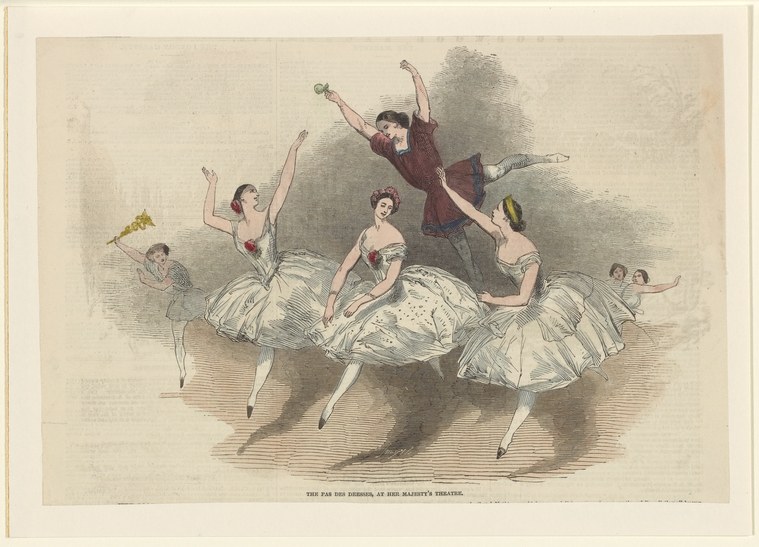
The Pas des déesses, at Her Majesty's Theatre
Unknown artist
- Collection:
- Prints depicting dance
- Source:
- New York Public Library
- Rights:
- Public domain — free to use, share and adapt.
- Recorded as:
- Public Domain
This print is direct evidence of how a celebrated ensemble piece looked in performance at a major theatre, showing the romantic ballet corps in its characteristic massed formation. For dancers and choreographers, it illustrates the visual purpose of ensemble work—not individual virtuosity but collective visual effect. For historians, it documents the stage practice, costume, and spatial arrangement of a specific work at a known venue.
What you are looking at
A theatrical scene set on the stage of Her Majesty's Theatre, showing a group of female dancers in romantic-era ballet costumes—white or pale tutus with off-shoulder necklines—arranged in a diagonal composition that suggests dynamic movement. The central figure, wearing a darker garment (possibly a shawl or cape in deep red or burgundy), stands elevated among the others in an arabesque or balletic pose with one arm raised. The surrounding dancers are captured mid-leap or in attitudes of flight, their bodies angled and limbs extended to suggest weightless suspension. The artist has used cross-hatching and tonal shading to create depth and atmosphere, with darker shadows massed behind the figures to throw the dancers into relief. The setting appears to be a stage with minimal scenery, focusing entirely on the dancers' bodies and their relationship to one another. The composition radiates outward from the central figure, creating a sense of coordinated, ethereal movement.
The dancing
Five or six dancers are distributed across the composition, each captured at a different point in a vertical or diagonal trajectory. The bodies display the characteristic lifted sternum, extended limbs, and pointed feet of classical ballet technique. Several dancers are en pointe or near-pointe, their legs extended in battements or attitudes. The central figure adopts a commanding vertical pose with one arm raised overhead, while the surrounding dancers lean and reach outward as though propelled by momentum. The spacing and angles suggest a corps de ballet or ensemble piece rather than a solo performance, with individual dancers maintaining their own vertical lines while appearing to move in concert.
The dance depicted
This is a scene from a ballet performance, most likely from the romantic period (1830s–1840s) based on the tutu style, pointe work, and ethereal aesthetic. The title 'Pas des déesses' ('Dance of the Goddesses') suggests a classical or mythological subject typical of romantic ballet. The image likely depicts a ensemble or corps section rather than a named solo, showing how such pieces were staged and the visual impression they created in the theatre. The prominence of the central figure in deeper colour, combined with the surrounding dancers in lighter tutus, suggests a hierarchical staging common to the era.
How it was made
This is a hand-coloured engraving or lithograph, identifiable by the fine linear hatching used to build form and shadow, the precise line work defining the dancers' contours, and the selective application of colour (particularly the deep red of the central figure's garment and the pale wash of the tutus). The technique allowed for relatively rapid reproduction and distribution to audiences and print collectors, suggesting this was a popular theatrical image circulated widely after the performance. The printing process enabled wide dissemination in an era before photography, making such prints important records of how ballets were staged and perceived.
About this work
This is a theatrical print documenting a scene from a romantic-era ballet performed at a major London theatre. The work captures not a moment of narrative drama but an ensemble visual spectacle—a massed display of female dancers in flight, arranged to create an overall impression of lightness and coordinated grace. Such prints served as souvenirs for theatre-goers and records of celebrated productions, preserving in two dimensions the ephemeral art of ballet performance.
The image belongs in a dance history collection as a primary source for understanding how romantic ballet was staged, how the corps de ballet functioned as a visual unit, and what spectators saw from the audience. It documents both the technique (pointe work, extended limbs, lifted carriage) and the theatrical presentation (costume, ensemble arrangement, stage composition) that defined the romantic ballet aesthetic.
How to look at it
Attend to the diagonal lines and the carefully orchestrated spacing: the artist has arranged the dancers to suggest simultaneous upward movement, creating a visual rhythm across the composition. The darker central figure anchors the composition while the surrounding lighter figures appear to move outward and upward. Note how the artist has rendered pointe work and extended positions, and observe how the shallow stage space compresses the dancers' bodies into an almost frieze-like arrangement. The moment captured is not a narrative peak but a moment of visual plenitude—the entire ensemble displayed at once in aesthetic formation.
The period
This print dates to the height of the romantic ballet era in Britain, when French and Italian ballet companies toured London theatres and when the ballet blanc—corps sections of ethereal, identically costumed female dancers—became a signature visual spectacle. Her Majesty's Theatre was a principal London venue for such productions in the 1830s–1840s. The romantic period saw a shift from narrative-driven ballet to spectacle-driven ensemble work, and such prints were produced and sold as souvenirs to capitalise on the popularity of these productions.
The engraving or lithographic technique was the standard means of circulating images of theatre performances before photography; such prints appeared in theatrical annuals, were sold at the theatre, and were collected by enthusiasts. They served a documentary function alongside their role as commercial prints, preserving impressions of celebrated productions.
Where it lives
The work is held in the NYPL's collection of prints depicting dance, a collection assembled from theatre prints, annuals, and period ephemera documenting performance history. Such prints were originally distributed as theatrical souvenirs and collected by theatre enthusiasts; the collection preserves them as historical records of nineteenth-century stage practice.
Dance in this work
Questions about this work
What is 'Pas des déesses'?
'Pas des déesses' (Dance of the Goddesses) is a generic title for an ensemble ballet number, likely featuring a group of female dancers in a classical or mythological setting. Many romantic-era ballets included such ensemble pieces, and the title does not necessarily indicate a specific single famous work. Theatrical prints often used such titles to indicate the character of the scene rather than identify a unique composition.
How do we know this was performed at Her Majesty's Theatre?
The caption beneath the print reads 'Pas des déesses, at Her Majesty's Theatre,' which explicitly identifies the venue. This was a common practice for theatrical prints, which often included the theatre name to document where a celebrated performance took place and to attract other theatre-goers who might wish to own a memento.
Why are the dancers all in white?
The pale, nearly identical tutus signal a corps de ballet in the romantic era aesthetic. The uniform costume and colour created the visual effect of a unified ensemble and was a hallmark of romantic ballet spectacle. The single darker figure in red appears to be a leading dancer distinguished from the corps.
What technique is being depicted?
The dancers display characteristic romantic ballet technique: pointe work (standing and moving on the tips of the toes), extended limbs, a lifted torso, and turned-out legs. The asymmetrical, dynamic poses—arabesques, attitudes, and leaps—reflect the vocabulary of classical ballet as practised in the 1830s–1840s.
More dance artwork





