49 works in this view — arrow keys or swipe to move between them.
Dance in Art
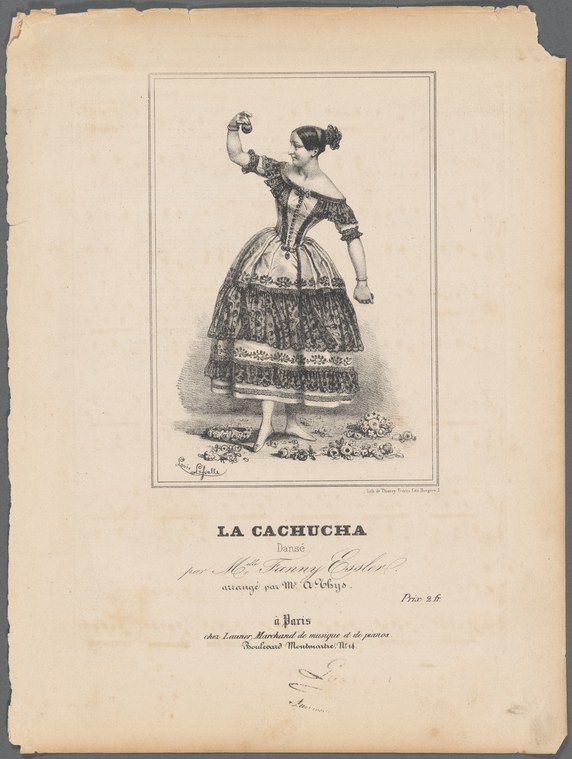
Fanny Elssler dancing the cachucha
Unknown artist
- Collection:
- Prints depicting dance
- Source:
- New York Public Library
- Rights:
- Public domain — free to use, share and adapt.
- Recorded as:
- Public Domain
Fanny Elssler was one of the most celebrated dancers of the nineteenth century, and the Cachucha was her signature role—a dance that made her name and demonstrated that character dance could achieve the prestige of classical ballet. This print is one of the few visual records of how the dance was costumed and performed, and it documents a moment when ballet began to expand beyond purely classical vocabulary to embrace the dramatic and rhythmic appeal of Spanish dance.
What you are looking at
A single female dancer in a theatrical pose stands against a plain background, captured in a moment of performance. She wears a fitted corseted bodice with what appears to be off-shoulder sleeves, paired with a full, elaborately decorated skirt that extends to mid-calf. The skirt features horizontal bands of ornate patterning or embroidery. Her dark hair is styled up and back in the fashion of the 1830s–40s. She holds her right arm raised at shoulder height, the hand turning inward as if displaying something small—possibly a fan or castanets. Her left arm hangs naturally. The figure is framed by a simple rectangular border, and scattered at her feet are what appear to be small flowers or floral motifs, suggesting a theatrical or romantic context. The print's soft tonal range and fine linear detail suggest an engraving or lithograph from the mid-nineteenth century.
The dancing
A single dancer in a three-quarter frontal pose, weight appears to be on the back foot with the body angled slightly forward in readiness. The raised right arm and turned hand suggest a moment of flourish or gesture, common in Spanish or Iberian dance vocabulary. The torso is upright and corseted, typical of Romantic-era ballet training. The posture conveys both controlled elegance and theatrical confidence—the body is composed rather than caught mid-leap, suggesting this captures a posed moment or attitude rather than dynamic momentum.
The dance depicted
This print documents the Cachucha, a Spanish dance that became an international sensation when performed by the Irish dancer Fanny Elssler in the 1830s–40s. The Cachucha is a lively, rhythmic solo typically in 3/8 time, characterized by rapid footwork, hip movement, and hand gestures using castanets—the latter visible in the raised hand posture here. Though Spanish in origin, when adopted into ballet it retained its energetic character while being refined into the vocabulary of Romantic ballet. Elssler's performances of this dance across Europe and America made her famous and helped establish that ballet could embrace folk and national dances without loss of prestige.
How it was made
This is a lithograph or engraving, identifiable by its crisp linear detail, tonal gradation through fine parallel lines (hatching), and the printed text at bottom. The technique allowed for wide reproduction and circulation to a middle-class audience eager for images of famous performers. The signature mark visible in the lower left corner suggests the artist's name, though it is not fully legible in this impression. The medium's accessibility made such prints important documents of nineteenth-century theatrical performance—the only visual record many viewers would ever have of a celebrated dancer's signature roles.
About this work
This is a mid-nineteenth-century theatrical portrait print documenting Fanny Elssler in the Cachucha, a Spanish dance that became a sensation of the Romantic ballet era. The print captures the dancer in a posed, moment of performance—arm raised, hand turned, suggesting the gestural refinement and national character dance brought into the ballet repertoire. Elssler's fame rested partly on her ability to dance both classical ballet and national/character dances; this print preserves that fusion and the visual memory of a role that defined her international career.
The work belongs in a dance history context because it documents not only a famous dancer and dance, but also a turning point in ballet aesthetics: the moment when Romantic ballet began to incorporate Spanish, Italian, and other European folk and character dances as legitimate theatrical forms. The print is both artwork and historical evidence.
How to look at it
Look at the raised hand and turned wrist: this is the signature gesture of castanets playing, central to the Cachucha's rhythmic character. The dancer is not in classical ballet position but in a moment of Spanish attitude—weight set, torso upright but mobile, ready to move through space with the rapid, articulate footwork this dance demands. The decorated skirt is crucial: it is fuller and richer than a classical ballet skirt, and the ornamental bands suggest Spanish costume, grounding the dance in national character even within the classical frame. The moment captured is not a jump or turn, but a posed moment that allows the hand, arm, and torso—the instruments of character and gesture—to be legible. This is a convention of theatrical portraiture: to freeze the dancer in an attitude that best conveys the essence of the role.
The artist
The artist is not recorded in the catalogue. However, the signature visible in the print suggests a professional lithographer or engraver working in Paris or another European art center in the 1830s–40s. Such prints were often made by specialist theatrical engravers who worked from sketches or memory to produce affordable images for the public—not always signed by the original designer but rather by the printmaker. The style and quality suggest a reputable workshop accustomed to theatrical subjects.
The period
The 1830s and 1840s were the height of Romantic ballet in Europe. Marie Taglioni and other stars of classical ballet dominated the 1830s, but by the 1840s dancers like Elssler were celebrated for different qualities: Spanish heat, folk authenticity, and dramatic character work rather than the ethereal, otherworldly aesthetic of Taglioni. The Cachucha arrived in the ballet repertoire around 1836–37 as a vehicle for Elssler, and it became one of the most frequently performed and parodied dances of the era. Lithographic and engraved portraits of dancers were booming as a commercial art form, fed by the demand of audiences who had seen performances and wanted mementos. This print sits at the intersection of ballet history, theatrical celebrity culture, and popular printmaking.
The dance itself represents a broader fascination in European Romantic culture with national identity, folk tradition, and the "authentic" or "natural"—Spain and Spanish dance were especially fashionable and coded as passionate and sensual in contrast to classical ballet's refinement. Elssler's Irish background and her embrace of character and Spanish dance also positioned her as a counterpoint to the more ethereal, Russian-associated classical tradition.
Where it lives
The work is held in the New York Public Library's Prints collection, which includes theatrical and dance-related prints from the nineteenth and early twentieth centuries. It is catalogued as a theatrical dance portrait, one of hundreds of similar celebrity prints produced for commercial sale and distribution to theater-goers.
Dance in this work
Questions about this work
Who was Fanny Elssler?
Fanny Elssler (1810–1884) was an Irish-born dancer who became one of the most celebrated performers of the Romantic ballet era. She was known for her technical brilliance and her mastery of character and national dances, in contrast to her contemporary rivals who specialized in ethereal, classical ballet. She performed across Europe and the Americas and was the first major ballet star to tour the United States (1840–42).
What is the Cachucha?
The Cachucha is a Spanish dance in 3/8 time, characterized by rapid footwork, hip movement, castanets, and hand gestures. Though its origins are in Spanish folk tradition, it entered the ballet repertoire in the 1830s as a showcase for Elssler's talents. It typically appears as a solo, and it remained popular throughout the nineteenth century and beyond.
Why is this image historically important?
This print is one of the primary visual records of how the Cachucha was costumed and performed in the nineteenth century. It documents a famous role by a legendary dancer, and it shows how Romantic ballet began to incorporate national and character dances into the classical vocabulary—a shift that defined mid-nineteenth-century theatrical dance.
How was this print made and distributed?
This is a lithograph or engraving, printed in quantity and sold to the public in the 1830s–40s. Such prints were affordable theatrical souvenirs, sold in print shops and at theaters. They were the primary way audiences could own an image of a celebrated dancer, before photography became widespread.
More dance artwork





