49 works in this view — arrow keys or swipe to move between them.
Dance in Art
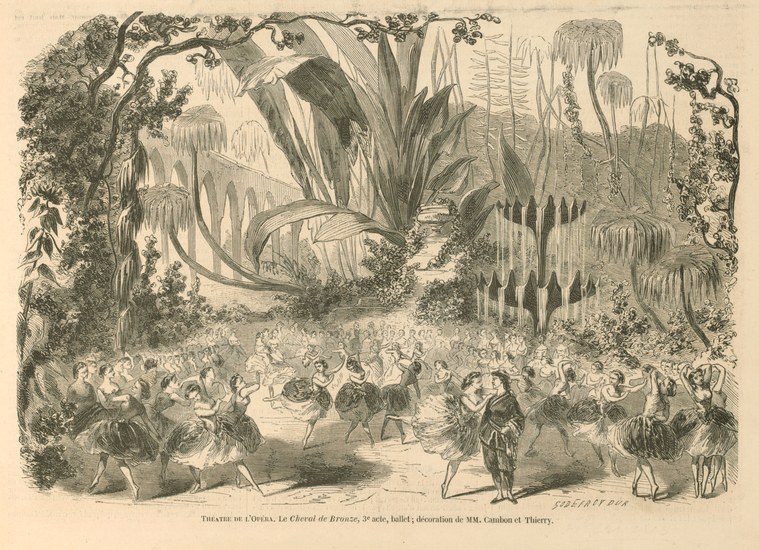
Théâtre de l'Opéra, Le Cheval de bronze: 3e acte, ballet; décoration de MM. Cambon et Thierry
Unknown artist
- Collection:
- Prints depicting dance
- Source:
- New York Public Library
- Rights:
- Public domain — free to use, share and adapt.
- Recorded as:
- Public Domain
This image is one of the few precise contemporary records of how a major romantic ballet was actually staged, designed, and danced, documenting the collaboration between choreographer, designers, and performers that defined the golden age of romantic ballet. For historians, it reveals the scale of ensemble work, the fantasy aesthetic, and the technical ambition of mid-19th-century opera-ballet; for dancers and designers, it shows the spatial relationships, costume silhouettes, and stage management of a work that influenced ballet composition for decades.
What you are looking at
A theatrical ballet scene set in a fantastical woodland grotto, likely from the third act of *Le Cheval de Bronze* (The Bronze Horse), a mid-19th-century ballet. The stage is dominated by enormous drooping willow-like vegetation and tall columnar plants rendered in delicate line-work, creating an ethereal, romantic forest setting. The floor is populated with a large ensemble of female dancers in tutus, arranged in loose groupings across the stage. In the foreground, dancers are positioned in various attitudes—some standing, some in movement—their light costumes contrasting sharply against the detailed botanical elements. Male dancers and figures in darker dress appear among the ensemble, including at least one figure in military or formal costume. The composition draws the eye upward through the hanging vegetation to a deep stage perspective, suggesting the vastness of this supernatural realm. The engraving technique creates a luminous quality through careful management of light and shadow, with the dancers' bodies emerging from the delicate cross-hatching of the forest.
The dancing
The female dancers wear the classical romantic tutu and pointe shoes typical of mid-19th-century ballet, with their bodies arranged in attitudes suggesting movement—supported développés, arabesques, and preparatory positions scattered throughout the ensemble. Several male figures in darker costume are interspersed, some appearing to gesture or conduct the action. The dancers' poses vary from lyrical and elongated to more grounded stances, suggesting a scene of gathering or ensemble interaction rather than synchronized formation. Arm positions are raised and graceful, consistent with the vocabulary of romantic ballet, though the engraving's linear technique makes fine details of footwork difficult to discern.
The dance depicted
*Le Cheval de Bronze* was a spectacular romantic ballet choreographed by Arthur Saint-Léon, first performed at the Opéra in 1857. This engraving depicts the third-act ballet scene, likely showing the enchanted realm or supernatural gathering central to the work's narrative. The ballet was famous for its elaborate machinery, fantastic settings, and large ensemble spectacle—precisely what this image documents. The ensemble composition, the magical woodland setting, and the mix of soloists and corps suggest the type of grand divertissement that characterized Second Empire ballet, combining narrative drama with pure dance spectacle. The presence of what appear to be both human and supernatural figures (suggested by their varied costume and positioning) reflects the Romantic-era fascination with bridging the real and magical worlds.
How it was made
This is a wood engraving, recognizable from its fine parallel hatching, precise line-work, and the characteristic tonal range achieved through varying density of cross-hatching rather than wash or color. The technique allowed for mass reproduction and circulation in illustrated journals and theatrical publications of the period, making this likely a documentation of the actual stage design and costume as performed. The decorative rococo-influenced frame border around the composition (formed by the hanging vegetation) is typical of mid-19th-century theatrical illustration. The engraver's skill in rendering both the intricacy of the set decoration and the movement of numerous figures demonstrates the high technical standard of theatrical documentation of this era.
About this work
This is a mid-19th-century theatrical engraving documenting the third-act ballet scene from *Le Cheval de Bronze*, a landmark romantic ballet choreographed by Arthur Saint-Léon and first presented at the Opéra de Paris in 1857. The work exemplifies the spectacular visual and choreographic aesthetic of Second Empire ballet, combining supernatural narrative, elaborate scenic design by the renowned decorators Cambon and Thierry, and a large ensemble of dancers in romantic classical style. The engraving served both as a record of the production and as promotional imagery, circulating through illustrated periodicals to reach an audience beyond the theater itself. It captures a pivotal moment of theatrical spectacle—the moment when fantasy overwhelms reality on the stage.
How to look at it
Focus first on the scale and depth—the composition demonstrates how romantic ballet used the full stage space, with dancers distributed across multiple planes from foreground to the far vanishing point, creating an illusion of a vast enchanted world. Notice how the set design overwhelms the human figures (which was the point), and how the engraver has used the density of line to create atmosphere and depth. Look at the individual poses: few dancers are in identical positions, suggesting the kind of varied, individualized movement within ensemble sections that choreographers like Saint-Léon favored. The framing of the set—those hanging botanical forms—creates a natural proscenium within the proscenium, directing attention to the central action.
The artist
The engraver is not recorded. The decorators credited—Messieurs Cambon and Thierry—were among the most accomplished theatrical scenic designers of the Second Empire, known for their ability to create convincing illusions of exotic and supernatural worlds through precise draftsmanship and innovative use of theatrical machinery and lighting. Their designs for *Le Cheval de Bronze* were celebrated as exemplars of romantic spectacle.
The period
The 1850s were the zenith of romantic ballet in Paris. *Le Cheval de Bronze* arrived as a culmination of the aesthetic perfected through *Giselle* (1841) and *La Sylphide* (1832), when the supernatural realm, the ethereal female dancer in pointe shoes, and elaborate scenic spectacle had become the dominant expression of theatrical dance. This was the era when ballet had fully separated from opera to become its own box-office draw, and when the visual documentation of ballets through engraving and lithography had become a major industry, allowing Parisian theatrical culture to be consumed across Europe. The woodcut/engraving technique itself was at the height of its refinement before photographic reproduction began to supersede it.
Where it lives
The engraving is part of the New York Public Library's collection of prints depicting dance, which preserves ephemeral theatrical documentation from the 19th and early 20th centuries. The inscription at the base identifies the work, act, ballet, and scenic designers, suggesting this was published as part of a contemporary theatrical journal or commemorative print series documenting major Parisian productions.
Dance in this work
Questions about this work
Was *Le Cheval de Bronze* performed outside Paris?
Yes, though the original 1857 Opéra production is the most celebrated. Ballets of this magnitude and spectacle were rarely exported intact; smaller traveling companies would perform adapted versions. This engraving documents the original Paris production, which was the most authoritative version of the work.
What was the role of scenery in romantic ballet?
By the 1850s, scenery had become almost as important as the dancing itself. The supernatural realm—forests, grottos, otherworldly palaces—was the essential setting for romantic ballet narratives, and advances in stage machinery and lighting made these visions increasingly convincing. Designers like Cambon and Thierry were celebrated artists in their own right, and their designs were often published separately as works of art.
How do we know what historical ballets looked like?
Engravings and lithographs like this one are among our most reliable sources, often more trustworthy than written reviews because they were created from direct observation of the stage or even from the set designer's own drawings. Photography was just beginning during this period but was not yet reliable for theatrical work, so engraving remained the standard method of documentation.
What is the difference between this and a photograph?
An engraving allows the artist to emphasize and clarify, to compose a moment that synthesizes the essence of the scene rather than simply recording what the camera would see. The engraver here has arranged the dancers to show both the spectacle and the action, and has rendered the scenery with clarity and drama that a photographic image might not capture.
More dance artwork





