49 works in this view — arrow keys or swipe to move between them.
Dance in Art
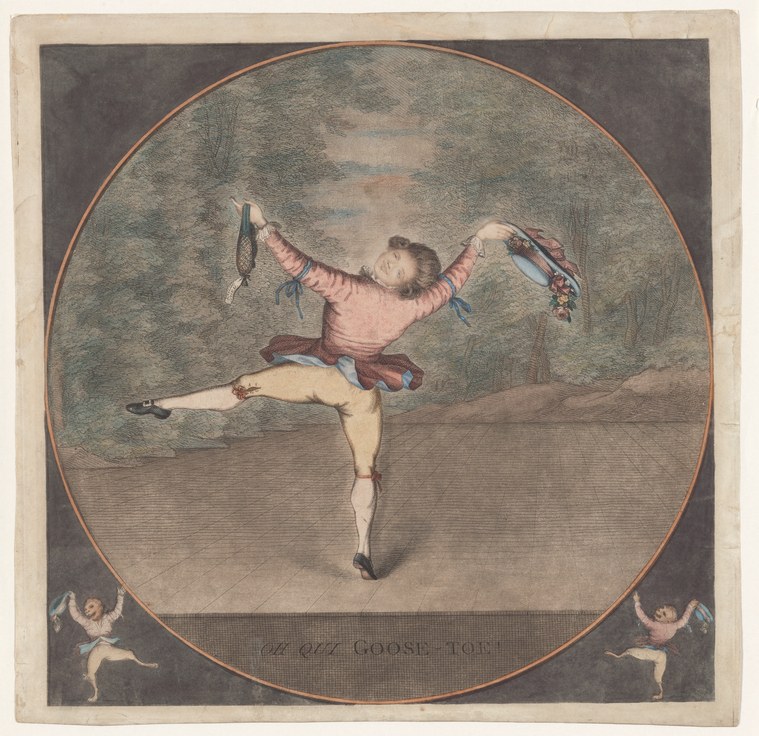
Oh qui goose-toe!
Unknown artist
- Collection:
- Prints depicting dance
- Source:
- New York Public Library
- Rights:
- Public domain — free to use, share and adapt.
- Recorded as:
- Public Domain
This print documents a moment in the history of male dancing when acrobatic feats of elevation and flexibility were central to theatrical appeal—a aesthetic now largely absent from classical ballet. The print format and unknown artist suggest that such images circulated among ordinary theatregoers, making this a window into what 19th-century audiences actually wanted to see and buy.
What you are looking at
A young male dancer in a pink silk jacket and burgundy breeches executes a high-kicking leap across a stage, his right leg extended nearly parallel to the ground and his left knee drawn up sharply. His arms are raised expressively, one hand holding a small object (possibly a fan or handkerchief). The stage floor is rendered in perspective; the background suggests a wooded or garden setting with trees and atmospheric perspective. The circular composition is framed by a reddish-orange line. Two putti (cherubs) appear in the lower corners, framing the central action. The entire scene has the quality of a theatrical performance piece, captured mid-motion.
The dancing
A single male dancer dominates the composition, captured in an acrobatic leap with a pronounced vertical extension of the right leg and a sharp flexion of the left. The torso twists slightly; one arm is raised high while the other extends laterally, creating a dynamic diagonal line through the body. The pose demands significant flexibility, core strength, and control of weight—characteristics of trained theatrical dance. The dancer's legs show the turned-out positioning and pointed articulation of the foot typical of ballet technique.
The dance depicted
This appears to depict a theatrical dance from the late 18th or early 19th century, likely a solo from ballet or a fashionable theatrical entertainment of the period. The acrobatic leap, silk costume, and stage setting suggest a trained dancer performing in an elite venue. The title 'Oh qui goose-toe!' is cryptic and may be a corruption or variant transliteration of a French or Italian phrase; it does not correspond to any identifiable dance name in standard repertory. The extreme pose—approaching an à la verticale or vertical split—suggests technical showmanship typical of Romantic-era male dancers or acrobatic pantomime performers.
How it was made
This is a hand-colored engraving or etching, identifiable by the linear hatching visible in the darker areas and the precision of line characteristic of reproductive printmaking. The colors—pinks, tans, blues—appear to have been applied by hand after printing, a common practice for popular theatrical prints of the period. The framing device (circular composition, putti, decorative border) and the scale suggest this was a mass-produced souvenir or advertisement for a specific performance or performer, intended for a middle-class audience interested in theatrical entertainment.
About this work
This is a hand-colored theatrical print depicting a male dancer in an acrobatic leap, likely from the early 19th century. The pink silk jacket, silk breeches, and stage setting place it firmly within the tradition of European theatrical dance in the Romantic period. The extreme technical display—a leg extended nearly vertical while in flight—speaks to the physical virtuosity valued in male dancers of that era, particularly in comic or acrobatic roles. The print's format (engraved, hand-colored, circular framed composition with putti) indicates it was a popular commercial product, circulating as a souvenir or advertisement among theatregoers.
The image belongs in a dance gallery because it is both documentary evidence of how theatrical dance was performed and consumed in the early 19th century, and an aesthetic object in its own right—a skilled printmaker's attempt to arrest a moment of balletic virtuosity. The unknown artist has succeeded in conveying the vigor, flexibility, and control required of the male dancer, while the decorative frame and cherub motifs signal the fusion of high art and popular entertainment characteristic of the period.
How to look at it
Observe the extreme vertical extension of the right leg and the sharp flexion of the left knee, both achieved while airborne—a feat that requires both training and significant flexibility. Note how the artist has composed the figure to emphasize the height and breadth of the leap; the torso's slight twist and the raised arms amplify the sense of dynamic motion. The cherubs at the base of the frame elevate this from a mere performance record to a quasi-mythological or allegorical image, suggesting that the dancer's body is itself an object of aesthetic contemplation, not just a vehicle for choreographed action.
The period
The early 19th century saw the rise of the Romantic ballet in Europe, with increasing emphasis on ethereal, weightless movement and the elevation of the female dancer as the focus of spectacle. Male dancers, however, retained a role emphasizing elevation, virtuosity, and comic or character dancing. This print captures the tradition of the acrobatic male dancer—the predecessor to the technical male roles that would dominate ballet by the mid-century. Hand-colored theatrical prints were a major form of popular commercial art in this period, advertising performances and recording famous dancers or celebrated moments on stage.
Where it lives
This is part of the New York Public Library's collection of prints depicting dance, a major archive of theatrical imagery from the 19th and early 20th centuries. Such prints were commonly sold as souvenirs at theaters or through print dealers; the hand-coloring and popular format suggest this was an affordable, mass-produced item.
Dance in this work
Questions about this work
What is 'goose-toe' and why is that in the title?
The title's meaning is unclear. 'Goose-toe' may be a corruption of a French or Italian theatrical term, or it may be a nonsense phrase intended as humor or an advertisement. Without additional documentation or knowledge of the print's original context, the phrase cannot be definitively explained. It may have been a familiar term to 19th-century theatregoers but is now obscure.
Is this ballet?
It depicts a theatrical dancer trained in ballet or acrobatic dance, performing what may be a solo from a theatrical entertainment (ballet, pantomime, or theatrical extravaganza). The technical facility, costume, and stage setting all point to professional theatrical dance rather than social dancing. Whether it depicts a specific ballet or another theatrical form cannot be determined without additional information.
Why are there cherubs at the bottom?
The putti (cherubs) are a decorative conceit common in prints of this era, suggesting that the dancer's art is a form of elevated or divine beauty. This framing device elevates the theatrical performer to the status of a classical or mythological subject, rather than presenting the image as a mere record of entertainment.
More dance artwork





