49 works in this view — arrow keys or swipe to move between them.
Dance in Art
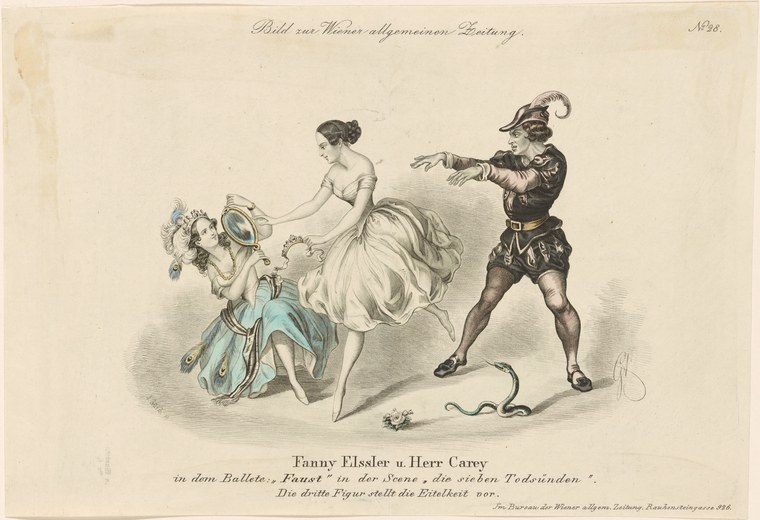
Fanny Elssler u. Herr Carey in dem Ballete "Faust" in der Scene "Die sieben Todsünden"
Unknown artist
- Collection:
- Prints depicting dance
- Source:
- New York Public Library
- Rights:
- Public domain — free to use, share and adapt.
- Recorded as:
- Public Domain
Fanny Elssler was one of the most celebrated dancers of the 19th century, and prints of her performances were major commercial products, spreading her fame across Europe and the Americas. This image preserves a specific moment from a historically significant narrative ballet and documents how Romantic ballet integrated mime, costume, and gesture alongside pure dance technique—a defining feature of the era's theatrical aesthetic.
What you are looking at
A theatrical scene in Romantic ballet style, rendered as a hand-colored engraving. Two female figures and one male figure occupy the composition. On the left, a woman in a pale blue bodice and white skirt sits or reclines, holding a hand mirror and wearing an elaborate headdress; beside her stands another woman in a flowing white dress and dark upswept hair, reaching toward the male figure. The male dancer, at right, wears a short tunic with ornate dark banding, hose, and a tall feathered hat in the manner of a jester or medieval costume. He is captured mid-gesture, one arm extended toward the women in a pose suggesting either temptation or accusation. The ground is minimal; the figures float against a plain background. The style and composition suggest a pantomime scene from a theatrical ballet—specifically, the inscription indicates this is from the ballet *Faust*, depicting the scene of "Die sieben Todsünden" (The Seven Deadly Sins).
The dancing
The male figure dominates through his active posture: his body is turned three-quarters toward the left, weight shifted forward on his legs, one arm extended in a beckoning or accusing gesture while the other remains at his side. The women are arranged in a more static grouping—one seated or half-reclining, the other standing and leaning toward him. Their bodies are oriented toward the male figure, creating a triangular composition. The costumes and poses suggest a theatrical tableau rather than a moment of dance steps: the emphasis is on mime and dramatic gesture rather than balletic technique. The extreme stylization of dress—particularly the jester's hat and medieval tunic—places this in the register of pantomime-ballet, where narrative and character expression outweigh pure dance display.
The dance depicted
This is from a Romantic-era ballet, specifically the ballet *Faust*, one of the most celebrated works of the period (most likely the version by Jules Perrot or Théophile Gautier, mid-19th century). The scene depicted is from "Die sieben Todsünden" (The Seven Deadly Sins), a key sequence in *Faust* ballets where allegorical or demonic figures tempt or torment the protagonist. The cast included the renowned dancer Fanny Elssler as one of the female roles and a performer named Herr Carey. This image shows theatrical ballet at its height: a narrative work combining mime, ensemble scenes, and individual dance roles. The composition and costume suggest this may depict a moment of dramatic confrontation rather than a dance phrase, consistent with Romantic ballet's emphasis on storytelling and character.
How it was made
This is a hand-colored engraving, a reproductive technique that allowed theatrical scenes to circulate widely to the ballet-going public and those who could not attend live performances. The engraver has used fine parallel lines to model form and shadow, with hand-applied color (particularly the blue bodice and flesh tones) added afterward. The technique was the standard method for theatrical prints in the 19th century, enabling rapid production and distribution. The presence of the artist's signature at the bottom—though not recorded in the catalogue—and the German-language inscription suggest this print was made for a German or Austrian audience, likely shortly after the ballet's premiere or a celebrated performance in that region.
About this work
This hand-colored engraving documents a moment from *Faust*, one of the most important narrative ballets of the Romantic era, featuring the celebrated dancer Fanny Elssler. The image shows a scene from the "Seven Deadly Sins" sequence, a central dramatic episode in which allegorical or demonic forces confront the protagonist. Rather than capturing a moment of technical ballet, the composition emphasizes theatrical mime and narrative drama—the male figure in costume making a gesture of temptation or accusation toward two female figures. As a reproductive print, it served to publicize the ballet and allow audiences beyond the theater to engage with its story and star performers. The work is both a dance record and a artifact of how Romantic ballet reached the public imagination.
How to look at it
This print is primarily a narrative document rather than a technical dance image—the focus is on theatrical composition and the story of temptation. Notice how the male figure is given the most dynamic posture and costume, placing him at the dramatic center despite the presence of two female dancers. The seated woman holding the mirror suggests vanity (one of the seven sins), while the standing woman's gesture toward the male figure suggests seduction or vulnerability. The elaborate costume and feathered hat, while historically inaccurate to any medieval reality, are typical of Romantic ballet's approach to spectacle: costume as character and visual fascination rather than historical authenticity. Look at how the artist has organized the three bodies to create narrative drama rather than balletic form.
The artist
The artist is not identified in the catalogue record. The print bears a signature at the bottom and a publication line indicating it was produced by a European printing house (visible as "Im Verlage der Hasse u Spies Zeitung" or similar). Hand-colored engravings of this type were produced by specialized theatrical print workshops, typically in collaboration with a draftsman who drew the original design and an engraver who cut the plate. These workshops served the major opera houses and ballet theaters of Europe, producing prints for sale to the public within weeks of notable performances.
The period
The Romantic era of ballet (roughly 1830s–1860s) saw the rise of narrative ballets based on literary works and legend, of which *Faust* was a prime example. Dancers like Fanny Elssler and Marie Taglioni became international celebrities, and theatrical prints were a major medium for their circulation. The fashion for *Faust* ballets reflected the broader Romantic fascination with Goethe's play and Gounod's opera (though the opera post-dates many ballet versions). The seven sins sequence allowed for spectacular ensemble work, dramatic pantomime, and display of individual star dancers—all key elements of Romantic ballet spectacle. At the same time, hand-colored engravings were being superseded by lithography as the dominant reproductive technology, making this print part of the tail end of an older tradition.
Where it lives
This print is held in the New York Public Library's collection of prints depicting dance. It represents a significant resource for understanding how 19th-century ballet was documented, publicized, and consumed by the broader public.
Dance in this work
Questions about this work
Who was Fanny Elssler?
Fanny Elssler (1810–1884) was an Austrian ballet dancer and one of the most celebrated performers of the Romantic era, rivaling Marie Taglioni in fame. She was known for her dramatic intensity and technical brilliance, and she danced across Europe and the Americas. Prints of her performances were major commercial products and helped spread her celebrity internationally.
What is the *Faust* ballet?
*Faust* ballets adapted Goethe's play and the Faust legend into full-length narrative works. Multiple versions were created by different choreographers, and *Faust* became one of the most popular ballet subjects of the 19th century. The ballets typically included spectacular ensemble scenes, pantomime, and individual star roles, making them ideal vehicles for both technical display and dramatic acting.
What are the Seven Deadly Sins in this ballet?
The "Seven Deadly Sins" scene typically depicted allegorical or demonic figures tempting or tormenting the Faust character, incorporating pantomime, ensemble work, and individual solos. Different versions of the ballet choreographed this sequence differently, but it was always a dramatic highlight and an opportunity for spectacular costume and stagecraft.
Why was this printed and distributed?
Theater-goers and admirers of famous dancers purchased prints as souvenirs and advertisements. These hand-colored engravings allowed the ballet to reach people who could not attend live performances and helped build the celebrity of star dancers like Elssler. They were a major medium for publicizing theatrical events before photography.
More dance artwork





