49 works in this view — arrow keys or swipe to move between them.
Dance in Art
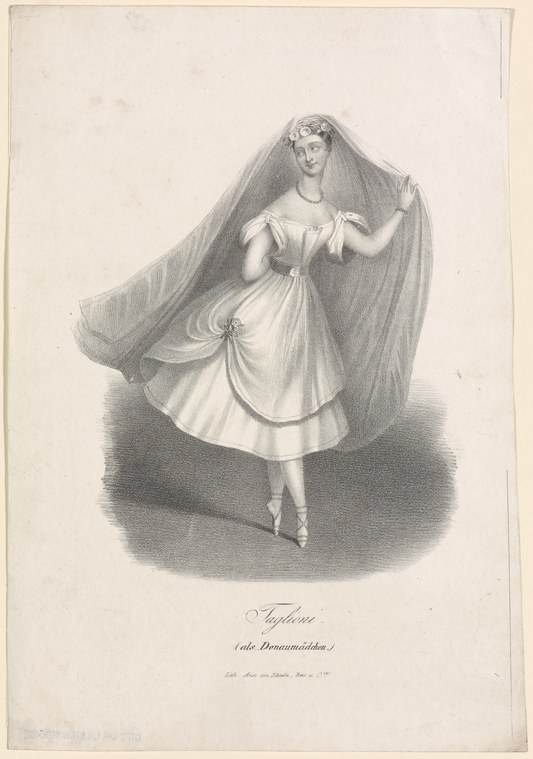
Taglioni, als Donaumädchen
Unknown artist
- Collection:
- Prints depicting dance
- Source:
- New York Public Library
- Rights:
- Public domain — free to use, share and adapt.
- Recorded as:
- Public Domain
This print preserves the visual language of Romantic ballet at its height—the specific aesthetic of ethereality, the costume conventions, and the pose vocabulary that shaped what audiences expected to see on stage. If this does represent Maria Taglioni (the world's most famous dancer of the 1840s), it is a direct record of how the greatest Romantic ballerina was marketed and remembered. For historians and dancers, the image shows how lithography made theatrical performance images portable, collectible, and central to a performer's fame.
What you are looking at
A single female dancer is depicted in three-quarter view against a plain, lightly shaded background. She wears a Romantic-era ballet costume: a fitted bodice with short, off-shoulder sleeves and a full, knee-length skirt in white. Her dark hair is crowned with a wreath or tiara. The most striking feature is an enormous, gossamer veil or cape that sweeps up and behind her, billowing dramatically to frame her body—it extends far beyond her shoulders and gives the entire composition a sense of ethereal movement. The dancer stands nearly en pointe, her weight forward on her right leg with the left leg lightly extended, creating an impression of forward motion or suspension. Her arms are held with classical grace, one extended gently to the side. The technique and the quality of the line suggest this is a print after a theatrical image—possibly a painted or photographic original—rather than a direct observation.
The dancing
A single dancer occupies the frame. She achieves an impression of elevation through a straightened right leg and a lifted left foot, though neither constitutes a fully articulated jump. Her arms are held with balletic grace and restraint—one extended, the other softly placed—and her posture is upright and elegant. The body is presented in profile-to-three-quarter aspect, which allows the veil to read as an extension of the figure rather than a separate prop. The proportions and the refined carriage of the head and shoulders show understanding of Romantic ballet's aesthetic of weightlessness and grace.
The dance depicted
This is a Romantic ballet image, almost certainly representing an actual dancer of the 1840s–1850s, given the title references 'Taglioni' (the great Italian-Swedish Romantic dancer Maria Taglioni) and 'Donaumädchen' (a Danube maiden). The costume and pose are consistent with the roles Taglioni danced in narrative ballets of that era. The veil and the impression of flight are hallmarks of Romantic ballet's visual vocabulary. The dancer is shown in a moment of arrested motion—neither fully landing nor fully leaping—which was the Romantic convention for suggesting otherworldly beings (sylphs, spirits, enchanted maidens) that the era favored.
How it was made
This is a lithographic print, as evidenced by the chalk-like tonal modeling, the soft grayscale palette, and the way the figure is built up through overlapping areas of light and shadow rather than line. Lithography allowed wide circulation of theatrical imagery and was the dominant medium for dance portraiture and promotional prints in the mid-nineteenth century. The print captures the flattering, idealized quality essential to stage publicity—the veil is rendered with particular softness to convey its gossamer quality. The technique also accounts for the absence of hard outlines and the emphasis on volume and drapery.
About this work
This is a mid-nineteenth-century lithographic print commemorating a famous Romantic ballet dancer—almost certainly Maria Taglioni—in a role named for a Danube maiden. The image exemplifies the Romantic ballet's visual and kinetic ideals: a solitary female figure poised in an attitude suggesting flight or enchantment, wrapped in diaphanous costume and veil, presented as an ethereal being rather than a human dancer. The work is both a portrait of a celebrated performer and a document of how Romantic ballet imagined the female body—weightless, graceful, removed from everyday gravity. It belongs in a dance gallery as evidence of how mid-century ballet was publicly presented and consumed, and what the era valued in movement and beauty.
How to look at it
Notice the veil: it is rendered as the dominant visual element, almost larger than the dancer herself, and it reads as motion frozen—as if caught mid-flight. The dancer's pose is not a static one; the slight forward lean and the impression of elevation suggest a moment in a step rather than a resting position. Observe how the print conveys softness and ethereality through tonal gradation rather than outline—the balletic ideal of the era was precisely this appearance of weightlessness and otherworldliness. The wreath or tiara anchors her as a character (likely a water nymph or fairy) rather than a real woman.
The artist
The artist is not recorded. The print appears to be a theatrical publicity image, possibly after a painting or daguerreotype portrait of the dancer. Such prints were typically produced by specialized lithographic workshops and sold as sheet prints to be collected and displayed. The absence of an artist attribution is consistent with mid-nineteenth-century theatrical print practice, where the dancer's name mattered far more than the engraver's.
The period
This print belongs to the height of Romantic ballet (1830s–1850s), when the ethereal female dancer became the aesthetic and commercial center of ballet performance. After the success of *La Sylphide* (1832), ballets increasingly featured supernatural heroines—sylphs, spirits, sleepwalkers, exotic maidens—and the veil, the pale tutu, and the illusion of weightlessness became essential to the genre's visual identity. Lithography, perfected in the 1820s, had made theatrical portraiture widely available for the first time, turning famous dancers into celebrities whose images were collected and displayed. Maria Taglioni epitomized this new star system and was the most famous dancer in Europe during the 1830s and 1840s.
Where it lives
The print is held by the New York Public Library as part of its collection of prints depicting dance. It is catalogued with minimal information, which was typical for nineteenth-century theatrical prints, whose attribution and provenance were often lost over time.
Dance in this work
Questions about this work
Is this Maria Taglioni?
The title refers to 'Taglioni' and 'Donaumädchen' (Danube maiden), which suggests it may represent Maria Taglioni in a specific role. However, without a signature or dated inscription, and given that the image is undated and the artist is unknown, we cannot be certain. The Romantic ballet conventions visible here—the veil, the ethereal pose, the costume—were shared across many dancers of the era.
Why is the veil so large?
The veil was a signature element of Romantic ballet spectacle and symbolism. It suggested otherworldliness, mystery, and the supernatural—qualities essential to the genre's themes. Dramatically scaled costume elements like veils also made dancers appear more imposing and memorable to audiences, and they were easier to render in prints, which is why they appear exaggerated in theatrical portraits.
What dance is this?
The title suggests a role involving a Danube maiden or water spirit, but without more information, the specific ballet cannot be identified. The pose and costume are consistent with many Romantic ballets of the 1830s–1850s. The image documents the aesthetic of Romantic ballet rather than a specific choreography.
Why was she printed on lithography?
Lithography was the dominant medium for theatrical publicity prints in the nineteenth century. It was faster and cheaper than engraving, allowed for soft tonal effects (ideal for conveying ethereal figures), and enabled wide circulation. Prints like this were sold to fans and displayed in homes, making famous dancers into public figures.
More dance artwork





