49 works in this view — arrow keys or swipe to move between them.
Dance in Art · 2014
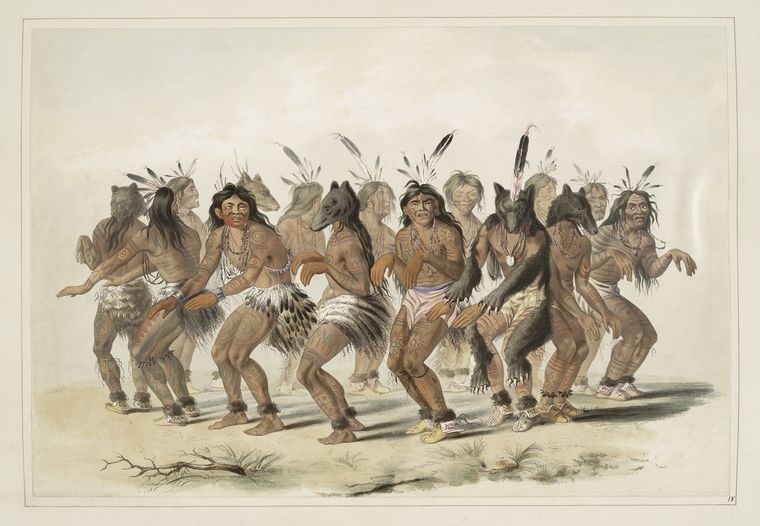
The Bear dance.
Unknown artist
- Medium:
- Source:
- New York Public Library
- Rights:
- Public domain — free to use, share and adapt.
- Recorded as:
- public_domain
This work documents an Indigenous North American ceremonial practice at a moment when such traditions were under pressure from colonization and cultural suppression. Though it captures a moment of stillness rather than active movement, it preserves visual evidence of regalia, body marking, and group ceremonial structure that would inform historians of Indigenous dance and ritual. The print's circulation in the 19th century shaped European and Euro-American perceptions of Native American cultures, making it important to understand both as artistic artifact and as instrument of ethnographic representation.
What you are looking at
Ten male figures stand in a loose horizontal line on bare ground against a pale sky, arranged as if for a group portrait or ceremonial moment. All wear feathered headdresses made of tall plumes—some with two or three long feathers, others with clusters—and most are bare-chested or minimally clothed, with fringed skirts or wraps at the hips and what appear to be animal skins or fur ornaments. Their bodies are painted or marked with patterns. The figures adopt varied poses: some stand with weight evenly distributed, arms at their sides or gesturing outward; others bend slightly at the knees or angle their torsos. The composition is frontal and symmetrical, presenting the group as a unified ensemble rather than capturing a moment of active movement. The style and medium suggest a 19th-century hand-colored print or lithograph, with careful attention to ethnographic detail in dress and ornament.
The dancing
The dancers' posture is upright but relaxed, with minimal flexion or dynamic tension in the body. Arms are mostly extended or held at mid-height, without the tight framing or closed holds of ballroom or partner dance. Weight appears grounded and distributed equally on both feet; there is no evidence of pointed feet, turnout, or the elevated carriage of ballet. The group maintains loose spacing and do not form pairs or sets. The gestural vocabulary is restrained and frontal, oriented toward display of regalia rather than demonstration of footwork or intricate partnering.
The dance depicted
This print is titled *The Bear dance* and documents a ceremonial or social gathering among Indigenous North American peoples, most likely of the Great Plains or Northeast. The feathered headdresses, skin ornaments, and body painting are consistent with Haudenosaunee (Iroquois), Miami, or similar tribal traditions of the 18th and 19th centuries. The composition suggests a moment of assembly or processional rather than active choreography—the figures are positioned as if for observation or documentation. The title references the bear dance tradition found in various Native American cultures, which often involved mimetic movement of animal behavior and served spiritual or social functions, though this print may capture a ceremonial gathering or preparatory moment rather than the dance itself in motion.
How it was made
This is a hand-colored engraving or lithograph, likely produced in the 19th century for circulation among a European or Euro-American audience interested in ethnographic documentation. The careful rendering of individual faces, the soft wash of background color, and the fine detail of featherwork and body ornament are typical of travel narratives and illustrated natural histories of the period. The technique allowed for reproduction and wide distribution, making this both an artistic interpretation and a document intended to inform distant viewers about Indigenous life and ceremonial practice. The coloring is naturalistic but restrained, emphasizing the ethnographic purpose over romantic or dramatized effect.
About this work
This print documents a ceremonial gathering of Indigenous North American dancers, titled *The Bear dance*. The work captures ten male figures in feathered headdresses and ornamental dress, arranged in a frontal group composition that emphasizes regalia and collective presence rather than active choreography. As a 19th-century engraving, it belongs to a tradition of ethnographic illustration that made Indigenous cultural practices visible to European and Euro-American audiences, though often through the filter of outsider observation and artistic convention. The image is valuable not as a record of actual dance movement—the static grouping and posed arrangement preclude that—but as evidence of how Indigenous ceremonial dress and social gathering were represented and understood in the period when these traditions were increasingly being documented by settlers and naturalists.
How to look at it
Attend first to the individual detail: the variety of feathered headdresses, the patterns on the bodies, the specific ornaments and skins each figure wears. These elements convey information about regalia and status within the group. Then step back to observe the overall composition—the horizontal line, the spacing, the frontal orientation—which suggests this is a moment of assembly or display rather than active performance. Notice that the artist has chosen stillness and clarity over movement or drama, prioritizing legibility of dress and bodily ornament for an audience unfamiliar with these practices. The work invites you to look at the ensemble as an ethnographic document rather than as a captured moment of dance in motion.
The artist
The artist is not recorded. The work comes from the New York Public Library collection and was likely produced as part of a larger natural history or travel narrative published in the 19th century. The style and ethnographic focus suggest work by a professional illustrator or engraver associated with documented accounts of North American Indigenous peoples, possibly supplementing written accounts of exploration or anthropological study.
The period
This print was made during the era of intensive ethnographic documentation of North American Indigenous peoples, roughly 1820–1880, when European and American artists and naturalists were producing illustrated accounts of tribal life, dress, and ceremonial practice. This period coincided with the height of forced removal policies, reservation confinement, and cultural suppression of Native traditions. The bear dance itself has roots in Indigenous ceremonial practice across multiple tribal nations and often served spiritual or social functions, but by the 19th century, such practices were increasingly being recorded by outsiders rather than transmitted within living communities. The print reflects both genuine ethnographic interest and the power imbalance inherent in European documentation of colonized peoples.
Where it lives
This print is held in the New York Public Library collection. It is catalogued as a print of unknown date and artist, making its original publication context and intended audience uncertain, though the style and subject matter suggest a 19th-century ethnographic source.
Dance in this work
Questions about this work
Is this actually showing a dance, or just a group portrait?
The composition is ambiguous. The title *The Bear dance* indicates the work is associated with a ceremonial dance tradition, but the static, frontal arrangement of the figures suggests a moment of assembly or gathering rather than active choreography. The artist may have documented a ceremonial moment before or between movement, or may have arranged the figures for clarity of representation. The work is valuable as evidence of regalia and group structure rather than as a record of movement itself.
What tribal nation did the bear dance come from?
The bear dance appears in traditions of multiple Native American nations, including the Ute, Shoshone, and various tribes of the Great Plains and Northeast. The feathered headdresses and body ornaments in this print are consistent with Haudenosaunee and Midwestern tribal traditions, but without documentation of the artist's source, it is not possible to identify the specific nation represented here. Bear dances often involved mimetic movement evoking animal behavior and served spiritual or social functions within their original contexts.
Why are these people arranged in a line like this?
The linear, frontal arrangement reflects the conventions of 19th-century ethnographic illustration, which prioritized clarity and legibility for an audience unfamiliar with the subjects. Arranging the figures in a line allows the viewer to examine each person's regalia and bodily ornament in detail. This may or may not reflect the actual arrangement of these people during a ceremony—the artist may have reorganized them for purposes of documentation and presentation.
Who made this print and when?
The artist and precise date are not recorded in the catalogue. The style, medium, and ethnographic subject matter suggest a 19th-century source, likely produced as part of a larger travel narrative, natural history, or illustrated account of North American Indigenous peoples. The work came to the New York Public Library through an unspecified source.
More dance artwork