49 works in this view — arrow keys or swipe to move between them.
Dance in Art
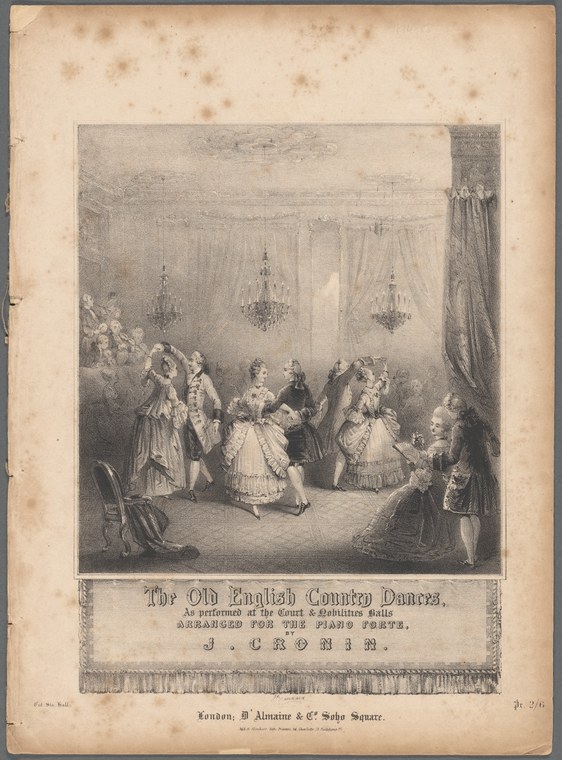
The old English country dances: as performed at the court & nobilities balls
Unknown artist
- Collection:
- Prints depicting dance
- Source:
- New York Public Library
- Rights:
- Public domain — free to use, share and adapt.
- Recorded as:
- Public Domain
English Country Dance was the dominant social dance of the English-speaking world for over two centuries, and this engraving is a primary source documenting how it actually looked in a ballroom setting. It also shows how dance knowledge was transmitted through print: orchestrated visual and textual instruction that made dancing a learned, documented practice rather than something passed on orally. The work witnesses the shift toward preserving and formalizing dance as cultural heritage—the recognition that these dances belonged to a tradition worth recording and defending.
What you are looking at
A formal interior scene depicts a group of elegantly dressed figures engaged in country dancing at what appears to be a court or aristocratic gathering. The space is defined by tall curtained windows with heavy drapes and multiple crystal chandeliers hanging from the ceiling, establishing an air of aristocratic formality. In the foreground, couples and individual dancers occupy the center of a polished floor; the nearest figures are women in elaborate white and pale-colored gowns with full skirts, their bodies angled to suggest movement and interaction. The composition suggests a moment mid-sequence in a structured dance, with figures arranged in the loose groupings typical of country dance formation. The lighting is even and formal, rendered through fine stippled engraving to suggest the interior's refined atmosphere. In the background, additional figures observe or await their turn, and the overall impression is one of coordinated social performance rather than spontaneous movement.
The dancing
The dancers' bodies are upright and composed, with arms either held in social dance position or gesturing with restrained elegance. The nearest woman is captured with her gown's skirt in motion, suggesting a turn or traveling step; her posture shows the kind of controlled, upright carriage expected in formal 18th-century dance. Several couples appear to be in or approaching closed or hand-hold positions, and the spacing and grouping suggest the longways or line formations characteristic of English country dancing. The engraver has rendered the figures with attention to period dress and social distance rather than to fine anatomical detail of footwork—the focus is on decorum and formation rather than technical execution.
The dance depicted
This is English Country Dance (also called Country Dance), the social form that dominated English ballrooms from the 17th through 19th centuries. The title specifies these are "old English country dances as performed at the court & nobilities balls," indicating both the social context (aristocratic and royal circles) and the period consciousness—this is documentation or celebration of an established, historically valued tradition rather than contemporary innovation. The image captures the formal, orderly character of the form: couples and sometimes larger groups moving through geometric patterns, with emphasis on elegance and social grace rather than athletic technique. The setting in a great house or palace confirms that this depicts the upper-class ballroom version of country dancing, distinct from folk variants.
How it was made
This is a steel or copper engraving, recognizable from the fine parallel hatching used to model form and the crisp linear quality of the line work. The printing history (London: S. Almaine & Co, Soho Square, visible at bottom) indicates this was a commercial print, likely part of a sheet music publication or dance instruction manual. The technique allowed wide distribution and fine detail; this would have circulated among the educated classes who danced and collected music. The refinement of the engraving technique suggests a professional hand and investment in quality reproduction—appropriate for instructional or commemorative material aimed at a literate, affluent audience.
About this work
This engraved sheet music cover or illustration documents English Country Dance as practiced in the aristocratic ballrooms of the 18th or 19th century. It is both a record of a specific dance form and evidence of how that form was valued, taught, and consumed: through printed images and written notation that made it available to a broad educated market. The work sits at the intersection of dance history, social history, and print culture, capturing a moment when country dancing was established enough—and prestigious enough—to warrant artistic and commercial documentation.
The image matters because it preserves a visual record of how formal country dancing looked in performance, how dancers held their bodies, and what kind of spatial relationships defined the form. It also shows how dance was circulated and taught through visual culture: prospective dancers could study the engraving to understand formation and decorum. For historians, it is evidence of what counted as respectable social dance in elite circles, and what aesthetic values—elegance, order, sociability—the form embodied.
How to look at it
Observe how the engraver has rendered the dancers' relationship to the ballroom space: they are framed within a formal architectural setting, with curtains and chandeliers that establish the social context. Notice the restrained, upright carriage of all the figures—this is not athletic or flamboyant movement, but composed social performance. Look at the groupings and the way hands and arms connect: this shows the structural principle of country dancing, in which couples and larger groups move through set patterns rather than improvising. The moment chosen is one of relative orderliness rather than climactic motion—the engraver was interested in showing formation and decorum, not momentary exuberance.
The period
English Country Dance emerged in the 16th century and became the dominant social dance of the English ballroom by the 17th, remaining central through the 18th and into the 19th century. By the time this engraving was made, the form had a long history and a substantial body of published dance manuals and notations (notably John Playford's *The English Dancing Master*, first published 1651 and reprinted many times). The print's title—emphasizing that these are "old" dances—suggests a moment of historical consciousness, when the form was being codified and preserved even as newer fashions (quadrilles, cotillions, eventually waltzes) were becoming fashionable in elite circles. The engraving belongs to a larger print culture of dance instruction and social documentation that flourished in the 18th and 19th centuries.
Where it lives
This engraving is held in the New York Public Library's collection of prints depicting dance. It is a commercial print, likely a cover or accompanying illustration for a sheet music publication or dance instruction manual. The imprint (London: S. Almaine & Co, Soho Square) locates it in professional print culture and confirms its circulation among the urban, educated classes.
Dance in this work
Questions about this work
What exactly were 'old English country dances'?
English Country Dancing was a social form in which couples (or sometimes larger groups) moved through geometric figures—longways sets, circles, or squares—following a set pattern that was repeated or varied. Unlike later ballroom dances like the waltz, country dance did not depend on close partnership or improvisation, but on knowledge of specific figures and the ability to execute them in formation. 'Old' here likely means established or traditional, rather than indicating a specific historical period.
Who danced these dances?
The title specifies 'court & nobilities balls,' indicating this version was danced by aristocratic and royal circles. However, country dancing existed in many social contexts—village celebrations, assembly rooms, fairs—and spread across the English-speaking world. This engraving documents the elite, formal ballroom version, which was carefully choreographed and taught through manuals and prints.
How was dance learning organized in this period?
Dance was taught by professional dancing masters who worked with wealthy families and in urban assembly rooms. Students learned set choreographies from published manuals—often beautifully illustrated—and from personal instruction. Prints like this one served as visual aids and as reference materials for those who had already learned the basics. Sheet music, notation systems, and engraved illustrations all worked together to standardize and circulate dance knowledge.
Why were these dances printed and preserved?
By the 18th century, English Country Dancing had enough prestige and historical depth that it became a subject for artistic and commercial documentation. Printing allowed these dances to be standardized, taught to new generations, and circulated widely. The emphasis on 'old' dances in titles like this reflects a growing historical consciousness—a recognition that these dances belonged to a tradition worth recording and defending, especially as new fashions competed for popularity.
More dance artwork





