49 works in this view — arrow keys or swipe to move between them.
Dance in Art
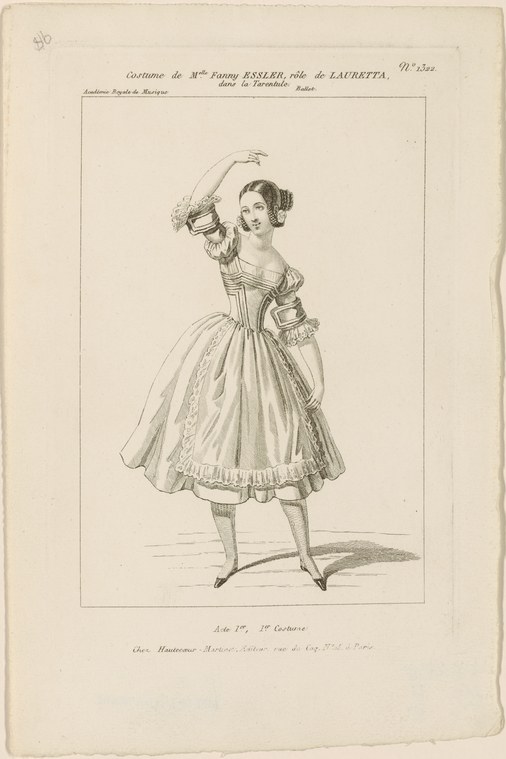
Costume de Melle. Fanny Essler [sic], rôle de Lauretta dans La tarentule.: Ballet. Académie Royale de Musique. Acte 1er, 1er costume
Unknown artist
- Collection:
- Prints depicting dance
- Source:
- New York Public Library
- Rights:
- Public domain — free to use, share and adapt.
- Recorded as:
- Public Domain
Fanny Essler was one of the two great rival prima ballerinas of the Romantic era, and *La Tarentule* was one of her signature vehicles. This image documents her actual stage appearance in a role that made her reputation, providing visual evidence of Romantic ballet practice at the moment of its greatest popularity. For students of 19th-century dance, costume, and theatrical history, such plates are primary sources: they show, rather than describe, what dancers actually wore and how they presented themselves on stage.
What you are looking at
A single female figure stands against a plain background in a three-quarter pose, her body angled toward the viewer's left. She wears a pale Romantic-era ballet costume: a fitted bodice with short puffed sleeves and a full skirt reaching to mid-calf, decorated with a ruffled hem. Her hair is styled in the fashion of the 1830s–40s, pulled back and adorned with what appears to be a feathered or ornamental headdress. Her right arm is raised gracefully above her head in a classical port de bras, while her left arm rests at her side. Her posture is upright and elegant, with her weight distributed evenly on both feet, one slightly forward. The figure casts a light shadow on the ground beneath her, suggesting studio lighting. The engraving is executed in fine lines with careful cross-hatching to model the folds of the fabric and suggest volume.
The dancing
The dancer's frame is vertical and composed, with her raised right arm in a soft, rounded position characteristic of Romantic ballet port de bras. Her shoulders are relaxed and level. The left arm hangs naturally at her side. Her legs appear to be in a relaxed standing position with no visible turnout or lift—this is a presentational pose rather than a moment of active movement. The single figure occupies the center of the composition, posed as if for a costume study or formal portrait.
The dance depicted
This is a costume study for *La Tarentule*, a ballet performed at the Académie Royale de Musique (Paris Opera) in the 1830s–40s. The inscription identifies the wearer as Fanny Essler (a prominent Romantic-era ballerina) in the role of Lauretta, Act 1, first costume. The image shows the theatrical dress prescribed for this character rather than a moment in performance. The gentle arm position and upright carriage reflect the aesthetic ideals of Romantic ballet, though no specific choreography is depicted—this is reference material for costume construction and appearance.
How it was made
This is a fine engraving, executed in the linear style typical of mid-19th-century theatrical costume documentation. The artist has employed fine parallel lines and cross-hatching to define the form and texture of the dress, particularly the volume of the skirt and the fall of fabric. This technique allowed for precise reproduction and wide circulation—such prints were sold individually or in series to document celebrated performances and to be collected by dance enthusiasts and theatre patrons. The clarity and detail suggest this was made for a discerning audience with direct knowledge of the Paris Opera.
About this work
This is a costume plate documenting the theatrical dress worn by the celebrated ballerina Fanny Essler in *La Tarentule*, a ballet of the Romantic era performed at the Paris Opera. The engraving serves a dual purpose: it is both a record of actual stage dress and a form of theatrical publicity, circulating the image of a famous dancer and performance to a wider audience. Costume plates of this kind were standard practice in 19th-century theatre, part of a system of documentation and marketing that made the ephemeral art of dance legible to those who could not attend performances.
The work belongs to the visual culture of Romantic ballet, a period in which the female dancer became the central focus of theatrical spectacle. The pale, ethereal dress, the classical arm position, and the neutral presentation all embody the aesthetics of that moment. For historians and dancers, the image provides concrete evidence of how these celebrated roles were physically realized—what a performer wore, how she held herself, what an audience expected to see.
How to look at it
Look at the costume itself: the pale color, the fitted bodice, the full skirt, the shortened length—all characteristic of the 1830s–40s Romantic ideal of the ethereal, weightless female dancer. Notice the arm position: the raised arm is rounded and soft, not angular or forceful, embodying the aesthetic values of the period. The pose is static and formal, almost heraldic in its symmetry—this is how the dancer was meant to be seen and remembered, a visual icon rather than a moment of motion. The engraving technique allows for precise rendering of textile detail, which would have been important to costume makers and to the theatre's reputation for spectacle.
The artist
The artist is not recorded. The inscription attributes the work to 'Académie Royale de Musique' (the Paris Opera house), suggesting it was made as part of the institution's official record-keeping or publicity apparatus. Costume plates of this quality and style were typically produced by specialist engravers working from drawings made by theatre designers or from life; the anonymous nature of the engraver was standard practice in this genre.
The period
The 1830s–40s was the height of the Romantic ballet era in Europe. Fanny Essler and Marie Taglioni were the reigning stars, and new ballets were created constantly to showcase their virtuosity and beauty. *La Tarentule* belongs to this period of intense theatrical innovation, when the ballet d'action—a narrative dance-drama—was the dominant form. Engraved costume plates were a key means of documenting and promoting these performances, circulating images of famous dancers to audiences across Europe and establishing their international celebrity. The theatre was the primary mass medium of the era, and such prints were a form of theatrical merchandising.
Where it lives
The work comes from the New York Public Library's collection of prints depicting dance, held as part of their performing arts materials. Such prints were typically sold to the public as single sheets or in bound series, making them accessible to theatre-goers, collectors, and students of dance.
Dance in this work
Questions about this work
Who was Fanny Essler?
Fanny Essler (1810–1884) was an Austrian ballet dancer and one of the two greatest prima ballerinas of the Romantic era, rivaling Marie Taglioni. She was known for her brilliant technique, her dramatic roles, and her international celebrity. She danced at the Paris Opera and toured Europe and the Americas, making her one of the first truly global dance stars.
What was La Tarentule?
*La Tarentule* was a ballet performed at the Paris Opera, typically dated to the 1830s–40s. It told the story of a young woman affected by the bite of a tarantula spider, which causes her to dance uncontrollably—a narrative device that allowed for brilliant dancing and dramatic spectacle. The role of Lauretta was a starring vehicle for the prima ballerina.
What is an 'Acte 1er, 1er costume'?
This notation means 'Act 1, first costume'—indicating that this is the dress the character wore at the beginning of the first act. Dancers typically changed costumes multiple times within a ballet, so documentation of each costume was necessary for the theatre's records and for costume makers tasked with maintaining or reproducing them.
Why would the theatre publish costume plates?
Costume plates served multiple purposes: they documented actual stage dress for the theatre's archives, they functioned as promotional materials showcasing the visual spectacle and the famous dancer, and they were sold to the public as souvenirs and collectibles. In an era before photography, such prints were the primary way audiences could own an image of a celebrated performance.
More dance artwork





