49 works in this view — arrow keys or swipe to move between them.
Dance in Art · 2015
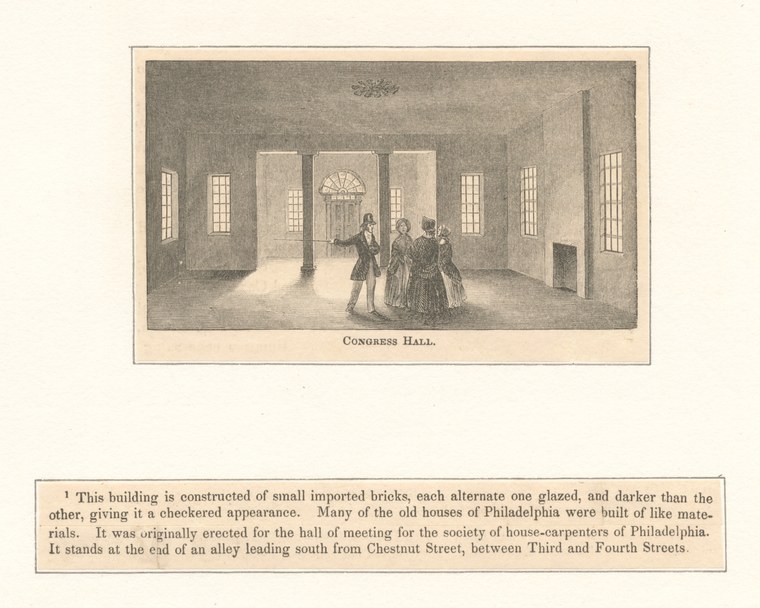
Carpenters' Hall ; Congress Hall.
Unknown artist
- Medium:
- Source:
- New York Public Library
- Rights:
- Public domain — free to use, share and adapt.
- Recorded as:
- public_domain
Although the catalogue assigns this to a dance collection, the image itself does not depict dancing. It is important to that collection because Congress Hall was a venue for social assembly and likely hosted dances, but the engraving itself shows the room empty of the social life that would have filled it. The work is valuable as a historical document of a Philadelphia institutional interior from the early American republic.
What you are looking at
A spacious, high-ceilinged interior with a geometric plan: a long rectangular hall with a central colonnade of four square pillars dividing the space. Light streams through tall sash windows on both the long sides and a semicircular fanlight in the far wall, creating strong geometric patterns of shadow and illumination across the floor. Three figures in late 18th-century dress occupy the center ground—a woman in a full-skirted gown with her back to the viewer, and two men in breeches and coats, one gesturing toward her. The architectural setting is austere and orderly: bare walls, clean lines, and classical proportions. The floor appears to be polished wood or stone. The entire composition is rendered in mezzotint or engraving, with careful attention to the play of light and shadow to define the volume and perspective of the interior.
The dancing
Three standing figures, none of whom appear to be dancing. The woman faces away, her full skirt a prominent silhouette; one man faces her with an extended arm or pointing gesture, the other stands to the side. The postures are formal and conversational rather than choreographic. No holds, frames, or weight shifts suggestive of ballroom technique are visible. The grouping is static and compositional rather than dynamic.
The dance depicted
This is not a dance scene. The three figures are posed in conversation or formal acknowledgment within an architectural setting. No movement, steps, or ballroom hold is evident. The work appears to be a record of the building and its spatial character rather than a representation of dance taking place within it.
How it was made
This is an engraving or mezzotint, identified from the catalogue as a print. The technique allows precise architectural delineation and sophisticated rendering of light and shadow through tonal gradation. The print's fine detail and tonal range suggest skilled craftsmanship aimed at a cultivated audience, and its format—a single architectural view with staffage figures—is typical of 18th-century architectural documentation for wealthy subscribers or patrons interested in notable buildings.
About this work
Congress Hall is a documentation of an important Philadelphia building in its interior spatial character. The engraving records the hall's neoclassical proportions, its system of support columns, and the quality of light that defined the space. The three small figures serve a conventional function: to establish scale and to animate the architectural interior without dominating the composition. This is fundamentally an architectural print, not a dance image.
How to look at it
Observe the play of light from the windows across the columned floor: this is the image's primary subject. The three figures are incidental staff, included to give human scale to the vast proportions and to suggest the building's use as a social space. The engraver's skill lies in the mathematical precision of the perspective and the subtle gradation of tone that makes the interior inhabitable, not in the representation of human activity.
The artist
The artist is not recorded. The print's style and technical competence suggest a professional engraver or architectural draftsman of the late 18th century, possibly working from a measured drawing or original design. Such prints were commonly produced for subscription or sale to document significant public and semi-public buildings in American cities.
The period
Congress Hall was erected in 1791–92 as a purpose-built meeting house for the Carpenters' Company of Philadelphia, a guild of master carpenters. The hall served not only as a guild meeting space but also as a venue for civic gatherings, lectures, and social events. In the 1790s and early 1800s, such buildings were sites of genteel assembly, including dancing. The engraving dates to this period or shortly after. Neoclassical architectural imagery was fashionable among the American educated classes in the 1790s and reflected an emerging national identity.
Where it lives
The print is held by the New York Public Library. It is part of a collection of historical prints and drawings related to American architecture and urbanism. The dual title—Carpenters' Hall; Congress Hall—indicates that the building may have been known by both names or that the print documents two different spaces or aspects of the same building complex.
Questions about this work
Why is this in a dance gallery if nobody is dancing?
Congress Hall was an important venue for social gatherings, civic ceremonies, and dancing in early Philadelphia. This engraving documents the interior space where such events took place. The print is valuable as evidence of the architectural context in which dance and other social practices occurred, even though the specific moment shown is not a dance itself.
What building is this?
Congress Hall was constructed in 1791–92 on Chestnut Street in Philadelphia between Third and Fourth Streets as the meeting hall of the Carpenters' Company, a guild of master carpenters. It functioned as both a guild headquarters and a multipurpose public assembly space. The building no longer stands.
Who made this print?
The artist's name is not recorded in the catalogue. Based on the print's technical quality and style, it was made by a professional engraver or architectural draftsman of the late 18th century, likely working in Philadelphia or commissioned by a Philadelphia patron.
More dance artwork