49 works in this view — arrow keys or swipe to move between them.
Dance in Art · 2019
Dancing of residents
Unknown artist
- Medium:
- Source:
- New York Public Library
- Rights:
- Public domain — free to use, share and adapt.
- Recorded as:
- public_domain
This photograph documents a moment when dance was understood as a social and communal practice rather than as performance or technique, and when institutional life included organized gatherings of residents. For historians of social dance, institutional history, and photography, the gap between the title's claim ('dancing') and the image's stillness raises important questions about how dance was recorded, valued, and understood in early 20th-century institutional contexts.
What you are looking at
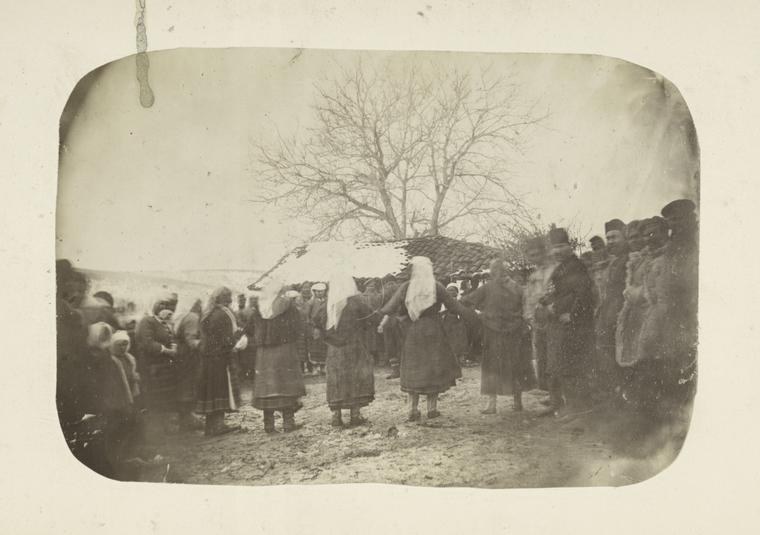
A large outdoor gathering of people stands in a loosely formed circle or group, facing toward the center of the frame. The figures wear dark winter clothing—long coats, hats, and what appear to be early 20th-century garments. The ground is bare earth or packed dirt, suggesting a courtyard, village green, or institutional grounds. A bare tree with sparse branches rises behind the assembled crowd, emphasizing the season and the outdoor setting. The photograph appears to have been taken in overcast daylight; the tonal range is compressed, creating a flat, documentary quality typical of early gelatin dry-plate or silver print processes. The composition is crowded and informal—people stand at varying distances from the camera, some partially obscured by others, creating the sense of an unscripted moment or a gathering of residents rather than a posed formal assembly.
The dancing
Individual figures maintain standing postures with minimal visible gestural expression. Most appear to be stationary or in the early stages of movement, their bodies oriented toward the center of the gathering but without the elevated carriage, turned-out positions, or extended limbs characteristic of trained dancers. Arms hang at sides or are held loosely; there is no evidence of partnering holds, lifted extensions, or the kinetic energy typical of active choreography. The scale of the group—roughly thirty to fifty people—and the loose, informal arrangement suggest this is a communal gathering rather than a performance or rehearsal.
The dance depicted
The title 'Dancing of residents' proposes that dancing is or was occurring, yet the photographic evidence does not show dancers in recognizable movement. The figures appear to be standing, waiting, or positioned to begin rather than actively executing dance steps. This may document a moment between movements, a folk gathering preparing to dance, a social assembly at a residential institution (workhouse, asylum, or community home), or a posed photograph taken to record participation rather than capture motion. Without visible footwork, arm styling, or body position specific to any dance tradition, the actual dance content remains unclear; this may be a document of social dance culture or institutional life rather than a technical record of choreography.
How it was made
This is a black-and-white photograph, likely a gelatin dry-plate print or silver gelatin print typical of early 20th-century documentary and institutional photography. The medium's technical constraints—long exposure times and limited ability to freeze rapid movement—mean that active dancing would have appeared blurred. The resulting sharp but static image suggests either a posed arrangement or a gathering frozen at a moment of stillness. The grainy texture and tonal compression are consistent with prints made from aged or heavily used negatives, suggesting this image may have circulated as part of archival or institutional records.
About this work
This photograph documents an outdoor gathering of residents in dark winter clothing standing in an informal group formation. The title attributes dancing to this moment, yet the visible evidence shows figures in static postures rather than active movement or choreography. The work belongs to the tradition of institutional and documentary photography from the early 20th century, a period when photographs were used to record daily life, community activities, and the routines of residents in workhouses, asylums, and other collective dwellings.
The image raises a productive ambiguity: it may record a genuine moment of folk or social dancing paused for the camera, a pre-dance gathering, or a posed photograph meant to document participation rather than motion. This ambiguity makes it historically valuable as evidence of how dance was understood and recorded in institutional contexts—not as a virtuosic display to be captured mid-leap, but as a social practice to be documented as evidence of community life or therapeutic activity.
How to look at it
Approach this image as a document of social practice rather than a record of choreography. Attend to the spacing and arrangement of the figures—the loose circle suggests a moment of community assembly rather than the tight lines or partnered arrangements of formal ballroom or theatrical dance. Note the stillness itself: the photograph captures not motion but readiness, waiting, or an institutional moment paused for the camera. The bare tree and institutional setting anchor this firmly in a particular historical and social context, inviting the viewer to consider what 'dancing of residents' meant in early 20th-century institutional life.
The period
This photograph belongs to the early 20th-century tradition of institutional documentation and social survey photography. During this period, workhouses, asylums, orphanages, and other residential institutions began to use photography to record daily activities, therapeutic programs, and evidence of 'care' or 'improvement.' Dancing and music were often introduced into such settings as forms of recreation, social training, or therapeutic activity. The formal outdoor gathering and the documentary style of photography reflect contemporary attitudes toward recording collective life and the belief that photographic evidence could testify to the orderliness, activity, and humanity of institutional care.
Where it lives
This print is held in the New York Public Library collection, from which it derives. The image appears to be part of a broader institutional or documentary archive, though its specific provenance—the institution depicted, the date of the photograph, and the reason for its creation—remains unrecorded in the available catalogue data.
Questions about this work
Is there actually dancing in this photograph?
The figures appear to be standing rather than actively dancing. The photograph may capture a moment of stillness before, after, or between movement; a posed grouping meant to record participation; or a social gathering preparing to dance. Early photographic technology's inability to freeze rapid motion meant that photographers often documented dance through posed or static moments rather than captured action.
What is the setting and who are these people?
The outdoor setting, winter clothing, and institutional quality of the gathering suggest this may be residents of a workhouse, asylum, orphanage, or similar collective dwelling. The bare tree and ground indicate either a courtyard or communal grounds. The photograph appears to be part of an institutional record documenting daily life and organized activities.
What does this tell us about social dance in the early 20th century?
It suggests that dancing was understood as a communal and social practice that could be organized as part of institutional life, and that photography was used to document such activities as evidence of care, community, or therapeutic benefit. The gap between the title and the static image reveals how dance was valued differently in documentary and institutional contexts than in theatrical or performance settings.
More dance artwork