49 works in this view — arrow keys or swipe to move between them.
Dance in Art
La vie parisienne
Unknown artist
- Collection:
- Prints depicting dance
- Source:
- New York Public Library
- Rights:
- Public domain — free to use, share and adapt.
- Recorded as:
- Public Domain
This print preserves a record of Romantic ballet aesthetics—the buoyant, airborne quality of female performance, the narrative framing of dance within fashionable society, and the relationship between the dancer's body and the watching crowd—at a moment when lithography made theatrical imagery accessible to a mass audience. It reveals how 19th-century audiences experienced and remembered dance performance, not as abstraction but as narrative spectacle embedded in contemporary society.
What you are looking at
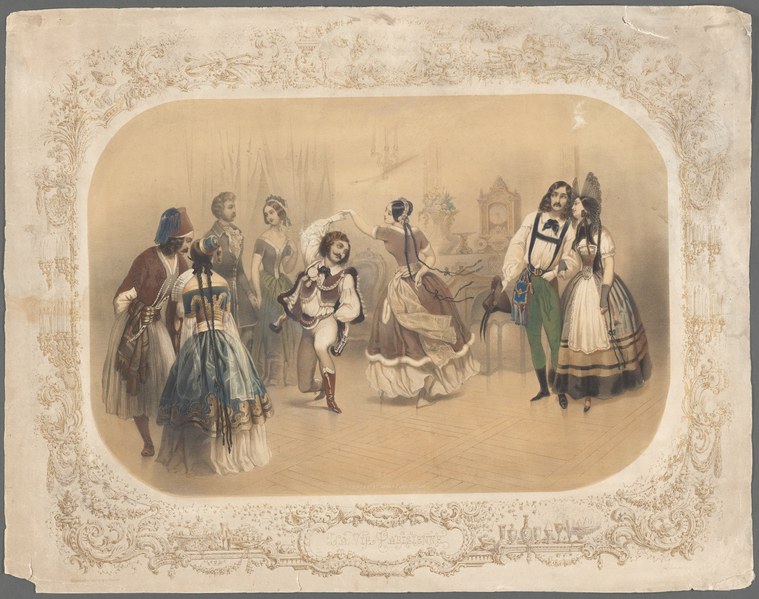
A fashionable Paris ballroom or salon scene, crowded with well-dressed figures in mid-19th-century costume. The composition centers on a young woman in a white or cream-colored dress executing a lively step or leap, her body airborne and skirts billowing around her. She is ringed by onlookers—men in dark coats and tailored trousers, women in elaborate gowns with full skirts and fitted bodices—who watch with evident amusement and interest. The setting is suggested by architectural elements in soft focus behind the crowd: a tall doorway or mirror-framed entrance and what may be a clock or ornamental fixture. The foreground is warm and intimate in tone; the background recedes into cooler, hazier tones. The entire scene is framed by an ornate rococo-style border of scrollwork and floral ornament, printed in sepia or pale gold, which was typical of mid-19th-century popular prints and theatrical imagery.
The dancing
The central dancer is captured mid-leap or grand battement, her body rising vertically with apparent lightness and control; her arms are open and her face animated. Her companions stand in various poses of attention—some with bodies angled toward her, some seated, some standing in relaxed conversation—but all oriented toward the spectacle. The men's posture is more static and observational; the women display more varied positions and gesture. The soloist's isolation at the center and the encircling crowd of stationary witnesses suggests a moment of exhibition rather than collective social dancing.
The dance depicted
This is a scene of theatrical or salon dancing, most likely a romantic ballet or comic theatrical piece of the 1840s–1860s. The white dress, the elevated position, and the joyful bounding quality of the movement suggest a ballerina in a solo variation—either a comic role (the lightness and abandon implied) or a romantic sylph-like character. The crowd composition and setting suggest a ball or fête within a dramatic narrative, a common framing device in the Romantic ballet repertory. The title *La vie parisienne* points toward a mid-19th-century French theatrical subject, likely Parisian society, but without inscription or signature the specific dance, choreographer, and dancer cannot be confirmed. The image documents the style of performance—the emphasis on buoyancy, display, and the marriage of technical skill with narrative charm—rather than any single canonical work.
How it was made
This is a hand-colored lithograph or engraving (likely a chromolithograph, given the subtle gradations and sepia tone), a mass-production print technique that allowed theatrical scenes to circulate to a broad paying audience in the mid-19th century. The ornamental frame and warm palate are characteristic of popular prints sold at the stage door or through print vendors. Lithography and hand-coloring made such images affordable and collectible for middle-class homes and theatres. The softness of the background and the linear detail in costume and setting are consistent with lithographic stone work, in which an artist drew directly onto a prepared surface.
About this work
This is a mid-19th-century lithographic print of a Parisian ballroom or theatre scene, likely from a ballet or comic theatrical piece with the title *La vie parisienne*. A young woman in a white ball gown executes a spirited leap or pas while a fashionable crowd of men and women watches from around her. The work is a document of Romantic-era dance performance and the theatrical mise-en-scène of Parisian society dances, captured in a popular print medium designed for wide circulation. It shows how ballet and theatrical dance were packaged and consumed as cultural commodities in the 1840s–1860s.
How to look at it
Look first at the central figure's pose and the energy it conveys—the leap is rendered with apparent ease and buoyancy, capturing the technical ideal of Romantic ballet. Notice how every figure in the crowd is oriented toward her, making her isolation and elevation a matter of both physical and social space. The ornate frame, rather than distancing the viewer, works as a window into an intimate theatrical moment; the warm sepia and the hand-coloring create a sense of memory or nostalgia. This is a print made to be desired and possessed, so attend to its status as an object: the border and coloring are designed to invite the viewer to imagine owning, displaying, and returning to this image of a fleeting performance.
The period
This work belongs to the Romantic ballet era (1830s–1860s), when French ballet dominated European taste and the ballerina's ethereal, weightless leap became an iconic symbol of artistic aspiration. *La vie parisienne* as a subject reflects the era's fascination with Paris itself as a modern, fashionable spectacle—the city was a subject for both satirical and celebratory theatrical treatments. The print medium was crucial: lithography and hand-colored engraving enabled theatres and print publishers to produce affordable souvenirs and promotional materials that kept dance images in circulation long after performances ended. The ornamental border frames this as a collectable object, suitable for albums or wall display in a middle-class home.
Where it lives
This work is held in the New York Public Library's collection of prints depicting dance. It is a mass-produced lithograph or engraved print, the type circulated as theatrical souvenir merchandise and popular press imagery in the mid-19th century.
Dance in this work
Questions about this work
Is this a painting or a print?
It is a hand-colored lithograph or engraving—a mass-produced print technique that allowed affordable copies to be distributed. The soft rendering of background and the linear detail in the figures are consistent with lithographic stone work or engraving. The ornamental border and warm sepia tone are typical of popular theatrical prints sold in the 1840s–1860s.
What is the woman in white doing?
She is executing a leap or grand battement—a jump common in theatrical and ballet choreography of the Romantic era. Her body is airborne, her skirts billowing, and her posture is open and joyful. The buoyancy and ease of the movement are hallmarks of Romantic ballet style.
Who is the artist?
The artist is not recorded in the catalogue. This is typical of popular theatrical prints, many of which were not signed or were issued as anonymous commercial products. The work's value lies in what it documents about performance and audience, not in authorship.
What does the title mean?
*La vie parisienne* means 'Parisian life.' This reflects the Romantic era's fascination with Paris as a modern, fashionable spectacle. The title suggests the scene is set within a narrative about society, courtship, or urban leisure, framed through dance and performance.
More dance artwork





