49 works in this view — arrow keys or swipe to move between them.
Dance in Art
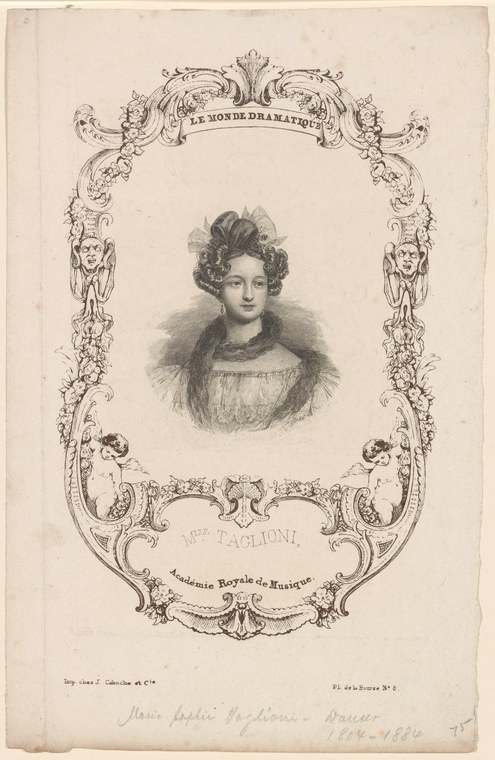
Mlle. Taglioni, Académie royale de musique
Unknown artist
- Collection:
- Prints depicting dance
- Source:
- New York Public Library
- Rights:
- Public domain — free to use, share and adapt.
- Recorded as:
- Public Domain
Taglioni revolutionized ballet by perfecting technique on pointe and embodying the ethereal, otherworldly aesthetic of Romantic ballet; this print circulated her image to thousands of admirers and is evidence of how dancers became celebrities through mechanical reproduction and theatrical publicity. For historians of dance, fashion, and visual culture, the print is a primary document of how Romantic ballet was understood and promoted during its most influential period.
What you are looking at
A portrait bust of a young woman occupies the center of an ornamental oval frame. She wears her dark hair pulled back in a style typical of the 1830s–1840s, with a few softly curled tendrils framing her face. Her dress is a simple, high-necked garment with delicate fabric suggested through light shading; a gauzy wrap or shawl drapes loosely across her shoulders. The image is rendered as a lithograph or engraving in fine lines and soft tonal gradations, creating an intimate, romanticized quality. The decorative frame itself is exuberant: a rococo-revival oval border with scrolling acanthus leaves, cherub heads at the cardinal points, and floral swags. At the top, a banner inscribed "LE MONDE DRAMATIQUE" identifies the series; at the base, text reads "Mlle Taglioni" and "Académie Royale de Musique." The entire composition is characteristic of French theatrical publicity from the mid-nineteenth century.
The dancing
The figure is shown only as a head and shoulders portrait, not as a dancer in motion. Her gaze is directed slightly downward and to the side, with a serene, composed expression. The soft modeling of the face and the gentle curve of her neck convey an idealized, romantic presentation typical of ballet publicity of the period. There is no visible evidence of dance posture or movement.
The dance depicted
Marie Taglioni (1804–1884) was the leading ballerina of the Romantic era and the first great exponent of pointe work. She created and danced the title role in *La Sylphide* (1832), the canonical work of Romantic ballet. This print documents her as a star of the Académie Royale de Musique (the Paris Opéra) during the height of her fame. The image itself is a portrait rather than a dance scene, but its inclusion in a theatrical series and its inscription confirm her prominence in Romantic ballet. The absence of dance imagery suggests that this is a celebrity portrait meant to circulate among audiences and collectors, celebrating the dancer as an idealized figure rather than capturing her in performance.
How it was made
This is a lithograph or engraved print, likely a hand-colored or tinted example, rendered with fine cross-hatching and soft tonal gradations to suggest the volume of the face and the texture of fabric. The delicate technique and the rococo-revival ornamental border are characteristic of French theatrical prints of the 1830s–1840s. Prints in this format—individual portrait sheets, often issued as series—were affordable, collectible, and widely distributed; they served as both souvenirs of performances and instruments of celebrity promotion, making them key documents of theater culture and fan engagement of the period.
About this work
This is a portrait print of Marie Taglioni, the most celebrated ballerina of the Romantic era, from a French theatrical series. It presents her not as a performer in motion but as an idealized celebrity—a romanticized face and figure framed in ornamental rococo revival borders. The print documents both the dancer's historical prominence and the visual conventions by which Romantic ballet stars were marketed and consumed by the public in the nineteenth century.
How to look at it
This is not a dance image but a celebrity portrait. Look at how the artist has idealized the face—soft, serene, almost ethereal—and how the ornate frame elevates the subject into a realm of beauty and refinement. The inscription grounds her historically and institutionally: she belonged to the highest state theater in France. Notice the contrast between the naturalistic rendering of the face and the fantastical baroque-revival ornament; this blend of realism and fantasy reflects the era's fascination with the dancer as an otherworldly being.
The artist
The artist is not recorded in the catalogue. The print is part of a series titled "Le Monde Dramatique" (The Dramatic World), a French theatrical publication that issued celebrity portrait sheets of major performers. Such series were typically created by a team of lithographers, engravers, and colorists rather than a single named artist. The quality and format suggest production by a commercial Parisian print house specializing in theatrical imagery.
The period
Marie Taglioni danced during the 1830s and 1840s, the zenith of Romantic ballet in Europe. Romanticism in ballet celebrated the ethereal, the supernatural, and the idealized feminine form; *La Sylphide* (1832) and *La Sylphide* (Paris, 1832) epitomized this aesthetic. Simultaneously, lithography and color printing were revolutionizing the circulation of theatrical imagery, allowing theaters and performers to reach audiences far beyond the opera house. Celebrity portrait prints became a major cultural commodity; collecting images of favorite dancers was a common practice among theatergoers and connoisseurs.
Where it lives
The work is held in the New York Public Library's collection of prints depicting dance. It is part of a series of theatrical celebrity portraits, a major genre of nineteenth-century commercial printmaking. Such prints were mass-produced and widely distributed, making them common in libraries and historical collections.
Dance in this work
Questions about this work
Who was Marie Taglioni?
Marie Taglioni (1804–1884) was the most celebrated ballerina of the Romantic era. She was the first dancer to master pointe technique and became famous for her role as the Sylph in *La Sylphide* (1832). She performed across Europe and was a cultural icon of her time, celebrated for the ethereal, weightless quality of her dancing.
Why is she shown as a portrait and not dancing?
This is a celebrity portrait print designed for sale and collection. Such prints circulated widely among admirers and served as souvenirs and promotional materials. A portrait allowed for a more intimate, idealized image of the star, distinguishing her as a cultural icon rather than documenting a specific performance.
What is "Le Monde Dramatique"?
"Le Monde Dramatique" was a French series of theatrical celebrity portrait prints, likely issued in the 1830s–1840s. It was a commercial publication that celebrated major performers of opera, ballet, and drama by issuing individual portrait sheets that could be collected and displayed.
What does the rococo frame tell us?
The ornate rococo-revival frame signals luxury, refinement, and cultural status. By the 1830s, rococo ornament evoked eighteenth-century aristocratic taste; applying it to a contemporary dancer elevated her into a realm of timeless, cultivated beauty—a visual rhetoric that was central to how Romantic ballet stars were promoted and understood.
More dance artwork





