49 works in this view — arrow keys or swipe to move between them.
Dance in Art
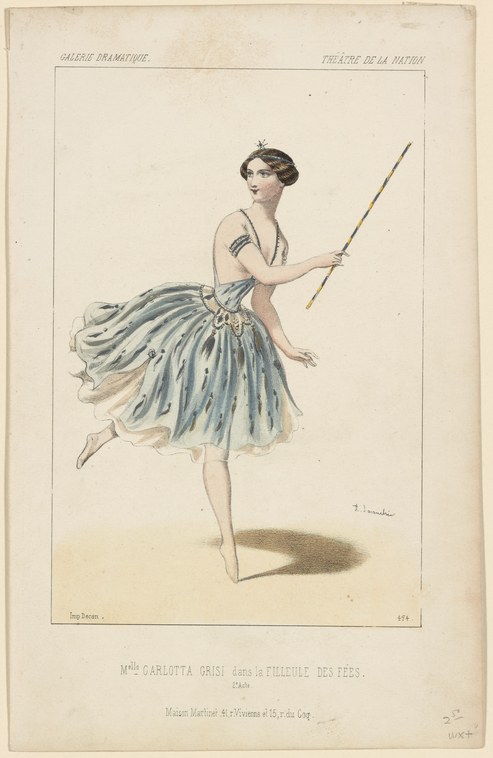
Melle. Carlotta Grisi dans La filleule des fées, 2e. acte
Unknown artist
- Collection:
- Prints depicting dance
- Source:
- New York Public Library
- Rights:
- Public domain — free to use, share and adapt.
- Recorded as:
- Public Domain
Carlotta Grisi was a major figure in mid-nineteenth-century ballet, and her performance in fairy tales and supernatural roles helped define the Romantic ballet aesthetic. This print is one of the primary visual records of how she was celebrated by her public and how Romantic ballet was marketed and consumed in Paris. The image also demonstrates how lithography made theatrical imagery reproducible and collectible, creating a culture of ballet fandom that anticipated modern theatrical publicity.
What you are looking at
A young woman in a pale, diaphanous tutu stands in profile, caught mid-movement on a bare stage. Her body is angled to the left, one leg extended behind her in a graceful lift, the other supporting her upright frame. She holds a thin wand or conductor's baton in her raised right hand, and her left arm floats softly. The tutu, rendered in delicate blue and white striations, billows around her hips and legs—the garment itself is the composition's focus, its weight and volume rendered with careful attention to how fabric moves through space. Her upper body is bare-shouldered, draped only in the thinnest sleeves. The figure casts a sharp shadow on the ground beneath her, grounding the scene in a single moment of performance. The background is plain cream, focused entirely on the dancer's form and the exquisite rendering of her costume.
The dancing
A single female dancer is shown in an attitude-like position—one leg extended behind and lifted, the body held upright with a graceful, elongated line. Her arms are raised asymmetrically: the right hand holds what appears to be a small wand or baton at roughly shoulder height, while the left arm extends softly in the classical port de bras. Her weight is on the supporting leg, and her head is turned slightly, gazing forward. The posture is characteristic of early-nineteenth-century ballet technique: the dancer appears light, weightless, and elegantly posed in a moment of stillness rather than rapid action. The elongated silhouette and the emphasis on verticality suggest trained classical form.
The dance depicted
This is a Romantic-era ballet image, most likely depicting a solo or scene from a ballet féerie—the title references 'La filleule des fées' (The Godchild of the Fairies), a work associated with the mid-nineteenth-century Paris Opéra repertory. The costume and pose identify this as theatrical ballet of the Romantic period, when supernatural and fantastical subjects dominated the stage. Carlotta Grisi was a celebrated Italian ballerina who performed in Paris during the 1840s–1850s and was known for her technical prowess and her roles in Romantic ballets. The wand in her hand suggests a magical or fairy subject—possibly the dancer portraying a fairy godmother or enchanted being. The delicate, elevated quality of the pose reflects the ethereal aesthetic of Romantic ballet, where dancers were meant to appear weightless and otherworldly.
How it was made
This is a hand-colored lithographic print, recognizable by the characteristic soft edges, the subtle modeling of tone, and the way color is applied in transparent washes. Lithography allowed for wider circulation of theatrical imagery than oil painting, and prints of celebrated dancers were popular souvenirs and publicity tools in nineteenth-century Paris. The colored finish—likely achieved with applied watercolor or gouache after printing—gives the work a luxurious, finished quality suitable for display or collection. The technique allowed the artist to capture both the precise outline of the figure and the flowing, suggestive quality of the tutu's fabric.
About this work
This is a colored lithographic portrait of Carlotta Grisi in a scene from 'La filleule des fées,' a mid-nineteenth-century Paris Opéra ballet. It documents both the celebrated dancer and a specific moment in Romantic ballet performance. The print exemplifies the theatrical iconography of the era: a single, idealized female figure in an elegant pose, wearing the costume and carrying the attributes of a supernatural being. Such prints circulated widely among theater-goers and ballet enthusiasts, serving as both documentation of performance and objects of aesthetic and commercial value.
The work belongs to a substantial tradition of ballet imagery created for and by the Parisian theater world. It captures the aesthetic of Romantic ballet—the emphasis on weightlessness, grace, and ethereal femininity—through a medium accessible to a broader audience than stage performance alone could reach. For dance historians, it provides visual evidence of how this celebrated ballerina moved and was presented to the public.
How to look at it
Look first at how the artist has rendered the tutu: the fabric is shown with remarkable attention to its weight, volume, and the way light falls through it. The striations of color suggest movement and the three-dimensionality of gathered silk—the tutu appears to have just been set in motion or is hovering in place. Notice the dancer's elongated proportions: the small head, the long neck, the extended limbs create a silhouette that is deliberately graceful rather than naturalistic. The wand in her hand—a fairy's magic wand—becomes the focus of her raised arm, giving the gesture purpose and narrative meaning. Finally, observe the stark ground and empty background: this is not a scene but a portrait, presenting the dancer as an object of aesthetic contemplation rather than as a participant in a narrative moment.
The artist
The artist is not recorded in the catalogue, but the print bears the signature or mark of the lithographer in the lower left. Theatrical prints of this period were often produced by specialized lithographic workshops in Paris (such as the firm of Benoist or Martinet, both active during this era) or by independent artists working in theater publicity. The style and execution suggest a professional hand trained in rendering both the human figure and fine decorative detail. These images were typically created from sketches made at rehearsal or performance, or from descriptions provided by dancers and their companies.
The period
This print dates to the 1840s–1850s, the height of the Romantic ballet era in Paris. This was the period of La Sylphide (1832) and Giselle (1841), when ballets depicting sylphs, spirits, and fairy-tale subjects dominated the Paris Opéra repertory. Carlotta Grisi was particularly celebrated for her roles in fantastical narratives; she created the role of Giselle in 1841 and was known for her technical brilliance and her ability to convey ethereal, otherworldly qualities. The broader theatrical context emphasized the ballerina as the primary focus of spectacle—male dancers were increasingly sidelined, and the female dancer in a tutu became the iconic image of ballet itself. Lithographic theater prints had become a major commercial and cultural product by this time, available for purchase in Paris foyers and in print shops, allowing wider circulation of images of celebrated performers.
Where it lives
This print is part of the Library of Congress's Prints depicting dance collection, housed in the New York Public Library. It is a nineteenth-century lithographic print with hand-applied color, typical of theater publicity materials produced and circulated in Paris during the mid-nineteenth century.
Dance in this work
Questions about this work
Who was Carlotta Grisi?
Carlotta Grisi (1819–1899) was an Italian-born ballerina who became a star of the Paris Opéra in the 1840s–1850s. She was celebrated for her technical virtuosity and her performances in Romantic ballets, especially as Giselle in the 1841 première of the ballet of the same name. She danced across Europe and was considered one of the defining ballerinas of the Romantic era.
What is 'La filleule des fées'?
The title translates as 'The Godchild of the Fairies' and refers to a Romantic-era ballet with a magical or fairy-tale subject. Such spectacle ballets were common at the Paris Opéra in the mid-nineteenth century, typically featuring elaborate scenery, supernatural beings, and showcasing the star ballerina in multiple scenes and costumes.
Why is she holding a wand?
The wand indicates that her character is a fairy or magical being. In Romantic ballets, fairies and supernatural creatures often carried attributes—wands, crowns, or branches—to signify their magical nature and to provide the dancer's hands and arms with purposeful gesture and narrative meaning.
What is a lithographic print?
Lithography is a printing technique based on the repulsion of oil and water. An image is drawn on a prepared stone with a greasy substance, the stone is dampened and inked, and prints are pulled from it. Hand-colored lithographs like this one were popular, affordable ways to circulate images of celebrated performers and theatrical scenes in the nineteenth century.
More dance artwork





