49 works in this view — arrow keys or swipe to move between them.
Dance in Art · 2018
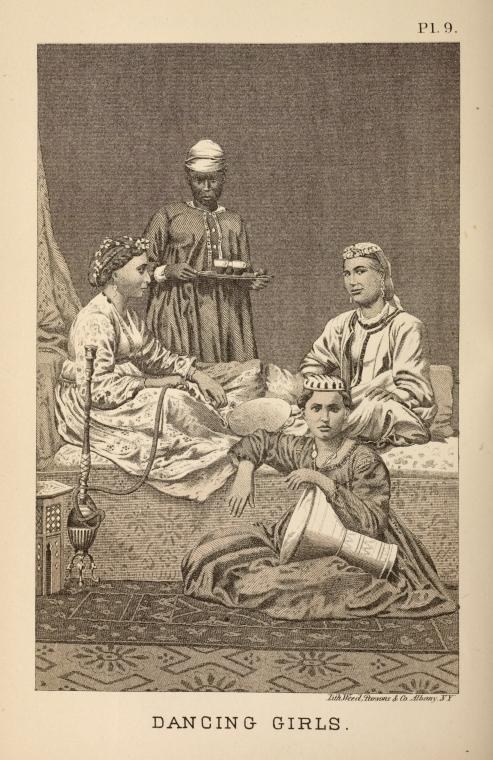
Dancing girls.
Unknown artist
- Medium:
- Source:
- New York Public Library
- Rights:
- Public domain — free to use, share and adapt.
- Recorded as:
- public_domain
The work is significant as a window into how European audiences in the late 18th or early 19th century imagined non-European performance, and how prints shaped that imagination. It demonstrates the gendering and exoticization of dance in the period—women as clothed observers, a youth's body as the primary site of visual interest and instruction—and raises questions about the difference between documentation and fantasy that remain relevant to how dance imagery circulates today.
What you are looking at
This engraving depicts four figures in an opulent interior, presented as a scene of entertainment or instruction centered on dance. Three women occupy the composition: one seated on the left in elaborate patterned dress with a jeweled headdress, leaning toward the center; a second woman standing in the middle distance wearing a long gown and turban-like headdress, holding what appears to be a serving vessel or instrument; and a third woman seated on the right in similar dress with a decorative headdress. A young boy or adolescent figure reclines on the floor in the foreground, his body stretched forward in an attitude of play or instruction. The floor is decorated with an ornate geometric pattern. Drapery and architectural elements suggest a wealthy household interior, possibly Oriental or fantastical in character. The lighting is even and rendered through fine engraved line-work, creating a carefully composed tableau.
The dancing
The three seated or standing women are arranged in a conversational or observational grouping rather than an active dance formation. The reclining youth in the foreground has extended limbs in an open, play-like posture—weight released, body elongated—that suggests flexibility, acrobatic play, or informal movement rather than formal dance technique. The women's postures are upright and dignified, with arms held in relaxed positions. The spatial relationship suggests spectatorship or instruction: the women appear to be watching or directing the child's movement rather than participating in it themselves.
The dance depicted
The image is titled 'Dancing Girls' but the actual content is ambiguous and does not clearly depict structured dance in the European theatrical sense. The posture of the youth suggests acrobatic play, contortion, or informal movement training—possibly an entertainment of the kind associated with Middle Eastern or exotic performance. The women's dress and setting invoke Orientalist fantasy rather than documented ethnographic practice. The image may represent either actual performance traditions or European imaginative reconstruction of non-Western movement practices. Without contextual inscription or clearer evidence of a specific dance form, only that this is presented as a scene of embodied performance and instruction can be stated with confidence.
How it was made
This is a copper engraving rendered in fine parallel line-work (hatching and cross-hatching) characteristic of late 18th or early 19th-century reproductive prints. The technique allowed precise tonal modeling and fine detail—visible in the patterning of textiles, the shading of faces, and the architectural background. Engravings of this quality and refinement were typically produced for educated, affluent audiences and suggest the work was made for book or portfolio circulation rather than broad public sale. The composition and style are consistent with European narrative and genre scenes of the period, likely engraved after a drawing or painting by another artist.
About this work
This engraving presents a scene of movement and entertainment in an imagined luxury interior, occupying the space between documented ethnographic record and Orientalist fantasy that characterizes much European imagery of 'exotic' dance in the 18th and early 19th centuries. The women are shown as custodians or observers of movement rather than dancers themselves; the focus falls on a young, flexible body in play or acrobatic display. The work is typical of how European print culture visualized non-Western performance—through costume, setting, and a focus on the body's flexibility and ornamental display—while revealing little about actual practice. It belongs in a gallery of dance in art as evidence of how dance imagery has been constructed and circulated rather than as documentation of a dance tradition itself.
How to look at it
Attend first to the distribution of action: the women are still and upright, while the youth's body is extended and open. This reversal of what one might expect from a title invoking 'girls' suggests the image is not about female virtuosity but about the observation and possible instruction of male youthful movement. Notice the rendering of textile pattern and ornament—the fine engraved detail creates a sense of luxury and foreign richness that carries the fantasy of the scene. The spatial arrangement, with the women positioned as witnesses, invokes an interior domestic or courtly context, but the youth's posture and setting remain ambiguous—neither clearly European nor clearly identified with a specific non-European tradition.
The artist
The artist is not recorded in the catalogue. The style and technique are consistent with reproductive engraving of the period c. 1770–1830, suggesting a professional printmaker working from a drawing or painting, possibly after a history painter or genre specialist. The subject matter aligns with the taste for Orientalist scenes in late Georgian and Regency visual culture.
The period
In the late 18th and early 19th centuries, European fascination with non-European dance and movement practices grew alongside imperial expansion and the circulation of travel narratives. Engravings like this one were produced to satisfy that appetite and to construct visual narratives of 'Oriental' or 'exotic' performance for domestic consumption. At the same time, European theatrical dance was dominated by ballet, which was undergoing professionalization and codification. The contrast between the documented, regulated movement of the ballet studio and the imagined flexibility and sensuousness of 'foreign' dance was a persistent theme in visual culture of the period.
Where it lives
The work is held in the New York Public Library collection. It is catalogued as a print of unknown artist and date, but the style and technique are consistent with engravings produced in the late 18th or early 19th century.
Questions about this work
What dance is actually shown in this engraving?
The image is ambiguous. The title claims to show 'dancing girls,' but the primary action is a youth in a horizontal stretch or acrobatic pose. The women are seated or standing in observation. This may represent acrobatic play, flexibility training, or an imagined version of non-European performance, but no specific dance form can be identified with certainty from the image alone.
Why are the women dressed in this style?
The turbans, patterned robes, and jeweled headdresses invoke Orientalist fantasy—a European imagining of Middle Eastern, North African, or South Asian luxury and exoticism. These garments were not necessarily accurate to any actual tradition but were assembled to signal 'otherness' and wealth to European viewers of the period.
When was this made?
The style and technique point to the late 18th or early 19th century (roughly 1770–1830), but the artist and exact date are not recorded. The catalogue entry does not provide a date, and attribution remains unknown.
Is this a documentary record of a real performance tradition?
It is more likely a European imaginative reconstruction than a report of actual observed practice. The composition, framing, and setting—while invoking an 'exotic' interior—follow European conventions of genre painting and narrative print, and there is no evidence that the artist witnessed the scene being depicted.
More dance artwork