49 works in this view — arrow keys or swipe to move between them.
Dance in Art
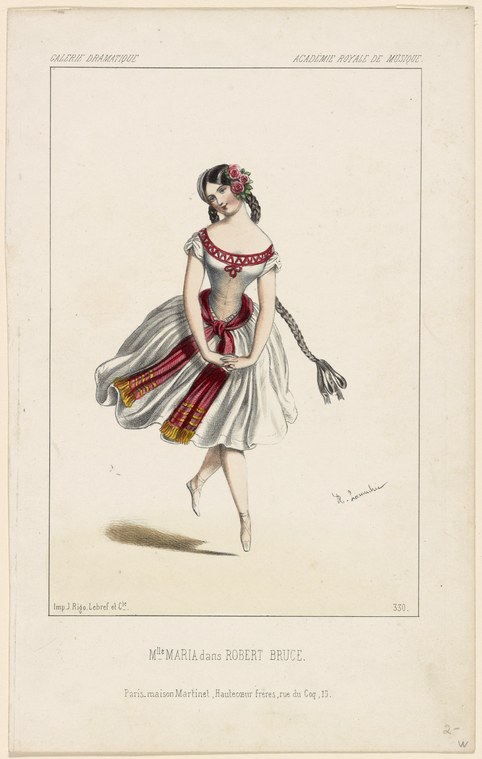
Mlle Maria dans Robert Bruce
Unknown artist
- Collection:
- Prints depicting dance
- Source:
- New York Public Library
- Rights:
- Public domain — free to use, share and adapt.
- Recorded as:
- Public Domain
This image is among the primary visual documents of Romantic ballet in performance. It shows us exactly what the Romantic ballet body looked like, how it was costumed, and how artists chose to immortalise dancers at the height of their fame. For historians of dance and theatre, such lithographs are nearly as important as the ballets themselves—they are often the only visual record of works that were danced for a few seasons and then disappeared.
What you are looking at
A young woman in theatrical dress is captured mid-movement against a plain background. She wears a pale cream or ivory tulle skirt with a voluminous lower half caught in motion, revealing her legs and pointe shoes. The bodice is fitted and decorated with a wine-red ribbon or trim at the neckline and waist, matching ribbon accents on the skirt. She wears short puffed sleeves and has flowers (pink or red roses) pinned in her dark hair. Her left arm extends gracefully downward while her right arm reaches back; her body is tilted forward slightly in an attitude or arabesque-like posture, captured at a moment of extension and elegance. The pose and lighting suggest a moment of performance rather than rest, with the artist attending closely to the fall of fabric and the line of the extended limbs.
The dancing
A single female dancer dominates the composition. She stands on pointe on her right leg, with the left leg extended behind or slightly to the side in a balletic position. Her torso is inclined forward with arms held in a softly curved classical frame—the left arm hangs or extends downward, the right curves back, both in the rounded port de bras characteristic of early 19th-century ballet vocabulary. Her weight appears concentrated and controlled, the pose suggesting the studied elegance of academic ballet rather than character dance or pantomime.
The dance depicted
This is almost certainly Romantic-era theatrical ballet, most likely from the 1840s–1850s based on the costume silhouette and the depiction of pointe work. The inscription names the dancer as 'Mlle Maria' in the ballet *Robert Bruce*, a historical drama-ballet that was performed in Paris during this period. The artist has chosen to show her in a moment of lyrical stillness or balance, the kind of attitude or arabesque that would have been central to the Romantic ballet vocabulary. The roses in her hair and the pale tulle skirt are hallmarks of the *ballet blanc* aesthetic—the ethereal, otherworldly quality that defined the Romantic ballet's visual language.
How it was made
This is a hand-coloured lithograph, recognisable from its characteristic crayon-drawn quality, the soft tonal gradations, and the subtle watercolour wash applied over the printed stone. The printing mark at lower left—'Imp.↓ Bry. Léveillé et Cie'—identifies the Paris printer. Lithography was the dominant medium for theatrical portraiture and dance documentation in early 19th-century France, allowing rapid, relatively inexpensive reproduction for sale to theatre audiences and collectors. The technique permitted both fine linear detail (in the costume trim, facial features, and pose) and softer tonal modelling (in the flesh tones and shadow work), making it ideal for capturing both the precision of academic ballet and the romantic atmosphere of the period.
About this work
This is a portrait of a named principal dancer, Mlle Maria, in a moment from the ballet *Robert Bruce* as performed in Paris in the mid-19th century. It is one of hundreds of such lithographs produced for the theatre-going public, celebrating the bodies, costumes, and innovations of the Romantic ballet era. The work documents both the visual spectacle the audience saw and the technical accomplishment of pointe work and classical positioning that defined the period. It belongs in a dance gallery because it is simultaneous an artwork, a historical record of performance, and evidence of how dance was commodified, circulated, and remembered in the early modern era.
How to look at it
Notice the exact moment the artist chose: not a dramatic leap or turn, but a sustained, elegant balance or attitude. This reflects the Romantic ballet's aesthetic of sustained lyricism and refined control rather than pyrotechnic virtuosity. The pale tulle and floral ornament are not incidental decoration—they are the entire visual argument of Romantic ballet, signifying the supernatural, the ethereal, the feminine ideal. Observe how the artist has rendered the pointe shoe and the mechanics of standing en pointe with precision: this was a novelty in the 1840s, and audiences marvelled at the feat. The lithograph's soft tonality—neither as harsh as engraving nor as painterly as oils—gives the image an immediacy and intimacy suited to a theatre souvenir.
The artist
The lithograph is unsigned, and the artist remains unknown. The publisher's mark (Imp. Bry. Léveillé et Cie) indicates it was produced by a commercial Paris printing house. Such theatrical portraiture was a major industry in 19th-century Paris, with dozens of lithographers producing thousands of images of actors, dancers, singers, and acrobats. These were sold at the theatre doors and in print shops, functioning much as photographs and celebrity posters would later. The anonymity of the artist is typical—the focus was on the celebrity of the performer and the spectacle of the costume, not on authorial signature.
The period
This lithograph was made during the height of the Romantic ballet, a movement that had transformed European dance after the 1830s with works like *La Sylphide* (1832) and *Giselle* (1841). The Romantic ballet celebrated lightness, otherworldliness, and the female dancer on pointe as the primary vehicle of choreographic innovation. Paris was the undisputed centre of ballet production and consumption, and the Paris lithographic industry boomed in response. By the 1840s–1850s, every successful dancer was immortalised in lithographic form, circulating their image across Europe and creating a visual archive of the period's greatest performers. The *ballet blanc*—scenes of ethereal, tutued dancers in moonlit forests or magical realms—had become the public's definitive expectation of ballet, and costumes like Maria's pale tulle skirt and floral headdress were instantly recognisable as signifying the Romantic ideal.
Where it lives
This lithograph is held in the Prints depicting dance collection at the New York Public Library, which preserves a substantial archive of 19th-century theatrical portraiture. It represents the commercial print trade that flourished around Parisian theatre in the 19th century.
Dance in this work
Questions about this work
Who was Mlle Maria?
The inscription identifies her only as 'Mlle Maria' in the role within *Robert Bruce*. She was evidently a principal dancer of sufficient prominence to warrant a lithographic portrait, suggesting she was known to Paris theatre audiences. Without further archival research, her full name and career details cannot be established from the print alone.
What is Robert Bruce?
*Robert Bruce* was a historical drama-ballet performed in Paris in the mid-19th century. The subject—the Scottish king—was popular in Romantic-era ballet as a framework for spectacle and national drama. The ballet itself is not documented in surviving choreographic records, making this lithograph one of the few visual traces of how it was staged and costumed.
Why are her shoes and dress so pale?
The pale tulle skirt and light-coloured pointe shoes are signatures of Romantic-era ballet aesthetics. Pale, ethereal costume created the illusion of otherworldliness—a dancer might represent a sylph, a spirit, or a supernatural being. This visual language was central to the Romantic ballet's artistic project and instantly recognisable to contemporary audiences.
How do we know this is a lithograph?
The image shows characteristic lithographic qualities: the soft crayon-drawn line, subtle tonal gradations, and the hand-applied watercolour wash visible in the tulle and flesh tones. The printer's mark at the bottom ('Imp. Bry. Léveillé et Cie') confirms it was produced by a Paris lithographic press, a major publisher of theatrical portraiture in the 19th century.
More dance artwork





