49 works in this view — arrow keys or swipe to move between them.
Dance in Art
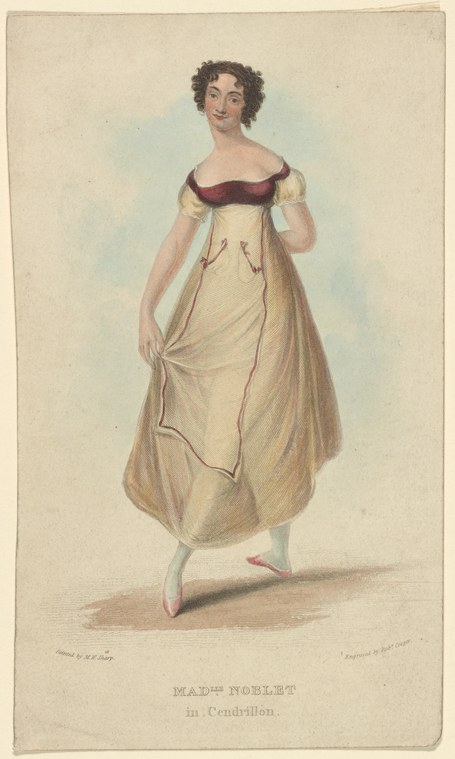
Madlle Noblet in Cendrillon
Unknown artist
- Collection:
- Prints depicting dance
- Source:
- New York Public Library
- Rights:
- Public domain — free to use, share and adapt.
- Recorded as:
- Public Domain
Noblet was a major dancer of her time, and this print is evidence of the specific way early Romantic ballet was marketed and memorialized: as elegant, noble, and physically graceful, with the body itself displayed as the primary spectacle. The image shows us what a professional ballet dancer of the 1820s actually looked like on stage—the real silhouette, the real costume, the real scale of skirts—rather than the stylized fantasies that later illustration would create.
What you are looking at
A young woman stands in a graceful contrapposto pose against a pale cream background, her weight shifted to one leg, the other extended in a gentle line. She wears a high-waisted, long cream-colored gown with vertical pleats that fall from beneath her bust to her ankles in the neoclassical style of the 1820s. A deep burgundy or wine-colored ribbon or band crosses her shoulders and forms the bodice, creating a striking color accent. Her dark curled hair is arranged in the Regency style, and she wears pink ballet slippers—a detail that anchors the image in theatrical dance practice. Her posture is upright and elongated, her arm held with balletic grace at her side, her expression serene and frontal. The figure is presented as if for the stage: a performer in full costume, frozen in a moment of poised readiness rather than active movement.
The dancing
The dancer stands alone in an almost heraldic pose: weight on one leg, the supporting knee slightly bent, the other leg straight but relaxed. Her torso is tall and lifted, shoulders squared, one arm hanging naturally while the other rests at her side. The port de bras is restrained and dignified, showing the balletic carriage of the period. Her feet are in pink ballet slippers, and her stance suggests either the preparation for movement or a moment of held repose. There is no visible tension in the frame; the whole effect is one of calm nobility rather than athletic exertion.
The dance depicted
This is a portrait of a Romantic-era ballet dancer, most likely from the Paris Opéra of the 1820s. The inscription identifies her as 'Mademoiselle Noblet in Cendrillon' (Cinderella), one of the earliest ballet versions of that fairy tale, first performed in Paris in 1822. The costume and pose are consistent with early Romantic ballet: the high waist, neoclassical drapery, and ankle-length skirt, together with the ballet slippers, confirm this is theatrical ballet of the Romantic period. Noblet was a principal dancer of her time, and this image documents both her as a performer and the visual grammar of the early Romantic ballet—before the tutus rose higher and before pointe work became the dominant technique.
How it was made
This is a hand-colored engraving or aquatint, worked with careful attention to fabric and form. The artist has used color economically—the cream ground, the golden-cream gown, the burgundy accent, and the pink slippers—to create a convincing sense of three-dimensional drapery and bodily presence. The line work is fine and precise, particularly in the definition of the pleats and the articulation of the face and hair. The technique allows for the kind of detailed, portable image that made theatrical portraiture accessible to a broad audience; this is the kind of print that would have been sold in Paris theaters and through print shops, accessible to anyone interested in the Paris Opéra and its stars.
About this work
This is a theatrical portrait of Mademoiselle Noblet in the role of Cinderella, a principal dancer of the Paris Opéra performing in one of the earliest ballet adaptations of Perrault's fairy tale. The image is both a record of a specific performer and a window into early Romantic ballet aesthetics: the neoclassical costume, the balletic port de bras, the pink slippers, and the calm, frontal presentation all testify to how ballet presented itself to the public in the 1820s. The work belongs in a gallery of dance imagery because it documents the visual culture of professional ballet at a crucial moment in its history—the transition from Napoleonic neoclassicism toward the full Romantic ballet of the 1830s and 1840s.
How to look at it
Look at the moment: the dancer is not in motion, but in repose, as if pausing between scenes or preparing for her entrance. This is not a snapshot of a leap or a turn, but a formal presentation—the way a star would have been drawn for the public to admire. Notice how the artist has rendered the fabric: the pleats fall perfectly straight, the ribbon sits flat against her body, the slippers are delicate and precise. The pose itself—weight shifted, one leg extended but relaxed—is the fundamental balletic stance, the foundation from which all movement springs. The artist understood ballet.
The period
This print dates to the 1820s, during the twilight of Napoleonic neoclassicism and the beginning of the Romantic movement in dance and art. Ballet was undergoing a transformation: the strict academic vocabulary inherited from the 18th century was being infused with a new aesthetic of grace, mystery, and emotional expression. Fairy-tale ballets—of which Cinderella was one of the earliest—were becoming fashionable, and dancers like Noblet, who could embody both technical mastery and romantic sensibility, were the stars of the Paris Opéra. In the visual arts, this was the era of Ingres and the last of the neoclassical painters; the print medium allowed theatrical portraiture to reach a wide public and to preserve the memory of celebrated performances.
Where it lives
This hand-colored engraving is held in the New York Public Library's collection of prints depicting dance. Such prints were typically produced in Paris and sold through theatrical print shops and booksellers; they were affordable, portable, and widely collected by enthusiasts of the Paris Opéra.
Dance in this work
Questions about this work
Who was Mademoiselle Noblet?
Marie Noblet was a principal dancer of the Paris Opéra during the 1820s and 1830s, celebrated for her technical skill and her embodiment of the emerging Romantic ballet aesthetic. She performed in several of the earliest Romantic ballets, including Cendrillon (1822), and was one of the first generation of dancers to work extensively in the fairy-tale repertoire that would define the Romantic era.
When was the ballet Cendrillon first performed?
The ballet Cendrillon premiered at the Paris Opéra in 1822, choreographed by Jean-Louis Aumer. It was one of the earliest ballets based on the Cinderella story and an important landmark in the development of the fairy-tale ballet, which would become central to Romantic ballet aesthetics.
Why are the slippers pink rather than the pointe shoes we know today?
Pointe work was not yet the dominant technique in the 1820s. Early Romantic dancers like Noblet wore soft pink slippers and rose en pointe only occasionally, using it as a special effect rather than as the foundation of technique. Hard pointe shoes were not developed until the mid-19th century.
Is this a costume study or a portrait of the dancer herself?
This is both: it is a theatrical portrait in which the dancer is shown in character and costume, as audiences would have seen her on stage. The inscription makes clear that we are looking at Noblet in the role of Cinderella, not Noblet in everyday dress. Yet the print also serves as a record of her as a performer—her name, her fame, her body, and her art.
More dance artwork





