49 works in this view — arrow keys or swipe to move between them.
Dance in Art
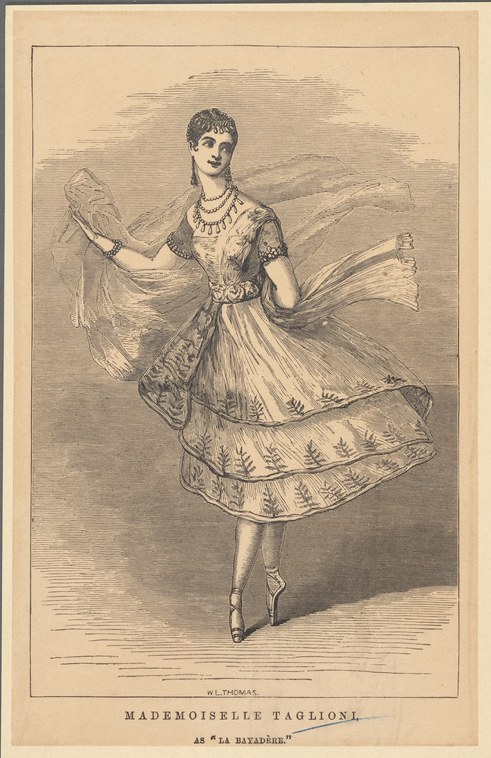
Mademoiselle Taglioni, as "La bayadere"
Unknown artist
- Collection:
- Prints depicting dance
- Source:
- New York Public Library
- Rights:
- Public domain — free to use, share and adapt.
- Recorded as:
- Public Domain
Taglioni was the most influential dancer of the Romantic era, and *La Bayadère* was among the works that defined her legacy. This engraving is primary evidence for how the role was performed and presented to the public, and it shows the integration of draped fabric as choreographic material—a practice central to Romantic aesthetics. For historians, this image provides concrete information about costume, silhouette, and the visual vocabulary used to convey exoticism and sensuality in 19th-century ballet.
What you are looking at
A single female dancer stands in a graceful pose against a plain background, rendered in brown ink on tan paper. She wears a Romantic-era ballet costume: a fitted bodice with short sleeves and decorative embroidery, and a long skirt with a deep border of small repeated motifs that falls below the knee. Over this she holds two large, diaphanous scarves or shawls that billow dramatically around her body, one swept high to her left shoulder and the other flowing down her right side. Her hair is arranged in a period style with what appears to be a jeweled ornament or tiara. Her posture is upright and composed, weight balanced on one leg, with the other leg extended slightly in a controlled position. The scarves create the primary visual interest and movement in the composition, their flowing lines suggesting the moment captured is one of graceful, sustained motion rather than explosive action. The overall effect is ethereal and theatrical.
The dancing
The dancer's frame is upright and composed, showing a controlled, balletic alignment. Her weight appears centered and grounded, with one leg supporting and the other extended in a modest turnout position typical of Romantic ballet. Her arms are positioned to frame and manipulate the flowing scarves rather than to demonstrate balletic port de bras, though one arm is extended and the other held closer to the body. There is only one figure. The scarves dominate the visual composition and are clearly integral to the choreography, used as props to extend the dancer's line and create sweeping visual patterns.
The dance depicted
This is Romantic ballet, specifically a representation of the title role from *La Bayadère* (also known as *The Bayadere*), a famous ballet featuring a Hindu temple dancer that premiered in the mid-19th century. The costume and the dramatic use of draped fabric—scarves rather than a tutu—are central to how this role was performed and visualized in prints and illustrations of the period. The dancer's balanced, controlled posture and the emphasis on graceful extension rather than dramatic jumps or turns suggests the Romantic ballet vocabulary of sustained, flowing movement. The scarves function as essential choreographic elements, used for visual extension and to convey the exotic, sensual character of the bayadère (temple dancer).
How it was made
This is an engraving or possibly a wood engraving, executed in brown ink on tan paper. The linear, parallel-line hatching used to create shading and volume, the clean outlines, and the overall tonal range are characteristic of 19th-century engraving practice. The technique allowed for fine detail and the reproduction of the image in relatively large print runs, making such theatrical portraits widely accessible to the theater-going public and to collectors of dance imagery. The precision of the line work suggests this was a professional theatrical print, likely produced for commercial circulation as a souvenir or promotional image.
About this work
This engraving depicts Mademoiselle Taglioni—the most celebrated ballerina of the Romantic era and a defining figure of 19th-century dance—in one of her famous roles: the title character of *La Bayadère*. Taglioni revolutionized ballet through her ethereal technique, her use of the pointe shoe, and her ability to convey emotion and fantasy through sustained, flowing movement. This print captures the essence of how the role was visualized: an exotic temple dancer defined not by virtuosic jumps but by graceful extension and the manipulation of draped fabric. The image belongs in a dance history collection because it documents both a canonical role and the specific way Taglioni embodied the Romantic ballet aesthetic that shaped all subsequent theatrical dance. The engraving format and the image's survival in an institutional collection indicate that this was a valued and circulated representation, part of the visual culture through which 19th-century audiences encountered and remembered dance.
How to look at it
Observe the moment the artist has chosen: not a leap or turn but a suspended, elegant pose that emphasizes the flow of the costume and scarves. The scarves are not incidental decoration but are positioned and shaped to create swooping lines that extend the dancer's body and suggest continuous, graceful motion. Notice how the artist has used the drape of fabric to create depth and dynamism within a fundamentally static pose—this was a key aesthetic of Romantic ballet, which valued the illusion of weightlessness and sustained ethereality over the athletic display of classical technique. The dancer's face is serene and aloof, consistent with the Romantic ideal of the ballerina as an otherworldly being.
The period
This print dates from the Romantic era of ballet, roughly 1830–1870, when the art form was dominated by ethereal, otherworldly subjects and by the technical innovations and star power of dancers like Taglioni, Fanny Essler, and Lucile Grahn. *La Bayadère* was part of a broader fascination with non-European subjects—India, Egypt, the Middle East—presented through a European theatrical lens. The role of the bayadère (Hindu temple dancer) allowed choreographers to explore themes of passion, exoticism, and spiritual transcendence while incorporating props and movement vocabularies distinct from the pure classical ballet line. Engraved and lithographed prints of celebrated dancers in famous roles were a major form of theatrical publicity and a way for audiences to own images of performances they had witnessed or heard about.
Where it lives
This engraving is held in the New York Public Library's collection of prints depicting dance. It is a theatrical print, a category of commercial illustration produced to promote performances, commemorate celebrated dancers, and serve as collectible souvenirs for theater audiences and dance enthusiasts.
Dance in this work
Questions about this work
Who was Mademoiselle Taglioni?
Marie Taglioni (1804–1884) was a Swedish-born dancer who became the most celebrated ballerina of the Romantic era. She revolutionized ballet through her technical innovations (particularly her mastery of pointe work), her ethereal performance style, and her starring roles in works like *La Sylphide* and *La Bayadère*. She was a global celebrity and set the aesthetic standard for Romantic ballet worldwide.
What is *La Bayadère*?
*La Bayadère* is a ballet about a Hindu temple dancer (bayadère). The title role became famous as a vehicle for celebrated ballerinas to perform exotic, sensual, and emotionally nuanced choreography. The work was part of 19th-century European fascination with non-European cultures, reimagined through a Romantic ballet aesthetic.
What are the scarves for?
The draped scarves or shawls are both costume and choreographic prop. They extend the dancer's lines, create visual interest and motion, and convey the exotic character of the role. In Romantic ballet, such props were used to enhance the illusion of weightlessness and grace and to suggest sensuality and otherworldliness.
How was this print made?
This is an engraving, a technique in which an image is carved or etched into a metal plate and then inked and printed. Engraving allowed for fine detail, a wide range of tones, and the production of multiple copies, making it ideal for theatrical promotion and mass distribution in the 19th century.
More dance artwork





