49 works in this view — arrow keys or swipe to move between them.
Dance in Art
Undine, by V. B. Aubert
Unknown artist
- Collection:
- Prints depicting dance
- Source:
- New York Public Library
- Rights:
- Public domain — free to use, share and adapt.
- Recorded as:
- Public Domain
For dancers and historians, this image captures the specific aesthetic of Romantic ballet at its height—the elevation of the ballerina as a passive, ethereal figure and the subordination of the male dancer and corps to an elaborate visual frame. It also documents the intersection of theatre, printmaking, and mass culture in the 19th century, showing how images of dance reached audiences who might never see the stage.
What you are looking at
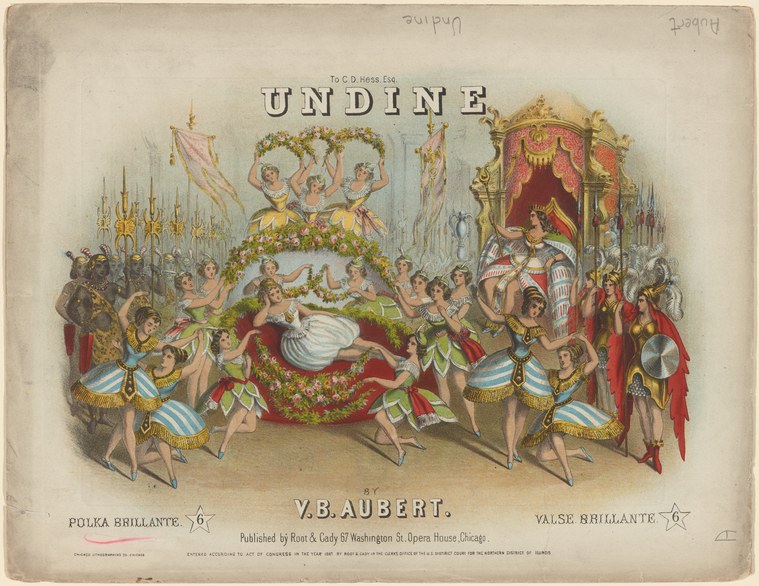
A theatrical procession celebrating the water nymph Undine occupies the full width of a richly decorated interior. At center, Undine reclines on an enormous floral bower elevated on the shoulders of male dancers in classical armor and pale skirts. She wears a white chemise and is attended by winged cupids who hover and cling to the flowers. Flanking this central car are two columns of warriors in Roman-style dress with ornate helmets, shields, and spears, and a figure of authority (perhaps a king or priest) sits enthroned under a crimson canopy on the right. The background rises in Gothic spires; the foreground is scattered with flower petals and garlands. The entire scene is suffused with theatrical splendor—feathered standards, swags of fabric, an almost architectural arrangement of bodies in service to spectacle.
The dancing
The male dancers supporting the bower are in a wide, stable stance, their bodies nearly rigid as load-bearers; their arms are raised or extended to steady the flowers and their precious cargo. Undine herself reclines in a languid, supported position—passive, displayed, decorative. The cupids are rendered as lightweight, aerial figures in complex poses around her, some seated on flowers, others airborne. The warriors flanking the procession stand in formal parade posture, arms at sides or holding weapons upright, creating a human frame rather than executing dance movement. The composition prioritizes symmetry and architectural stability over the articulation of bodily movement.
The dance depicted
This image records the theatrical spectacle and processional dance culture of 19th-century opera and ballet pantomime, specifically the kind of grand divertissement associated with Romantic ballet. Undine was the subject of multiple ballet treatments in this era, most famously Jules Perrot's *Ondine* (1843). The image shows not virtuosic technical dance but rather the corps de ballet as architectural element—the human body deployed for visual and allegorical effect within an elaborate mise-en-scène. The bower-bearers are executing a sustained, coordinated support rather than steps; the movement is processional and ceremonial.
How it was made
This is a hand-colored engraving or lithograph, evident from the fine line work, the delicate modeling of flesh tones, and the careful application of flat and translucent color washes. The technique allowed for wide distribution and multiple impressions. The inscription credits V.B. Aubert as designer and Rost & Cady of Washington Street, Chicago as publisher—suggesting this was a commemorative or promotional print, likely circulated as a souvenir of an actual production or as a model for theatrical designers. The hand coloring and the level of detail indicate this was a premium product, not a cheap broadside.
About this work
This hand-colored print documents the aesthetic of Romantic ballet spectacle in the mid-to-late 19th century, when ballet was as much a feast for the eye as a display of technique. The image is organized around a single iconic figure—the water nymph Undine—elevated and framed by the coordinated bodies of the ensemble. It is a record of how ballet companies deployed dancers as elements of design, how classical mythology was staged as pageantry, and how the role of the corps de ballet was understood: not as equal partners in movement, but as willing supports for the vision of a single star. The print itself, as a marketable reproduction, tells us that such spectacles were among the most celebrated entertainments of the age, worth publishing and owning.
How to look at it
Notice the geometric precision of the composition: Undine and her bower form a central vertical axis, with warriors arrayed symmetrically on either side, and spires rising behind—this is architecture as much as dance. Observe the passivity of Undine herself: she is supported, cradled, displayed, not moving. The real movement—if any—lies in the procession's slow forward motion and the cupids' aerial gestures around her. This image freezes not a moment of virtuosic technique but of apotheosis: the elevation of the ballerina as a decorative and allegorical object. It is a document of taste and power as much as of movement.
The artist
V.B. Aubert is credited as the designer of the print. Rost & Cady, the publishers, were a Chicago firm active in the mid-to-late 19th century, known for theatrical and musical prints. No further biographical detail on Aubert is recorded in the collection metadata.
The period
The print dates to the height of Romantic ballet (approximately 1840s–1870s), when the ethereal, supernatural female figure dominated ballet repertory and aesthetics. Undine stories were among the most popular subjects: water nymphs, sylphs, and other creatures from the natural or magical realm were used to justify the prominence of the ballerina and her otherworldly, weightless movement. This was also the age of the *prima ballerina assoluta*, the star system, and the dependence of ballet companies on a handful of celebrated women. The print's Chicago publication suggests the reach of such spectacles into American cultural life, not merely European court or urban centers.
Where it lives
The print is held in the New York Public Library's Prints collection. It is a published theatrical print, not a unique artwork, and was created for circulation—as a souvenir, a model for stage designers, or a record of a famous production or performer's appearance in a famous role.
Dance in this work
Questions about this work
Was this a real ballet, and when was it performed?
Undine was the subject of several ballets in the 19th century, most notably Jules Perrot's *Ondine* (1843). This print likely documents a later production or revival. The hand coloring and the print technology suggest a date in the 1860s–1880s, but without further research or comparison to known productions, the specific performance cannot be identified from the image alone.
Why is Undine lying down if this is a ballet?
In Romantic ballet, the ballerina often played ethereal, supernatural figures (sylphs, spirits, nymphs) who were not bound by gravity or realistic human behavior. Recumbency on a decorated throne or bower was a common way to present the star dancer as an object of beauty and wonder, removed from ordinary physicality. This print shows a grand entrance or apotheosis moment, not a step-by-step dance.
What are the male dancers doing?
They are bearing the bower on their shoulders and maintaining the architectural frame of the spectacle. Their role is to support and elevate the ballerina, not to dance as equals. This was typical of the star system in 19th-century ballet: the male corps and partners served the prima ballerina.
How do we know this is a print and not a painting or photograph?
The fine, precise line work, the way the colors are laid in flat washes over the engraving, and the evidence of hand-coloring (visible in the slight irregularities where the color meets the line) all indicate this is a hand-colored engraving or lithograph. Photography existed by this date, but would show continuous tone and photographic texture. The text and publication information also confirm it was issued as a reproducible print, not a unique object.
More dance artwork





