49 works in this view — arrow keys or swipe to move between them.
Dance in Art
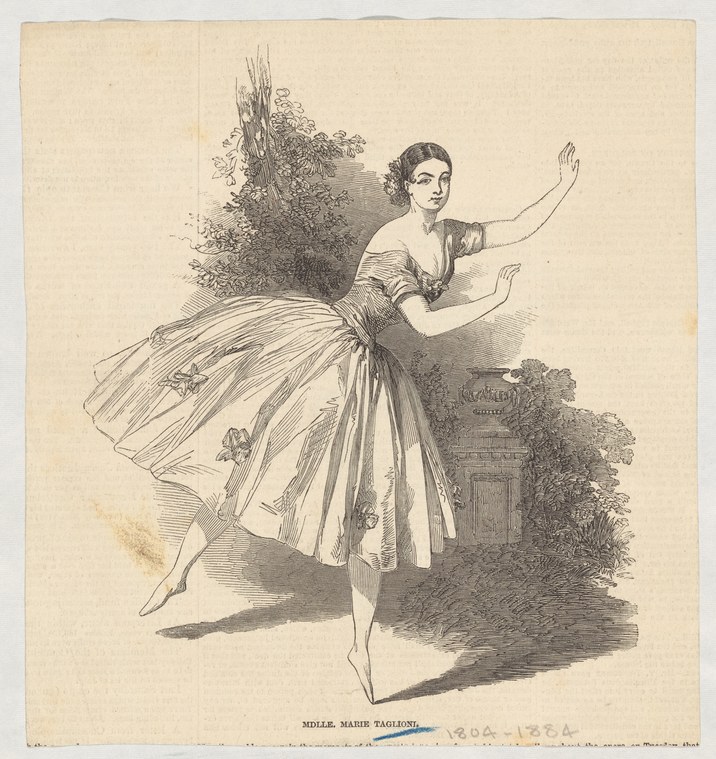
Mdlle. Marie Taglioni
Unknown artist
- Collection:
- Prints depicting dance
- Source:
- New York Public Library
- Rights:
- Public domain — free to use, share and adapt.
- Recorded as:
- Public Domain
Taglioni was the defining figure of Romantic ballet and the first ballerina to achieve international celebrity; understanding how she was represented visually is central to understanding how the ballet public conceived of the art form in its golden age. This print exemplifies the way reproductive engraving democratized access to images of celebrated dancers and helped shape public expectation and desire around the ballet body.
What you are looking at
A young woman in a voluminous striped skirt is caught mid-movement in a garden or park setting. She wears a dark off-shoulder bodice with short sleeves and gazes toward the viewer with a composed expression while her arms frame her body in an attitude of balanced repose. Her weight appears to rest on one leg, the other slightly extended, and her skirt billows around her in deep, regular pleats that follow the movement. Behind her, architectural elements—a gate or fence overgrown with ivy—and naturalistic foliage anchor the composition in a Romantic landscape. The engraving technique renders the figure with fine cross-hatching that suggests both the texture of fabric and the modeling of the body beneath it. The overall effect is one of arrested motion: a moment of apparent stillness that nonetheless conveys the dancer's command of her form.
The dancing
The single figure stands in an upright, elongated frame characteristic of academic ballet training. Her arms are held in a port de bras that suggests neither tension nor collapse—a poised, receptive quality. One foot appears to bear the weight while the other is placed lightly, suggesting the preparation for or recovery from a movement phrase. The extension is modest, controlled, and the overall posture emphasizes verticality and grace rather than dramatic line. The composition isolates her against the background, making the body's alignment and carriage the primary subject.
The dance depicted
This is almost certainly Romantic ballet, most likely from the 1830s–1840s, the era in which the named subject—Marie Taglioni—dominated European stages. Taglioni was the supreme ballerina of her time and the first to achieve fame performing on the tips of her toes; she was known for ethereal, controlled technique and for roles in ballets such as *La Sylphide* (1832) that defined the Romantic aesthetic. The modest extension, upright posture, and graceful arm placement are consistent with the Romantic vocabulary. The engraving appears to be a portrait of the dancer in character or idealized form, rather than a scene from a specific ballet, though the garden setting suggests the sylph-in-nature imagery characteristic of Romantic ballet's preoccupations.
How it was made
This is a wood or steel engraving, a reproductive printmaking technique that allowed fine detail and wide distribution. The parallel lines and cross-hatching are typical of the engraving process, which was the dominant medium for mass-produced portraiture and theatrical imagery in the 19th century. The precision of the technique permitted the detailed rendering of costume and facial features, making it ideal for circulating images of celebrated performers to audiences who might see them in person only occasionally or not at all. The print's survival in a collection labeled as depicting dance suggests it was distributed and valued as a theatrical document.
About this work
This engraving is a portrait of or in the manner of Marie Taglioni, the most celebrated Romantic ballet dancer of the 19th century. It captures the aesthetic and physicality that defined her era: elongated line, controlled extension, and a composed grace that appears effortless. The work is a documentary artifact of how Taglioni was visualized and circulated in her own time, and a record of what the Romantic ballet ideal looked like to the public. The print belongs to a vast visual archive of 19th-century theatrical portraiture—cheap to produce, widely distributed, and essential to the celebrity of the stage.
How to look at it
Observe how Taglioni's body is composed: note the vertical alignment of the head, spine, and supporting leg, and the way her arms frame rather than lead the body. The moment chosen is one of apparent repose, yet it conveys readiness and control. The engraving technique—the precise parallel lines and cross-hatching—creates the illusion of three-dimensionality and fabric texture, allowing the viewer to read both the body's structure and the costume's weight and movement. The background is deliberately sketched and atmospheric, keeping focus on the figure. This is a portrait of a dancer, not a scene of dancing, yet it conveys the discipline and physical intelligence that made Taglioni's art transcendent.
The artist
The artist is not recorded. The print bears the inscription 'Mdlle. Marie Taglioni' and appears to be a commercial theatrical portrait, likely produced by a Paris or London printmaker in the 1830s or 1840s. Many such prints were created without named engravers, as they were commercial products meant to circulate quickly and cheaply. The quality of the engraving and the care devoted to rendering Taglioni's likeness suggests a professional workshop accustomed to theatrical and portrait commissions.
The period
This engraving dates to the height of the Romantic movement in ballet and in art. The 1830s–1840s were the era of *La Sylphide*, *Giselle*, and *La Peri*—ballets that valorized the ethereal, the supernatural, and the melancholic. Visually, the Romantic movement in painting was at its peak; artists across Europe were exploring landscape, emotion, and the individual. In the theatre, the ballerina became the primary vehicle for Romantic aesthetics: weightless, otherworldly, and often tragic. Marie Taglioni embodied this ideal more perfectly than any of her contemporaries. The garden setting of this portrait echoes the natural settings and Romantic imagery of contemporary painting.
Where it lives
The print is held in the New York Public Library's collection of prints depicting dance. It belongs to a vast archive of 19th-century theatrical portraiture produced for public circulation and consumption. Such prints were sold to audiences, collected, and pasted into scrapbooks; their distribution networks and survival rates tell us much about the celebrity and reach of individual performers.
Dance in this work
Questions about this work
Who was Marie Taglioni?
Marie Taglioni (1804–1884) was a Swedish-Italian ballerina who became the supreme dancer of the Romantic era and the first ballerina to achieve international celebrity. She was famous for her ethereal technique, her control and elongation, and for creating roles in foundational Romantic ballets including *La Sylphide*. She was the model against which all other ballerinas of her time were measured.
What is Romantic ballet?
Romantic ballet emerged in the 1830s as a reaction against the geometric, virtuosic aesthetics of classical ballet. It valued ethereality, melancholy, the supernatural, and the individual emotion of the ballerina. Sylphs, ghosts, and tragic heroines replaced the nymphs and allegorical figures of earlier ballet. The ballerina danced on the tips of her toes (en pointe) and was often costumed in a white tulle skirt (the tutu), which became the visual signature of Romantic ballet.
Why are there so many engravings of 19th-century dancers?
Engraving was the fastest, cheapest way to reproduce images in the 19th century, before photography became widespread. Prints of celebrated performers could be produced in large numbers and sold to theatregoers and collectors. They were far more accessible than paintings and helped create celebrity culture around individual dancers. This print is one of thousands of such artifacts.
What does her posture tell us about how she danced?
Taglioni's upright carriage, controlled extension, and economical use of the arms exemplify Romantic ballet technique. There is no drama in her gesture—instead, the effect comes from the elongation of the body, the precision of the line, and the impression of effortless grace. This aesthetic required extreme discipline and control, even though it looked weightless.
More dance artwork





