49 works in this view — arrow keys or swipe to move between them.
Dance in Art
Fanny Elssler
Unknown artist
- Collection:
- Prints depicting dance
- Source:
- New York Public Library
- Rights:
- Public domain — free to use, share and adapt.
- Recorded as:
- Public Domain
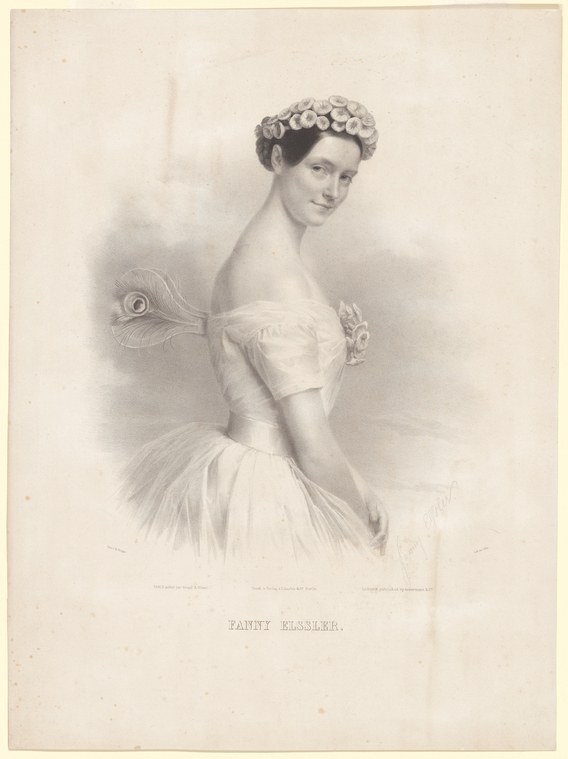
Fanny Elssler was one of the most celebrated dancers of her generation, a major figure in Romantic ballet who performed across Europe and America and commanded the kind of public adoration and merchandise that was unusual for dancers of any era. This image is evidence of how that celebrity was constructed and circulated: as a portable, purchasable image of glamour and elegance, available to the public in print form. Understanding how dancers were visualized and marketed in the nineteenth century is crucial to understanding how dance history itself has been preserved and transmitted.
What you are looking at
A three-quarter-length portrait of a young woman in an off-the-shoulder white ball gown, shown in profile turning toward the viewer. She wears her dark hair pinned up with what appears to be a floral or jeweled ornament. Her right arm is raised and extended, holding a large peacock feather that curves gracefully behind her body; her left arm rests at her side. The gown has short, puffed sleeves and a fitted bodice; the skirt falls in soft, full folds of white fabric. The background is plain and luminous, rendered in soft gray wash that creates no sense of setting or stage—the figure floats in an undefined space. The entire composition has the quality of a theatrical portrait: the woman is posed, alert, and presented for admiration. The peacock feather is the only element of visual narrative; it dominates the composition and suggests costume, spectacle, or theatrical display.
The dancing
The dancer's posture is upright and composed, with the weight settled on both feet in a natural standing position rather than in motion. The raised arm holding the feather traces an arc that follows the line of the body, creating an elegant S-curve from shoulder to the tip of the plume. Her head is turned to gaze toward the viewer over her shoulder—a pose of modest coquetry rather than dramatic exertion. There is no indication of a partner or ensemble; this is a solo portrait, and the body language suggests presentation or display rather than active dancing.
The dance depicted
This is a portrait of the famous Romantic-era ballerina Fanny Elssler, a leading dancer of the 1830s and 1840s known for both classical ballet and for her performance of character dances, particularly the Cachucha and other Spanish-inspired pieces. The peacock feather is a costume property associated with her theatrical roles rather than classical ballet technique. While the image presents her in theatrical dress and a posed, graceful attitude, it does not depict her mid-performance or executing any recognizable ballet movement; it is a glamour portrait in the manner of theatrical publicity imagery of the era.
How it was made
This is a lithographic print, recognizable from the soft tonal gradations, the fine stippled quality of the shading, and the characteristic pale sepia or gray tone. Lithography allowed for wide circulation of theatrical portraits at relatively modest cost, making this the kind of image that would have been sold as a souvenir or publicity image in theaters and print shops. The artist is not recorded, but the execution is professional and the style consistent with 1830s–1840s theater publicity prints. The medium's capacity for nuance in portraiture made it ideal for capturing the likeness and glamour of celebrated performers.
About this work
This is a lithographic portrait of Fanny Elssler, one of the most celebrated ballerinas of the Romantic era, depicted in theatrical costume holding a peacock feather. The image captures her as a performer and public figure rather than as an active dancer; it is a work of theatrical publicity and portraiture. Elssler was known for bridging classical ballet and character dance, and for her star status as a performer who commanded international audiences. The portrait belongs in a gallery of dance imagery because it documents both a landmark figure in ballet history and the visual culture of theater celebrity in the nineteenth century—the way dancers were marketed, remembered, and circulated as images.
How to look at it
This is a posed portrait, not a snapshot of movement, so attend to what the pose itself conveys: the graceful arm line, the modest but confident turn of the head, the way the fabric drapes. The peacock feather is not incidental—it is a symbol of her status as a celebrated performer in exotic and character roles. Notice how the artist has used the feather to create visual rhythm and to frame the body; it is a compositional tool as much as a costume element. The soft, featureless background is deliberate; it directs all attention to the figure and costume, making this a pure portrait of a performer at the height of her fame.
The period
Fanny Elssler's career spanned the peak of Romantic ballet, when the ethereal, melancholic, otherworldly ballerina became a central figure in European culture. She was celebrated not only for classical technique but also for her interpretations of national character dances—most famously the Spanish Cachucha—which allowed her to display a different kind of virtuosity and sensuality. In the 1830s and 1840s, when this print was likely made, theatrical portraiture in lithographic form was a major industry; famous performers' likenesses were packaged and sold as collectibles, in ways that anticipated modern fan culture. The peacock feather in this image likely references one of her costume roles rather than a specific ballet, and its inclusion signals the range of her performance repertoire.
Where it lives
This print is held in the Prints collection at the New York Public Library, part of their extensive holdings of nineteenth-century theatrical portraiture and dance imagery. It is a lithographic print, likely a commercial publication produced for distribution and sale to theater audiences.
Dance in this work
Questions about this work
Who was Fanny Elssler?
Fanny Elssler (1810–1884) was an Austrian ballerina and one of the most celebrated dancers of the Romantic era. She was known for both classical ballet technique and for character dances, particularly the Spanish Cachucha, which became one of her signature roles. She performed across Europe and America and was a major international star in the 1830s and 1840s.
What does the peacock feather represent?
The peacock feather is a costume property associated with Elssler's theatrical roles, likely from one of her character dance performances or an exotic role rather than from classical ballet. It signals her range as a performer and her status as a star of spectacle and glamour as well as technical ballet.
Is this an action shot of her dancing?
No. This is a posed portrait for publicity and sale, not a documentation of her in performance. It shows her in character and costume, presenting herself as a theatrical star, but not executing any specific dance movement.
Why are there so many prints of ballet dancers from this era?
Lithography made theatrical portraiture affordable and portable, and dancers and theater managers recognized the commercial and publicity value of circulating images of famous performers. These prints were sold as souvenirs to audiences and functioned as the main way the public could own an image of their favorite stars.
More dance artwork





