49 works in this view — arrow keys or swipe to move between them.
Dance in Art
Valse favorite de La péri
Unknown artist
- Collection:
- Prints depicting dance
- Source:
- New York Public Library
- Rights:
- Public domain — free to use, share and adapt.
- Recorded as:
- Public Domain
This lithograph is primary-source visual documentation of Romantic-era ballet at its height—the period when the genre defined itself through supernatural heroines, ethereal pointe work, and an aesthetic of weightlessness and transcendence. For dance historians and students, the image directly shows how bodies were positioned, dressed, and presented on the Romantic stage, making it more reliable evidence than written description alone. For general readers, it captures a pivotal moment when ballet became a major cultural form in the nineteenth-century city.
What you are looking at
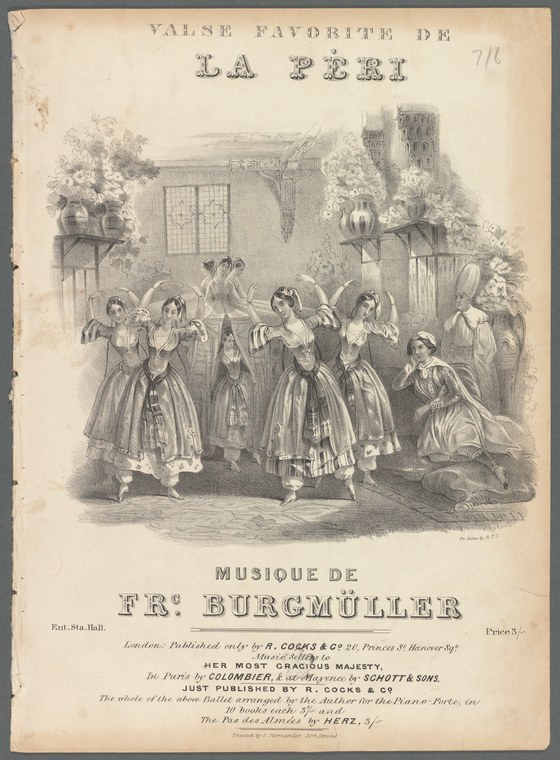
A lithographed sheet-music cover depicts a group of eight female dancers arranged in a line across a theatrical courtyard. The women wear pale romantic-era tutus—knee-length skirts with fitted bodices—and each holds a pair of wings, suggesting supernatural or sylphide characters. The setting is a Mediterranean or Italianate villa with arched doorways, stone walls, and flowering vines climbing the architecture; the space is rendered in a soft, atmospheric style typical of early nineteenth-century theatrical imagery. The women are posed in a choreographed frieze, their bodies angled to show profile and three-quarter views, creating a sense of synchronized movement even in a static composition. The overall tone is one of lightness and ethereality—the ink is delicate, the women appear weightless, and the garden setting enhances the romantic, otherworldly mood.
The dancing
The dancers stand with an upright, elongated posture characteristic of early Romantic ballet. Most are captured in profile or slight three-quarter turn, with their wings held high and away from the body, emphasizing the lifted line from shoulder to fingertip. Arms are mostly extended or held aloft in attitudes suggesting flight or buoyancy. The women's weight appears to be held delicately, consistent with the ethereal aesthetic of early nineteenth-century technique. There is no evidence of contact between dancers—each woman occupies her own space in the line, suggesting a corps de ballet moving in parallel rather than in contact or formation with partners.
The dance depicted
The work almost certainly illustrates or commemorates *La Péri*, the Romantic ballet created in 1843 with music by Burgmüller and choreography by Jean Coralli (with significant contributions from Jules Perrot). The peri of Islamic tradition—a beautiful, supernatural female being—became the subject of several Romantic ballets; this version was a signature role for Marie Taglioni and other leading ballerinas of the era. The winged costumes and ethereal poses visible here are consistent with the visual language of Romantic ballet and the peri figure specifically. The lithograph was evidently circulated as sheet-music cover art, making it a commercial product aimed at audiences who attended the ballet and wished to own a memento or the music itself.
How it was made
This is a lithograph, a printing technology in which an image is drawn on stone and chemically treated to receive ink on the drawn areas and repel it elsewhere. Lithography allowed rapid, relatively inexpensive production of multi-copy images with subtle tonal gradations—visible here in the soft shadows and atmospheric rendering. The technique was ideal for theatrical promotion and sheet-music covers in the nineteenth century, reaching a broad urban audience who could purchase a souvenir of a celebrated performance. The lithograph's soft, sketchy character is consistent with the period of production—likely 1843 or shortly after.
About this work
This is a lithographed cover for a musical publication associated with the 1843 Romantic ballet *La Péri*, one of the seminal works of early nineteenth-century theatrical dance. The image captures the visual grammar of Romantic ballet—ethereal female figures, supernatural costuming (wings and pale tutus), an idealized garden or fairy-tale setting, and a compositional emphasis on grace and weightlessness. The work is a commercial artifact: a sheet-music cover intended to promote and memorialize the ballet for the paying audience who attended performances in Paris or London and wished to bring the aesthetic experience home. As such, it documents how the Romantic ballet was marketed, visualized, and circulated in the 1840s, and what audiences understood the form to look like.
The image is historically valuable because it preserves a moment in the development of ballet costume and narrative structure. The peri—a creature from Persian mythology reimagined as a romantic heroine—allowed choreographers and audiences to explore themes of desire, the supernatural, and the boundaries between earthly and ethereal realms. The wings, the pale drapery, and the garden setting all signal this symbolic content. The composition itself, with its frieze of female figures in synchronized pose, tells us something about how corps de ballet was arranged and how that arrangement communicated beauty and unity.
How to look at it
Attend first to the posture of the dancers' bodies—notice how they are elongated, held upright, weight seemingly concentrated in a narrow base (suggesting early nineteenth-century pointe technique). Look at the treatment of the wings: they are not painted realistically but suggested schematically, kept light and airy to enhance the impression of flight rather than burden the figure. Notice also how the artist has staggered the women's poses slightly—some face right, some face forward, some turn back—so that despite the static nature of the image, a sense of sequential or synchronized movement emerges. Finally, observe the setting: the garden with its climbing vines and distant architecture creates a romantic reverie rather than a realistic stage, placing the action in a realm between dream and theatrical illusion.
The artist
The lithograph is credited to "FRS. Burgmüller" in the imprint, a likely reference to Frédéric Burgmüller (1806–74), the composer of the score. However, the artist who drew the image for the stone is not identified here. The London publisher Cramer & Co. and the Paris publisher Schott & Sons both appear on the cover, suggesting a work with multinational reach. The engraver's mark at the bottom right is illegible in this image. Theatrical lithographs of the period were often produced by specialist firms working from designs by artists connected to the theater world—costume designers, set painters, or dance-focused illustrators—though attribution frequently remains uncertain.
The period
The 1840s were the apex of Romantic ballet in Paris and London. Marie Taglioni had recently dazzled audiences as the sylph in *La Sylphide* (1832), establishing the pointe-shoe-wearing, supernatural heroine as the defining figure of the era. Composers like Adolphe Adam and Frédéric Burgmüller wrote music specifically for ballet, elevating the form's musical prestige. Lithography had just become commercially mature as a medium, allowing theaters and publishers to circulate images of celebrated dancers and scenes across Europe within months of a premiere. The market for ballet ephemera—prints, sheet-music covers, engravings of famous dancers—was booming, fed by urban audiences hungry for souvenirs of performances that were ephemeral by nature. This lithograph sits squarely in that commercial and aesthetic moment.
Where it lives
This lithograph is housed in the New York Public Library's collection of prints depicting dance. It was circulated as a commercial sheet-music cover and theatrical promotional item, likely in the 1840s, through London and Paris publishers. Such objects were common and widespread in the nineteenth century, but their survival in organized collections is invaluable for the study of dance history.
Dance in this work
Questions about this work
Who was La Péri and why did she matter in Romantic ballet?
The peri is a supernatural female being from Persian mythology—beautiful, ethereal, and often associated with love and the unattainable. Romantic choreographers adapted the figure to explore themes of desire and the otherworldly. The 1843 *La Péri* was choreographed by Jean Coralli and became one of the canonical roles of the Romantic repertoire, danced by Marie Taglioni and other ballerinas. The character allowed audiences to engage with fantasy and transcendence on the stage.
How do I tell this is a lithograph and not an engraving?
Lithographs have a distinctive soft, grainy quality in their tonal areas—notice the subtle shading in the stone wall and sky here. Engravings depend on lines cut into metal and tend to be more linear and graphic. Lithography also allows for easier, broader gestural marks, which you can see in the loosely rendered vines and the fluid outlines of the dancers' costumes. The technique was preferred for theatrical promotional work because it was faster and cheaper than engraving.
Why are the dancers shown with wings if ballet dancers don't actually wear wings?
The wings are a costume element that signals the supernatural or fairy-tale nature of the character. They are part of the romantic vocabulary—visual shorthand for 'this is not a human being but an ethereal creature.' The ballet stage used costume and scenery to create a world of fantasy, and wings helped audiences understand they were watching a peri (or sylph, or other supernatural character) rather than a human woman.
What was the purpose of publishing sheet-music covers like this?
Audiences who attended celebrated ballets wanted to own a memento and often purchased the published orchestral score or piano reduction. The lithographed cover served as both advertisement and souvenir—it kept the ballet's image and music in circulation, promoted future performances, and allowed people to bring the aesthetic experience of the theater into their homes. For music lovers and amateur pianists, the cover image made the purchase attractive.
More dance artwork





