49 works in this view — arrow keys or swipe to move between them.
Dance in Art
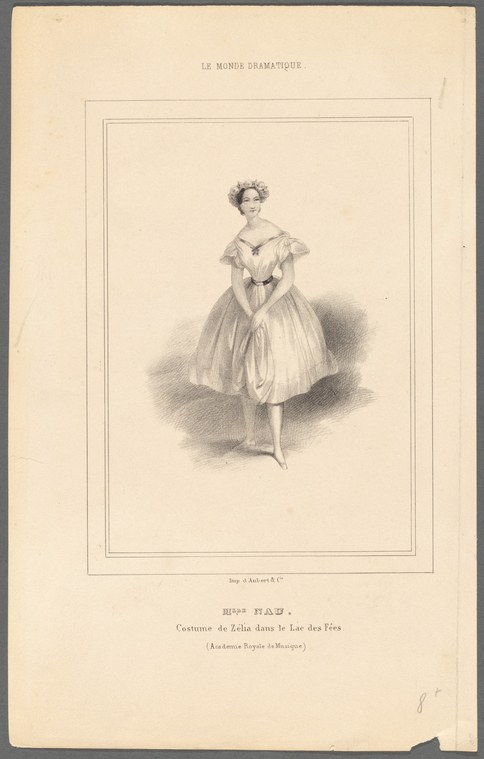
Mlle. [Maria] Nau, costume de Zélia [sic] dans le Lac des fées (Academie Royale de Musique)
Unknown artist
- Collection:
- Prints depicting dance
- Source:
- New York Public Library
- Rights:
- Public domain — free to use, share and adapt.
- Recorded as:
- Public Domain
For historians and dancers, this print documents the appearance and alignment of Romantic ballet as it was actually performed, not as later ballet history has imagined it. The image preserves specific information about costume construction, body carriage, and the visual identity of a named performer and role, making it a rare window into performance practice and celebrity before photography.
What you are looking at
A young woman in a white Romantic-era ball gown stands alone against a plain background, posed in a graceful contrapposto stance characteristic of early 19th-century dance imagery. She wears a high-waisted dress with off-shoulder sleeves and a full skirt that falls to mid-calf, her hair crowned with a small tiara or ornament. The figure is rendered in fine lithographic line with subtle shading that gives dimension to the fabric and creates a soft, ethereal quality. The composition is formally centered within a double-ruled border, following the conventions of theatrical costume plates and dance prints of the period. Her posture suggests the refined, vertical alignment and gentle turnout of academic ballet technique, with her weight balanced and her arms positioned with the elongated grace expected of professional dancers of her era.
The dancing
The dancer stands in a relaxed but controlled pose, weight on one leg with a subtle articulation of the supporting hip. Her arms hang naturally, hands visible and shaped with the delicate precision typical of Romantic ballet. The elongation of the neck and the lifted carriage of the upper body create the impression of minimal effort and maximum elegance. Her gaze is directed downward and away, a convention of Romantic portraiture that emphasizes an air of refinement and introspection rather than direct engagement with the viewer.
The dance depicted
This is a costume study for a named role in a French operatic ballet production—specifically Zélia from *Le Lac des Fées* (*The Lake of the Fairies*), performed at the Académie Royale de Musique (the Paris Opéra) in the early 1830s. The dress places this squarely within the Romantic ballet tradition at its height: the white gown, pointe-ready silhouette, and ethereal styling are hallmarks of the Romantic fairy-ballet aesthetic. The figure's classical posture and the formal presentation suggest a principal dancer, likely in a lyrical rather than dramatic role. The print serves both as a record of production design and as a promotional image of the performer in her celebrated part.
How it was made
This is a lithograph, a technique that allowed fine detail and rapid reproduction for distribution to audiences and print collectors. The line work is precise and economical, with shading achieved through subtle layering rather than dense hatching. The double-ruled border and the printed credit line at bottom indicate this is a commercial theatrical print, likely issued shortly after the ballet's premiere or during its run. Lithography was the dominant medium for dance costume documentation in the Romantic era, making such prints both historical records and objects of performance promotion and fan culture.
About this work
This is a lithographic costume study from the Romantic ballet era, documenting the dress and figure of a named performer in a specific production. It belongs to a rich tradition of theatrical prints that circulated among Paris's opera-going public and dancers themselves, serving simultaneously as souvenir, costume reference, and evidence of a performer's celebrated roles. The work demonstrates how Romantic ballet dancers and designers were promoted and remembered, and how the idealized female body of the period—elongated, ethereal, weightless—was constructed and disseminated through print culture.
The plate is a primary source for the history of French Romantic ballet at the Opéra, where such productions drew large audiences and created celebrity performers. The precision of the costume rendering—the specific cut of the sleeves, the exact drape of the skirt, the placement of ornaments—makes it valuable evidence for the actual material and visual culture of the stage.
How to look at it
Attend to the posture and the treatment of the arms and hands—these reveal the dancer's training and the refinement expected of a principal performer. Notice the balance of line and shading, which creates an impression of grace without obvious exertion. The costume itself is as much the subject as the figure: observe the exact cut of the bodice, the placement of the neckline, and the way the skirt is shown to move and fall. The neutral background and formal frame remove the dancer from any narrative moment and present her instead as an ideal—a study in beauty, elegance, and technique rather than a moment of action.
The artist
The artist is not recorded, which is typical for commercial lithographic costume prints of the period. Such prints were often the work of house studios or journeyman lithographers working for Paris publishing firms that specialized in theatrical subjects. The technique and style—the refined line work, the careful attention to costume detail, the formal compositional frame—are consistent with the output of the major Paris lithographic workshops of the 1830s.
The period
This print dates to the height of Romantic ballet in France, roughly 1830–1845, when the Paris Opéra dominated European dance and created a cult of celebrity around its performers. Ballets with supernatural and fairy themes—often drawn from literature, folklore, or orientalist fantasy—were enormously popular. The ethereal, weightless aesthetic embodied in this figure represents the period's idealization of femininity and its turn away from the athletic, technically brilliant dancing of the late 18th century. Lithographic costume plates were an essential part of theatrical marketing and fan culture, circulating widely and shaping public imagination of performers and roles.
Where it lives
The print is held by the New York Public Library in its collection of prints depicting dance, a collection assembled to document performance history across periods and genres. Objects like this one are rarely dated or attributed individually, as they were commercial products distributed in quantity; their value lies in their witness to actual performance and their circulation among contemporary audiences.
Dance in this work
Questions about this work
Was this costume actually worn on stage?
Almost certainly yes. Costume prints like this one were made from the actual garments or from careful observation of them during rehearsal or performance. They served as records for the theater's archives and as promotional images for audiences. The specificity of the details—the exact cut of the sleeves, the placement of trim—suggests direct knowledge of the actual costume.
Who was Mlle. Nau?
Maria Nau was a French dancer active in the 1830s at the Paris Opéra. She performed in several of the major Romantic ballets of the period, but little personal information survives. This print is one of the primary documents we have of her performance and her roles.
What is 'Le Lac des Fées'?
This is a French Romantic ballet based on fairy-tale themes. The title translates as 'The Lake of the Fairies.' Zélia was a character role in this production. The ballet was part of the standard repertory of supernatural and fantastical ballets that were extremely popular at the Paris Opéra during the Romantic era.
How can I tell this is Romantic ballet and not an earlier period?
The evidence is in the costume and the body carriage. The white dress, the off-shoulder neckline, the soft, ethereal silhouette, and the gentle contrapposto stance are all hallmarks of Romantic ballet aesthetics. The precision of the pointe-ready line and the refined posture place this in the professional ballet world of the 1830s–1840s.
More dance artwork





