49 works in this view — arrow keys or swipe to move between them.
Dance in Art
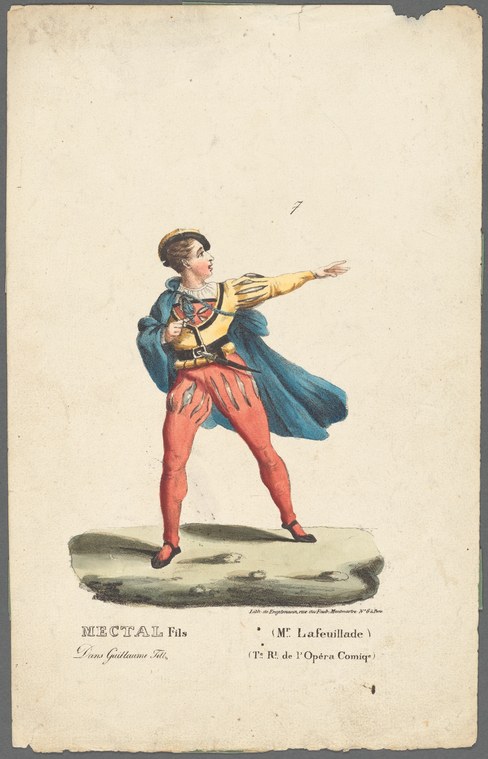
Mectal fils dans Guillaume Tell (Mr. Lafeuillade), (Te. Rl. de l'Opéra Comique)
Unknown artist
- Collection:
- Prints depicting dance
- Source:
- New York Public Library
- Rights:
- Public domain — free to use, share and adapt.
- Recorded as:
- Public Domain
This is a named record of a professional male dancer in a canonical work of early Romantic opera-ballet, capturing the arm vocabulary, turnout, and heroic posture valued in early 19th-century theatrical dance—a period from which few clear images of actual male dance vocabulary survive. The print format indicates the performer had sufficient fame to be commercially reproducible, making it evidence of the dance celebrity economy of the period.
What you are looking at
A young male dancer in early 19th-century theatrical costume executes a dramatic leap or arabesque on a narrow platform stage. He wears a blue military-style jacket with gold braiding, red tights, and a blue cape that sweeps from his shoulders. His right arm extends sharply forward in a pointing gesture while his body arcs backward in a pose of theatrical display. The figure is rendered in hand-colored engraving against a plain cream background with minimal setting. The pose captures a moment of virtuosic male dancing: weight lifted, one leg extended, the torso open to the audience. The artist has paid careful attention to the fall of the cape and the precision of the arm extension, suggesting a trained eye for dance vocabulary.
The dancing
A single male dancer occupies the composition. His weight appears to be on one leg while the other extends behind or to the side; the exact rear leg position is obscured by the cape. His extended right arm points sharply forward at roughly shoulder height, a gesture common to pantomime and romantic-era male vocabulary. His body opens fully to the audience with the chest high and the head turned in profile. The pose suggests elevation and control rather than a moment of active motion—it is a held position for display.
The dance depicted
This depicts a moment from *Guillaume Tell* (William Tell), an opéra comique that premiered in 1829 and became a standard European theatrical vehicle. The catalogue identifies the dancer as Mectal fils (Mectal Junior), performing in a role or a solo inserted into the opera at the Opéra Comique in Paris. The pose is characteristic of male classical dance in the early Romantic period: a demonstration of lift, turnout, and precise arm placement. The cape and military costume indicate this is a heroic or noble character role rather than a purely abstract dance moment.
How it was made
A hand-colored engraving on laid paper, characteristic of early 19th-century theatrical portraiture in Paris. The engraving technique allowed for clean line work defining the dancer's silhouette and precise rendering of costume detail—the braiding on the jacket, the sweep of the cape, the clarity of the extended arm. Hand coloring applied afterward in watercolor or gouache. This was the standard format for distributing images of celebrated dancers to a print-buying public, giving performers a currency of fame and allowing theater-goers to collect images of their favorite artists.
About this work
This is a record of a named male dancer performing in a famous opera-ballet of the early Romantic period. Mectal fils was a professional dancer at the Opéra Comique, and this print documents a specific performance or role—a valuable snapshot of how male classical dance vocabulary was executed and valorized in the 1820s–1830s. The print format indicates the dancer had sufficient celebrity to warrant commercial reproduction, reflecting the star system that was transforming theatrical dance in this era.
The image is important to the history of ballet because it preserves a moment of male dancing in a work that blended opera, pantomime, and dance in ways that shaped Romantic theatre. Few records survive of male dancers of this generation in performance; this print is one of them.
How to look at it
Attend to the precision and clarity of the arm extension: the angle, the turn of the wrist, the carriage of the shoulder. Notice how the dancer's torso is opened fully to the audience while the rear leg is concealed by the cape—a deliberate compositional choice that shows the artist understood the importance of the front line in classical dance display. The pose itself—not a transient moment but a held shape—is typical of theatrical dance portraiture of the period, which froze a dancer's most flattering and skillful instant rather than capturing action in motion.
The artist
Unknown. The print carries a publication line that would normally identify the engraver, but the image quality and catalogue record do not provide it. The hand-coloring and engraving style are typical of Parisian theatrical print production in the 1820s–1830s, when publishing houses produced dozens of such portraits of celebrated opera and ballet performers for sale to the theater-going public.
The period
The 1820s–1830s were the period of the emergence of Romantic ballet and the consolidation of male classical technique as codified in the work of Carlo Blasis and others. *Guillaume Tell*, which premiered at the Opéra Comique in 1829, is remembered primarily as Rossini's opera, but it was also a vehicle for spectacular choreography and male dancing in supporting roles. Mectal fils was a working dancer of the generation immediately before the dominance of the ballerina. Male dancers of this era were expected to master elevation, turnout, and mime work, often in heroic or military roles that showcased these skills.
Where it lives
This print is held in the New York Public Library's collection of prints depicting dance, identified as part of the library's visual materials on theatrical and social dance history. It is an artifact of the commercial theatrical print trade that flourished in Paris in the early 19th century.
Dance in this work
Questions about this work
Who was Mectal fils?
Mectal fils (the younger) was a professional dancer performing in Paris in the early 19th century, active at the Opéra Comique. The suffix *fils* indicates he was likely the son of another performer named Mectal. Beyond what is documented in theatrical prints and programs of the period, little is widely known of his career.
What is an opéra comique?
An opéra comique was a French theatrical form combining sung dialogue, spoken dialogue, dance, and pantomime. Despite the name, opéras comiques were not necessarily comic; *Guillaume Tell* was a serious heroic work. The form allowed for elaborate spectacle and featured both instrumental dancers and actors who danced.
Why is this dancer's pose held rather than in motion?
Theatrical portraiture of the period typically captured a dancer frozen in the most skillful or flattering moment of a performance—a position that displayed technique, costume, and the performer's beauty. The held arabesque or allegro position became the standard format for dance prints, advertising both the dancer and the spectacle of the theater.
Is this a ballet or a stage dance from an opera?
This is a stage dance within an opera—a solo inserted into or choreographed as part of *Guillaume Tell*. At this period, such theatrical dancing occupied a middle ground between pure ballet and operatic mime, drawing on both vocabularies.
More dance artwork





