49 works in this view — arrow keys or swipe to move between them.
Dance in Art
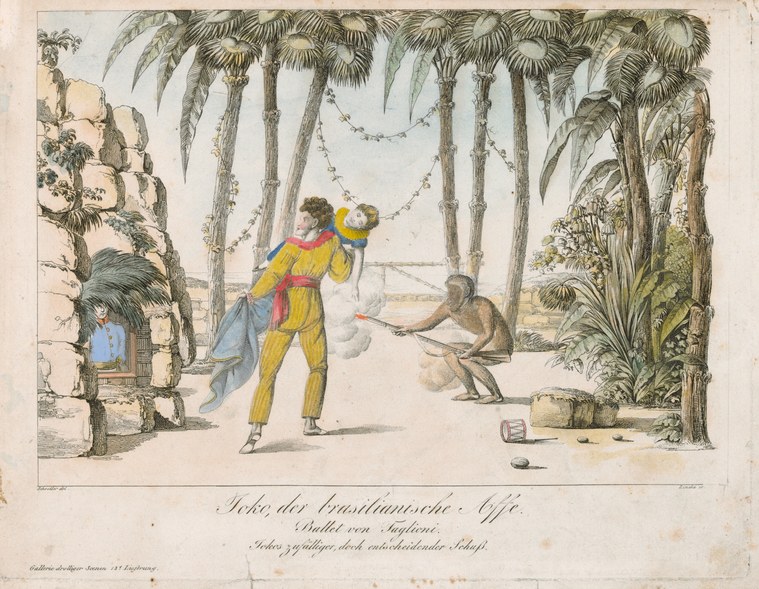
Joko, der brasilianische Affe, Ballet von Taglioni
Unknown artist
- Collection:
- Prints depicting dance
- Source:
- New York Public Library
- Rights:
- Public domain — free to use, share and adapt.
- Recorded as:
- Public Domain
This is a rare visual record of a specific historical ballet performance, showing not the formal academic poses of high Romantic ballet but the comic, physical, exoticist theater that drew paying audiences. It documents the theatrical and cultural values of the era—the embrace of 'exotic' characters, the prominence of physical comedy, and the role of animals and spectacle in ballet production.
What you are looking at
A palm-lined tropical garden or conservatory serves as the stage for this lively theatrical scene. A man in a yellow costume with red trim stands at the center-right, holding a child aloft with both arms while maintaining an animated posture. To the left, a second figure in blue clothing gestures toward them from near an ornate stone archway. A third figure—rendered in darker tones and smaller scale—crouches or sits at the right, apparently observing or reacting to the central action. Tall palm fronds frame the composition on all sides, creating a theatrical proscenium effect. The color palette is restrained: ochres, pale blues, greens, and browns dominate. The style is that of a hand-colored engraving, with fine linear detail defining form and drapery. The composition suggests a moment of theatrical climax: the vertical lift and the gestural energy of the standing figures convey surprise, delight, or dramatic revelation.
The dancing
The principal male figure displays an exaggerated, athletic posture: legs set in a wide stance for stability, both arms raised overhead to lift the child. His torso is upright and engaged. The figure in blue on the left stands in profile with one arm extended in a rhetorical or astonished gesture. The crouching figure at right has a compact, observant posture. The arrangement is asymmetrical and dynamic rather than a formal dance hold. Spatial relationships and gestural clarity suggest the artist understood theatricality and physical comedy rather than technical dance vocabulary.
The dance depicted
The title identifies this as 'Joko, der brasilianische Affe, Ballet von Taglioni'—Joko the Brazilian Monkey, a ballet by Taglioni. This work belongs to the tradition of Romantic-era theatrical ballet that incorporated exotic animals, comic characters, and spectacular effects. The image depicts a theatrical scene rather than formal ballet vocabulary: the lifting and gestural play suggest pantomime and character acting within a ballet frame. The 'Brazilian monkey' character and tropical setting indicate the 19th-century taste for exoticist spectacle. No pointe work or classical ballet positions are evident; the movement vocabulary is that of theatrical comedy and physical mime.
How it was made
This is a hand-colored engraving, evident from the fine parallel line work defining contours, drapery, and architectural detail, and from the careful application of color washes in the palm fronds and costumes. The technique allowed wide distribution of the image as a theatrical souvenir or print for the popular press. The restrained color palette and fine detail are characteristic of early 19th-century theatrical prints. The hand-coloring indicates this was a valued object, likely sold to patrons of the ballet or to collectors of theatrical imagery.
About this work
This hand-colored engraving documents a scene from a Romantic-era ballet that exploited the period's appetite for exotic spectacle, animal characters, and comic performance. The work shows a moment of theatrical business—a lift and gestural exchange—rendered with the technical precision of engraving but without the formal vocabulary of classical ballet technique. It is a record of theatrical fashion and popular entertainment rather than an exploration of serious dance form. Such prints circulated widely, making them primary evidence for what 19th-century audiences actually saw on stage and what they valued in theatrical performance.
How to look at it
Attend first to the moment chosen: a peak of physical action, the child lifted high, arms extended, gesture emphatic. The artist has frozen the moment of greatest visual drama, not a static pose. The yellow costume of the central figure is rendered with careful attention to fabric weight and movement—it reads as theatrical dress, intentionally vivid and attention-drawing. Notice the spatial relationships: the composition places the yellow-clad figure slightly off-center and elevated, commanding the eye. The tropical setting, rendered in fine detail, functions as theatrical backdrop rather than natural environment—the tall palms are almost architectural, framing the action. The print style itself—fine line engraving with hand coloring—conveys both theatrical aspiration (engraving was the premium reproductive technology of the era) and accessibility (such prints were affordable souvenirs for theater-goers).
The period
This work dates to the Romantic era of ballet (early to mid-19th century), when choreographers and composers embraced narrative, emotion, and exotic or supernatural subjects. Marie Taglioni was the preeminent dancer and choreographer of the period, celebrated for her ethereal technique and her roles in works such as La Sylphide (1832). Taglioni created and performed in numerous ballets throughout the 1830s–1850s, many of them now lost except through such prints. The introduction of animal characters and exoticist settings was consistent with Romantic taste for novelty, spectacle, and escape from European urban life. Such ballets were entertainment productions designed to fill theaters and showcase stars, rather than works of lasting choreographic invention.
Where it lives
This work comes from the NYPL's prints collection depicting dance. No publication date, artist name, or medium are recorded in the catalogue, but the object type and visual evidence identify it as a hand-colored engraving from the early-to-mid 19th century, likely issued as a theatrical souvenir or print for popular sale.
Dance in this work
Questions about this work
Was this a real ballet that Taglioni danced in?
Very likely. Marie Taglioni was the most celebrated dancer of the Romantic era and created and performed in dozens of ballets. However, many ballets of that period are now lost to us except through images, playbills, and written descriptions. No score or choreographic record of this work has survived, so the print itself is among the primary documents of what was actually performed.
Why is there a monkey in a ballet?
Early 19th-century Romantic ballet embraced exotic characters, animals, and spectacular effects as part of a broader cultural fascination with 'otherness' and spectacle. Animal characters—danced by humans in costume—featured in various ballets of the era. They allowed for physical comedy, novelty, and entertainment value alongside more serious Romantic themes.
What does the yellow costume tell us about the period?
The bright, contrasting color and exaggerated cut suggest theatrical dress designed to be visible to audiences in a large hall lit by candlelight or gas lamps. The costume prioritizes legibility and visual impact over naturalism. The fitted bodice and breeches are typical of early 19th-century stage wear for male dancers and comedians.
Is this a valuable historical document?
Yes. Such prints are among the few visual records of what 19th-century ballet actually looked like in performance. Choreography was not notated, films did not exist, and most ballet scores are lost. Images like this one preserve evidence of costume, setting, physical action, and theatrical taste that would otherwise be invisible to us.
More dance artwork





