49 works in this view — arrow keys or swipe to move between them.
Dance in Art
Piramo e Tisbe
Unknown artist
- Collection:
- Prints depicting dance
- Source:
- New York Public Library
- Rights:
- Public domain — free to use, share and adapt.
- Recorded as:
- Public Domain
The work demonstrates that what we now call 'dance' in the Renaissance and Baroque courts was inseparable from theatre, mime, and narrative spectacle. A dancer studying the vocabulary of baroque theatrical movement will recognize in this figure the formal gestural language they inherited—the attitudes, the asymmetry, the use of the body to express emotion and tell a story. The engraving is also evidence of how performance was documented and preserved before photography: through prints that captured key moments and could be studied, circulated, and recreated.
What you are looking at
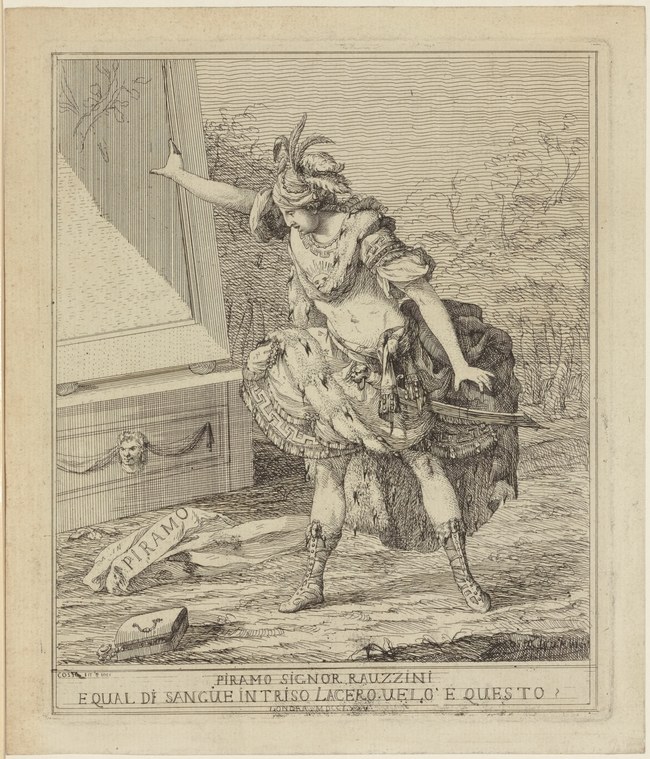
A dramatic moment from the Pyramus and Thisbe legend, rendered in fine engraving. A female figure in classical drapery and a feathered headdress stands in a dynamic, emotionally charged pose against a columned architectural interior on the left and open landscape on the right. Her body arches backward in an attitude of despair or ecstatic grief, one arm extended upward toward the building, the other reaching across her body. A male satyr figure—goat-legged and muscular—supports or steadies her from behind, his hands at her waist and shoulder. The ground is scattered with objects: a sword or dagger lies in the foreground, and what appear to be blood-stained cloths or garments. The scene captures the tragic climax of the lovers' story, likely the moment after one has discovered the other's death.
The dancing
Two figures occupy the composition: the woman carries the full dramatic weight, her torso twisted in a deep backward arch, her head thrown back, weight shifted onto one leg in an unstable, emotionally expressive position. The satyr provides physical and narrative support, his stance grounded and muscular, knees slightly bent, positioned to catch or steady her. Their interaction is intimate and protective rather than partnered in a balletic sense—this is dramatic mime and classical pantomime, not structured dance. The woman's extended arm and thrown-back head recall the vocabulary of Baroque theatrical gesture.
The dance depicted
This is not social or recreational dance but theatrical pantomime in the classical tradition—the visual language of 17th-century court spectacle and baroque opera-ballet. The pose and emotional intensity belong to the gestural vocabulary of tragic heroines in court ballet and early opera, where the body expressed narrative and emotion through exaggerated, held attitudes rather than continuous movement. The presence of the satyr and the mythological subject suggest this may depict a moment from a court entertainment or theatrical production staging the Pyramus and Thisbe tale, which was performed frequently in Renaissance and Baroque courts across Europe. The engraving records a suspended moment of maximum dramatic intensity—the kind of tableau that would have concluded a dance sequence or formed the climax of a court spectacle.
How it was made
This is a finely executed line engraving, identifiable by the parallel hatching lines used to create shadow and volume, the sharp clarity of contour, and the delicate gradation of tone. The engraving technique allowed for wide distribution of detailed narrative images and made this work accessible to educated viewers across Europe who could not attend court performances. The skill and refinement of the engraving suggest this was a valued record of a significant theatrical moment, printed from a copperplate and potentially circulated in portfolios of theatrical designs or famous scenes.
About this work
This engraving records a moment of classical theatrical pantomime depicting the tragic climax of Pyramus and Thisbe, a favorite subject of Renaissance and Baroque courts. The figure's pose—with its exaggerated backward arch, extended gestures, and emotional intensity—belongs to the formal vocabulary of court ballet and early opera rather than to social dance. The work preserves the visual language of a performance tradition in which trained dancers and actors expressed narrative and emotion through carefully composed attitudes and gestures, often with mythological or literary subjects. The engraving itself is a document of how such theatrical moments were designed, remembered, and circulated among the educated classes who patronized court entertainment.
How to look at it
Observe the woman's body position: she is not in a position of balance or repose but captured in a moment of maximum instability and emotional extremity. The backward arch, the thrown head, the extended arm reaching toward the building—these are not dance steps but attitudes, held poses designed to communicate despair, loss, and tragedy. Notice the satyr's role: he is not dancing with her but supporting her, his function narrative and emotional rather than choreographic. The artist has chosen to freeze the moment of crisis, the gesture of maximum expression, rather than recording a movement in transition. This is the aesthetic of court ballet, where poses held and displayed mattered more than the steps between them.
The period
The Pyramus and Thisbe legend was a popular subject in Renaissance and Baroque courtly entertainment, adapted into ballets, operas, and mixed spectacles throughout the 16th and 17th centuries. Court ballet in Italy, France, and the Habsburg lands made extensive use of mythological narratives and tragic subjects, staging them as vehicles for political allegory and displays of princely magnificence. The theatrical vocabulary visible here—the exaggerated poses, the emotional expression through bodily attitude, the involvement of supernatural or mythological figures—was standard in court spectacle. The engraving's style and execution place it in the 17th century or early 18th century, when such prints were produced to record and preserve famous theatrical moments.
Where it lives
The work is held in the New York Public Library's collection of prints depicting dance. It is catalogued under the title Piramo e Tisbe (Pyramus and Thisbe in Italian), indicating either an Italian source or an Italian title applied to the work. The inscription at the base reads 'PIRAMO SIGNOR RAUZZINI' and includes text in Italian, suggesting the print may have commemorated a specific performance or performer of note.
Dance in this work
Questions about this work
Is this actually a dance?
It is theatrical pantomime and court spectacle rather than what we would now call dance technique. However, it records the vocabulary of Baroque court ballet, where expressive pose and gesture were primary, and dancers trained extensively in the classical positions and attitudes visible here. For a historian of dance, this is essential source material on how trained performers used their bodies to communicate narrative and emotion.
Who is Signor Rauzzini?
The inscription suggests Rauzzini was a performer in the production this engraving records, though without more information on the print's date and origin we cannot identify him further. The inscription indicates this was a notable performance worth documenting and circulating to a wider audience.
Why is there a satyr in a tragic love story?
Satyrs and other mythological creatures were stock characters in court entertainment and added visual spectacle and comic or grotesque elements. The satyr here may represent fate, supernatural intervention, or simply the mythological context of the tale. In court ballet, such figures often served both narrative and decorative functions.
How do we know what dance this depicts?
We don't know definitively, but the style of the engraving, the Italian title, and the subject matter point to a court ballet production, likely Italian, from the 17th or early 18th century. The gestural vocabulary and theatrical framing are consistent with the documented practices of court spectacle in that era.
More dance artwork





