49 works in this view — arrow keys or swipe to move between them.
Dance in Art
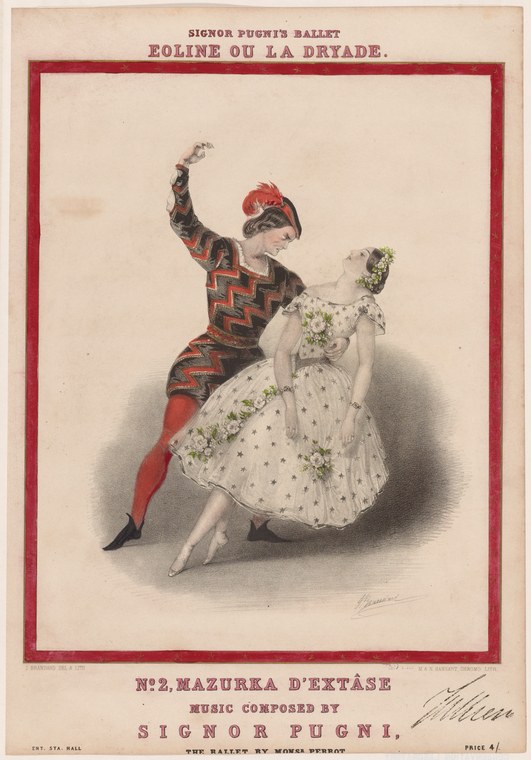
Signor Pugni's ballet Eoline ou La dryade. No. 2, Mazurka d'extâse.: Music composed by Signor Pugni, the ballet by Monsr. Perrot
Unknown artist
- Collection:
- Prints depicting dance
- Source:
- New York Public Library
- Rights:
- Public domain — free to use, share and adapt.
- Recorded as:
- Public Domain
This image is a primary source for how mid-nineteenth-century ballet was actually staged and how it was marketed to audiences; prints like this were the social media of the era, circulating the image of famous dancers and famous ballets far beyond the theatre. The inscription of the choreographer's name (Perrot) and composer's name (Pugni) on the print itself reflects the growing celebrity status of these figures and the audience's hunger to know the creators, not just the performers.
What you are looking at
A male dancer in brilliant red silk costume with a geometric black pattern stands in a dynamic lunge or arabesque position, one arm raised expressively overhead in a gesture of exultation or rapture. He wears a red cap with an ornament and black shoes. Beside him sits a female dancer in a white tulle skirt adorned with ivy or grape-vine wreaths across the bodice and in her hair, her pale arms and neck exposed in the classical ballet manner. She inclines toward him, her body forming a gentle curve that emphasizes the contrast between his vertical thrust and her yielding posture. The composition is intimate and theatrical: the two figures occupy the center of the frame against a pale background with soft shadow modeling beneath them, creating the illusion of a lit stage. The artist has rendered the fabrics with delicate attention—the shimmer of silk against the transparency of tulle, the texture of the wreaths. This is a moment of dramatic encounter, possibly a woodland scene suggested by the vegetation in her hair and costume.
The dancing
The male figure dominates through vertical extension: his raised arm creates an upward line through the body, his torso lifted, one leg extended behind in what appears to be an arabesque or similar lifted position. The female figure is seated or in a low position, her upper body twisted toward him, her arms positioned with one hand reaching or gesturing. The poses suggest a classical ballet vocabulary of the mid-nineteenth century—the lifted épaulement, the pointed foot, the balletic port de bras. The spatial relationship between them is one of dramatic asymmetry: his height and explosive energy contrasts with her more grounded, receptive position.
The dance depicted
This is a scene from a Romantic-era ballet, identified as the Mazurka d'extâse (Mazurka of Ecstasy) from *Éoline ou la Dryade*, choreographed by Jules Perrot with music by Cesare Pugni. The title and the male dancer's ecstatic gesture suggest a character—possibly male—experiencing rapture or exultation, while the female figure (the dryade or dryad nymph) responds. Though titled a mazurka, a Polish social dance, the image shows classical ballet technique in a narrative context rather than the strict ballroom hold or the folk character that a mazurka typically retained in theatrical use. The ivy wreaths in the female dancer's hair and costume align with the dryad theme—a forest nymph from classical mythology.
How it was made
This is a hand-colored lithographic print, identifiable from the characteristic soft tonal gradations, the fine linear work, and the signature of what appears to be the artist at lower right. Lithography allowed the rapid and economical production of theatrical imagery for sale to the public, particularly through London and Paris print publishers who marketed ballet scenes to a middle-class audience. The color has been applied by hand in watercolor or gouache after printing, a labor-intensive but standard practice for popular theatrical prints of the 1840s–1850s. The quality of the image and the care taken in rendering fabric textures suggest this was a relatively high-end commercial product aimed at ballet enthusiasts.
About this work
This is a promotional print from the Romantic ballet era, capturing a single dramatic moment from *Éoline ou la Dryade*, one of the major vehicles for the ballerina Carlotta Grisi and her male partners in the 1840s. It documents not only the ballet itself but the visual culture surrounding it—the way theatrical dance was commodified, circulated, and consumed as a fashionable art form. The print serves as evidence of what Romantic ballet looked like in performance: the ethereal female figure in tulle, the virtuosic male dancer, the mythological and literary themes, and the emotional intensity of the encounter.
How to look at it
The artist has frozen a moment of high emotion—the mazurka is not a group dance or a corps de ballet number but an intimate pas de deux, and the print captures the instant of the male dancer's ecstatic gesture, arms flung upward in joy or exultation. Notice how the composition uses asymmetry: the male figure's vertical line and reaching gesture create energy and movement even in stillness, while the female figure's seated or lowered position and her yielding posture suggest a different kind of role—responsive, ethereal, grounded. This reflects a fundamental Romantic ballet aesthetic: the male dancer as virtuoso and actor, the female as the object of desire and embodiment of otherworldly beauty. The wreaths and the pale tulle also convey the ballet's literary conceit—a wood nymph from classical mythology rendered in contemporary balletic vocabulary.
The artist
The artist is not recorded in the catalogue, but the signature at lower right suggests a professional print-maker working for a London or Paris publisher in the mid-nineteenth century. The quality of the lithographic line and the sensitivity of the hand-coloring indicate a specialist in theatrical imagery—a category of commercial artist who was highly skilled but often anonymous, producing hundreds of images of popular ballets, opera singers, and actors to meet market demand.
The period
This print dates to the golden age of Romantic ballet, when the ballet d'action—a narrative form combining classical technique with pantomime and elaborate staging—dominated European stages. *Éoline ou la Dryade* premiered in Paris in 1845 and was a vehicle for the ballerina Carlotta Grisi, one of the era's greatest stars. Jules Perrot, the choreographer, was celebrated for creating roles that showcased female dancers while giving their male partners strong dramatic moments. The dryad mythology appeals to Romantic taste for the supernatural, the natural, and the melancholic. Cesare Pugni, the composer, was one of the most prolific ballet composers of the age, supplying music for dozens of ballets across Europe.
Where it lives
The print is held at the New York Public Library in the Prints collection, part of a substantial archive of theatrical imagery from the nineteenth century. It is a commercial theatrical print, the kind sold in print shops and through subscription, and its presence in a major research library reflects the recognition that such ephemeral objects are valuable documents of performance history.
Dance in this work
Questions about this work
Who actually danced in this ballet?
*Éoline ou la Dryade* was created as a vehicle for the ballerina Carlotta Grisi, one of the era's greatest stars, who danced the title role. The male role was typically danced by a premier danseur such as Lucien Petipa or another leading partner of the time. This print may represent a specific cast or may be a generic advertisement of the ballet.
What is a mazurka, and why is this called that?
A mazurka is a Polish social dance in triple meter, traditionally danced in ballrooms. In Romantic ballet, mazurkas often retained folk character but were elevated into theatrical form. The title 'Mazurka d'extâse' here suggests a character dance—a ballet solo or pas de deux set in the style or rhythm of a mazurka—which was a popular vehicle for showcasing a dancer's technique and emotional expression.
What does 'dryade' mean?
A dryade (or dryad) is a tree nymph from classical Greek and Roman mythology. In Romantic ballet, nymphs and supernatural beings were favorite subjects, appealing to the era's fascination with the otherworldly and magical. The ivy wreaths in the female dancer's costume and hair invoke this mythological theme.
How common were prints like this?
Very common. From the 1820s through the end of the nineteenth century, theatrical prints were a major commercial genre, sold in print shops, by theaters, and through subscription. Every popular ballet and every celebrated dancer generated multiple prints, often in different poses and formats. They were affordable, collectible, and essential to the celebrity culture around dance.
More dance artwork





