49 works in this view — arrow keys or swipe to move between them.
Dance in Art
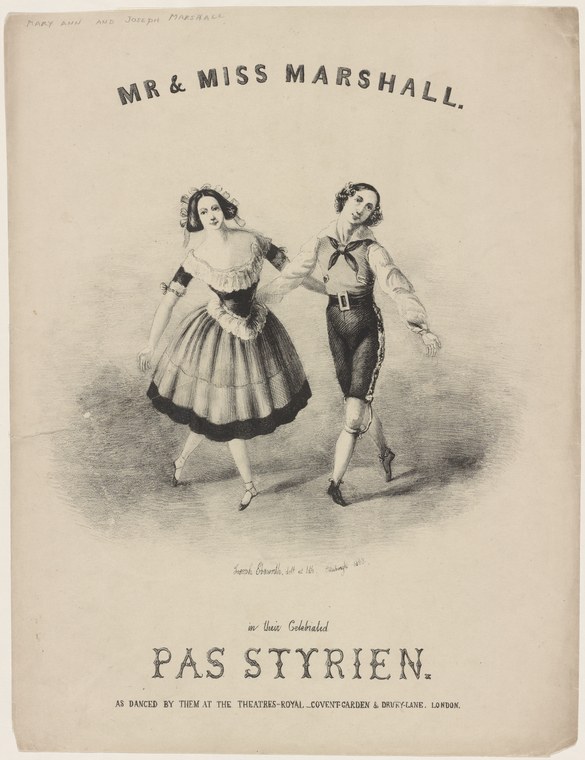
Mr & Miss Marshall in their celebrated Pas styrien.: As danced by them at the Theatres - Royal - Covent Garden & Drury Lane, London
Unknown artist
- Collection:
- Prints depicting dance
- Source:
- New York Public Library
- Rights:
- Public domain — free to use, share and adapt.
- Recorded as:
- Public Domain
This is a documentary record of a named performance by identifiable dancers in a major London theater, capturing both the technical style and the theatrical conventions of Romantic-era ballet. Such prints—unpretentious, widely distributed, and ephemeral—are among the most trustworthy sources for understanding what 19th-century ballet actually looked like in practice, not just in idealized paintings.
What you are looking at
A lithographic print depicts a male and female dancer in mid-performance, dressed in early 19th-century theatrical costume. The woman wears a full-skirted white dress with dark trim, her hair arranged with ringlets and decorative elements typical of Romantic-era ballet; her pose shows her in a supported moment, one arm raised and extended while the other rests lightly on her partner's shoulder. The man is dressed in dark knee-breeches, a short jacket, and a bow at his neck—the costume of a male danseur of the period. His body is angled to support her weight while maintaining his own upright frame. The two figures occupy the center of a plain background rendered in soft gray wash, giving the composition a classical theatrical print aesthetic. The poses suggest a moment of partnered movement in which the man serves as support rather than co-equal mover, a positioning characteristic of the Romantic ballet aesthetic where the ballerina is the primary focus.
The dancing
The male dancer stands in profile or three-quarter view, his weight settled and stable, his free arm extended in a supporting gesture. The female dancer is posed in an attitude or attitude derrière-like position, supported by her partner's shoulder and hand; her working leg appears lifted or extended, her torso inclined slightly forward into the embrace. Both dancers maintain the elongated posture and upright carriage of academic ballet technique. The composition emphasizes the woman's form and extension while the man functions as an architectural support—a convention central to Romantic-era partnering. Their positioning suggests a moment of choreographed elegance rather than explosive or acrobatic movement.
The dance depicted
This is a theatrical ballet pas (a duet or short choreographed sequence), almost certainly from the early 19th-century Romantic ballet repertory. The title *Pas Styrien* references the Styrian region of Austria and suggests a regional or character dance incorporated into a ballet narrative. Mr. and Miss Marshall, named in the title, were performers of the 1840s–1850s era who danced at London's major patent theaters. The image captures the formal, supported partnering style of the period, in which the male dancer's role was primarily to frame and elevate the female dancer's line. The soft academic technique and the woman's centered, elongated carriage indicate this was a theatrical work performed before paying audiences, not a social ballroom dance.
How it was made
This is a lithographic print, a process that allowed for rapid reproduction and wide circulation of theatrical imagery. The artist has used tonal lithography—building up grays and shadows through layered stone work—to render fabric, shadow, and the softer modeling of the bodies. This technique was ideal for theatrical prints distributed to the public as souvenirs or publicity; lithography was cheaper and faster than hand-colored engravings and produced a softer, more atmospheric image. The print's modest size and the simplicity of its composition suggest it was produced for a general theater-going public rather than as a fine art print for collectors. The technique's ease of printing allowed theater managers and print publishers to capitalize quickly on popular performances.
About this work
This lithographic print documents a theatrical ballet pas performed by named dancers—Mr. and Miss Marshall—at Covent Garden and Drury Lane theaters in London. It is a record of Romantic-era ballet technique and aesthetics: the emphasis on the ballerina's line and extension, the supporting role of the male dancer, and the incorporation of character or regional dances into formal ballet narratives. The work belongs to a large body of 19th-century theatrical prints that served as mementos of performances and as evidence of the kinds of dance that were considered fashionable and worthy of reproduction for public circulation.
The *Pas Styrien* is not a surviving work of major historical significance—neither Marshall became a canonical figure in dance history—but the print is invaluable as a record of how Romantic ballet was actually practiced and presented in London theaters. It shows the body positions, partnering conventions, and performance contexts that shaped the era. For dancers and historians, such prints are primary documents of the era's aesthetics: they confirm that the idealized images in Romantic ballet paintings were reasonably faithful to what audiences saw.
How to look at it
Look at how the male dancer's body is arranged entirely in support of the female dancer's line and extension. His stance is stable and his arm raised to frame her movement; his body does not compete for attention. This is not a pas d'action (a dance for two equals), but a pas supporting a featured ballerina—a distinction visible in the composition and posture. Notice also the refinement of the woman's arm and hand position, and the precision of her leg extension; these details would have been visible to audiences in the theater and are faithfully recorded in the print. The lithographic medium here is important: it softens and romanticizes the figures without obscuring the accuracy of their technique, making the print both a promotional image and a useful record of how the body was positioned and trained.
The period
The 1840s–1850s were the height of the Romantic ballet era in London. The major theaters (Covent Garden and Drury Lane, named in the print) competed intensely for audiences by importing celebrated European dancers and commissioning new ballets on Romantic themes—sylphs, spirits, and tragic heroines. Lithographic prints of popular dancers and famous pas were produced in large numbers and sold to audiences as souvenirs and promotional material. The Marshall dancers were minor figures in this competitive landscape, but their appearance at both patent theaters suggests they had solid reputations as reliable professionals. The *Pas Styrien* itself represents a category of choreography common to the era: the character pas, often featuring music and movement evoking a regional or national dance tradition (in this case, Austrian) embedded within a larger ballet work. These sequences allowed choreographers to display virtuosity in a new genre while audiences enjoyed the novelty of 'authentic' regional dance styles—a form of cultural tourism that was part of the Romantic era's fascination with folklore and exoticism.
Where it lives
This print is held by the New York Public Library in its collection of prints depicting dance. It is one of thousands of theatrical prints produced during the 19th century as promotional material and souvenirs for audiences at major London playhouses.
Dance in this work
Questions about this work
Who were Mr. and Miss Marshall?
They were professional ballet dancers performing in London during the 1840s–1850s, the height of the Romantic ballet era. They danced at both Covent Garden and Drury Lane, the two major patent theaters in London. Beyond their names and performance venues, little specific biographical information survives; they were among the many skilled dancers who formed the corps and secondary roles of the era rather than international stars. This print is one of the few records of their work.
What is a 'Pas Styrien'?
A pas (French for 'step' or 'dance') is a choreographed sequence for one or more dancers. The Styrien refers to the Styria region of Austria and suggests this pas was a character dance incorporating stylized Austrian folk movement or music. Character dances—choreographed versions of regional or national dance traditions—were popular in Romantic-era ballets and allowed choreographers to vary the aesthetic while displaying dancers' technical range.
Why is the male dancer so much less visible than the female dancer?
This composition reflects the Romantic ballet aesthetic, in which the ballerina was the primary focus and the male dancer's role was to support and frame her beauty. Male dancers in this era were not featured soloists; they were partners. This convention would gradually change during the 20th century as male technique and choreography became equal to the female.
How do we know this is actually what they danced?
We cannot know with certainty. Theatrical prints of this era were promotional images, often idealized. However, the precision of the technique shown—the positions, the carriage, the relationship between partners—is consistent across many prints of the period and with descriptions of Romantic ballet in written sources, suggesting the prints faithfully captured the general style even if they romanticized individual moments.
More dance artwork





