49 works in this view — arrow keys or swipe to move between them.
Dance in Art
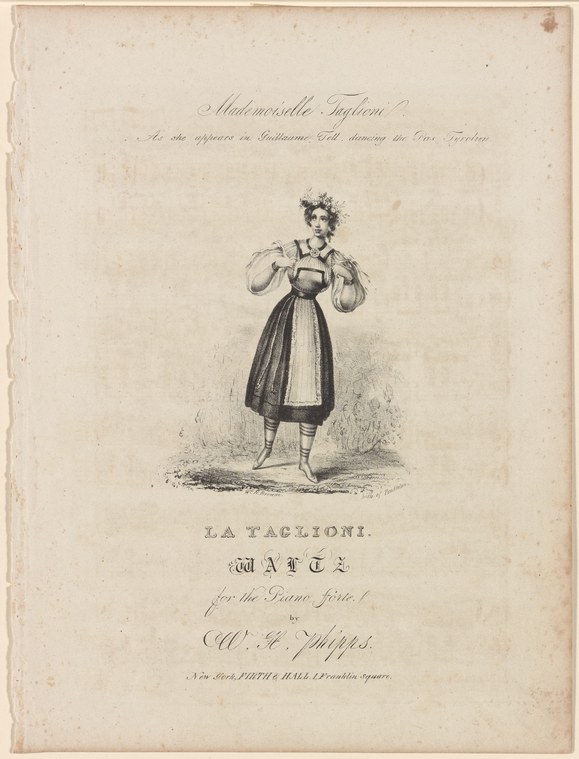
Mademoiselle Taglioni as she appears in Guillaume Tell, dancing the pas tyrolien.: La Taglioni waltz for the piano forte, by W. H. Phipps
Unknown artist
- Collection:
- Prints depicting dance
- Source:
- New York Public Library
- Rights:
- Public domain — free to use, share and adapt.
- Recorded as:
- Public Domain
Taglioni was the defining ballerina of the Romantic period and her roles—especially in character dances like this—established templates that persisted in ballet for generations. This print shows how dancer celebrity was manufactured and circulated in the 19th century, and preserves visual evidence of a specific choreographic performance that no longer exists except in such images and in written reviews.
What you are looking at
A single female dancer stands alone against a plain background, dressed in early 19th-century performance costume: a white muslin dress with short puffy sleeves and a fitted bodice, paired with a dark skirt that reaches mid-calf and white stockings. She wears a floral wreath in her hair and stands in a composed frontal pose with one arm raised gracefully and the other at her side, her weight settled on one leg in a relaxed stance. The engraving is finely detailed in the neoclassical style, with delicate cross-hatching to suggest volume and form. Below the figure, text identifies this as "La Taglioni Waltz for the Piano Forte," indicating this is a musical arrangement inspired by or dedicated to the dancer's performance. The composition is formal and presentational—a portrait of a specific dancer in a specific role rather than a scene of dance in progress.
The dancing
The dancer presents a single figure in a relaxed, almost stational pose rather than mid-movement. Her right arm is raised to approximately shoulder height with the hand open and graceful; her left arm hangs at her side. Her torso faces forward, her head inclined slightly, and her weight appears settled through one leg. The pose has the formal, controlled quality of a presentation or curtsy moment rather than the vigorous extension of active dancing. There is no partner, no ensemble—she occupies the stage alone.
The dance depicted
This is a portrait of Marie Taglioni, the renowned Romantic-era ballerina, as she appeared in the role of a Tyrolese peasant woman in Adolphe Adam's ballet *Guillaume Tell* (William Tell), first performed at the Paris Opéra in 1837. The "pas tyrolien" (Tyrolese dance) was a distinctive character dance inserted into the ballet, performed in folk-inflected costume as a scenic interlude. The pose and dress here emphasize the hybrid nature of Romantic ballet's engagement with folk idiom—the dancer is neither in peasant clothes nor in classical ballet dress, but in the theatrical compromise between them. The title's reference to a piano waltz version of the dance suggests that Taglioni's choreography had already entered popular music and domestic performance culture.
How it was made
This is a steel or copper engraving, executed with fine linear detail and cross-hatching to create tone and form. The technique allowed for mass reproduction and distribution—such prints were a primary medium for circulating images of celebrated dancers to audiences beyond the theater, and for creating profitable popular merchandise around star performers. The print's inclusion of a title connecting it to a published piano arrangement confirms that this was a commercial object: a souvenir that advertised both the dancer and a musical transcription of her performance.
About this work
This engraved portrait documents Marie Taglioni in the character role that made her fame extend beyond the ballet stage into European popular culture. The image captures not a moment of virtuosic dancing but a posed presentation of the star in costume—the visual language of 19th-century celebrity. As a printed object, it participated in the commodification of Romantic ballet: it sold to middle-class audiences, it advertised a published musical arrangement, and it disseminated Taglioni's likeness and her roles beyond those who could attend the Paris Opéra. The work sits at the intersection of theater, print culture, and commercial mass production that defined the Romantic era.
How to look at it
Observe how the artist has posed Taglioni not in motion but in a moment of stillness and presentation—the pose is legible, frontal, and designed to display the costume and the dancer's bearing to best effect. This is the language of theatrical portraiture in the pre-photographic age: the dancer is shown as she would appear to an audience, not as a document of a specific step or jump. The dress itself is the key visual content—the balance between folk idiom and classical ballet costume shows how Romantic choreographers negotiated the appeal of peasant authenticity within the grammar of the Paris Opéra.
The artist
The artist is not recorded. Steel engravings of this type were produced in commercial workshops in London and Paris, often by artisans who specialized in theatrical portraiture. The print was published by Chappell, a music publisher (the imprint reads "J. & Son, 50 New Bond Street, London"), which confirms its status as a commercial tie-in to a published musical score rather than a fine-art print.
The period
This print dates to the height of the Romantic ballet era, when the Paris Opéra was the center of European dance innovation. *Guillaume Tell* premiered in 1837 and was a huge success; Taglioni's roles in classical and character dances made her the dominant star of her decade. The 1830s–40s saw an explosion in theatrical prints and celebrity portraiture, driven by new reproduction technologies and a growing middle-class audience for entertainment imagery. Character dances like the pas tyrolien were a key feature of full-length Romantic ballets, providing comic or picturesque contrast to the ethereal classical dances that were the genre's hallmark.
Where it lives
The print is held by the New York Public Library in its collection of prints depicting dance. It is part of the documentary and commercial apparatus surrounding Romantic ballet performance, and as such belongs with theatrical ephemera and celebrity portraiture rather than with fine-art prints.
Dance in this work
Questions about this work
Who was Marie Taglioni?
Taglioni (1804–1884) was a Swedish-born ballerina who became the defining dancer of the Romantic ballet era. She created and danced in many of the canonical roles of Romantic ballet, including the title role in *La Sylphide* (1832). She was famous for her lightness, her technical refinement, and her dramatic presence, and she was one of the first dancers to achieve international celebrity status.
What was the pas tyrolien in Guillaume Tell?
A "pas" (step or dance) inserted into a full-length ballet, typically as a solo or small-group interlude. Character dances like the pas tyrolien drew on folk or regional dance idioms and offered contrast to the ethereal classical dancing that was the Romantic era's primary focus. The Tyrolese dance would have been a relatively buoyant, grounded, folk-inflected piece set in the Alpine setting of Schiller's *William Tell*.
Why does the print mention a piano waltz?
Publishers issued musical transcriptions of popular ballet music for domestic piano performance. Successful ballets like *Guillaume Tell* had their most famous dances arranged for piano and published as sheet music, which generated revenue and kept the music in circulation among music-making households. Such arrangements democratized access to ballet music and made star dancers' work part of parlor culture.
What was the point of these theatrical prints?
Before photography, engraved and lithographed theatrical portraits were the primary way to circulate images of celebrated performers. They functioned as celebrity merchandise—sold to theatergoers as souvenirs and mementos. They also advertised performances to a wider public and, when tied to published music or dramatic texts, helped market those products as well.
More dance artwork





