49 works in this view — arrow keys or swipe to move between them.
Dance in Art
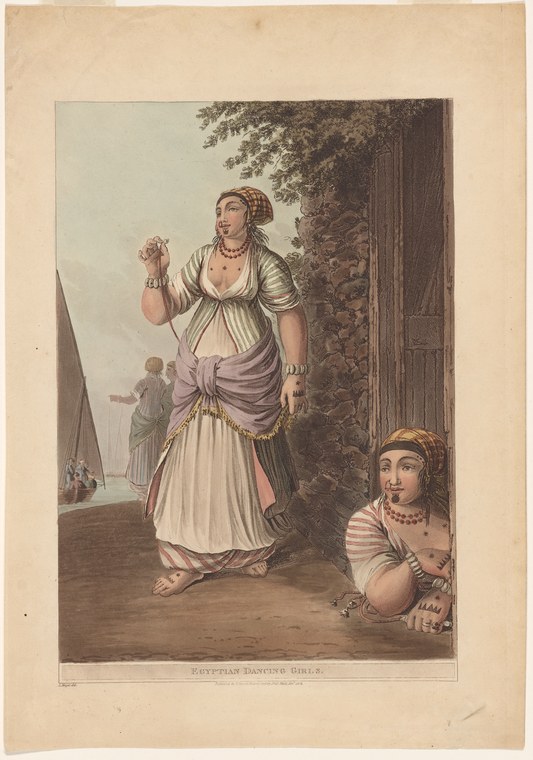
Egyptian dancing girls
Unknown artist
- Collection:
- Prints depicting dance
- Source:
- New York Public Library
- Rights:
- Public domain — free to use, share and adapt.
- Recorded as:
- Public Domain
This image documents the moment when European theater began to exploit non-European cultures as sources of exotic spectacle, a practice that shaped ballet and modern dance for two centuries. The work reveals how dance imagery operated as both art and propaganda for empire, dressing European Romantic movement in the costume of elsewhere. Understanding this genealogy is essential for contemporary dancers grappling with cultural appropriation and the history of Orientalism in theatrical form.
What you are looking at
A colored engraving depicting two women in Neoclassical dress within a Classical architectural setting. The standing figure in the center wears a high-waisted white chiton with a pink draped shawl or himation, her head bound with a decorative band, her gaze lifted and her right arm raised expressively. She stands on a shallow stage lit from the left, creating volume in her drapery. To the right, a seated figure in similar dress watches intently, one knee raised. Behind them, a darker background suggests a columned interior or temple, with ivy or foliage visible overhead. A third figure appears in shadow at left, partially obscured. The composition is tightly framed, focusing attention on the central dancer's posture and costume.
The dancing
The standing figure displays an open, upright frame with her weight settled on both feet, her right arm raised to shoulder height with palm open and fingers extended—a gesture of expression rather than partnered support. Her head is tilted back slightly, suggesting emotional intensity or transcendent focus. The seated figure maintains an attentive, static pose, functioning as witness or respondent. Neither figure is in a closed hold or ballroom frame. The raised arm and lifted gaze suggest solitary, emotionally-charged movement rather than social or competitive dance.
The dance depicted
The title assigns this to Egypt, but the visual evidence contradicts it entirely. The Neoclassical dress, the columned architecture, and the compositional mode all point to early 19th-century European theatrical Romanticism—specifically the movement toward Orientalist ballet and pantomime that drew on Classical and exotic fantasy. This appears to be a scenic moment from a theatrical production rather than a documentation of Egyptian dance practice. The standing figure's expressive arm and uplifted gaze are consistent with the nascent Romantic ballet aesthetic of the 1820s–1840s, though the figure remains grounded and does not display the turned-out positions or verticality of later Classical ballet.
How it was made
This is a hand-colored engraving, a technique that allowed for relatively rapid reproduction and distribution of theatrical imagery in the early 19th century. The fine linear detail characteristic of engraving appears in the architecture, drapery folds, and anatomical precision, while the soft hand-coloring creates atmospheric depth and costume clarity. The technique and presentation suggest this was a commercial theatrical print—likely made for sale to opera and ballet audiences, collectors, or to document a specific production. The quality of execution and hand-finishing indicate a mid-market or better workshop production.
About this work
This is a Neoclassical-theatrical engraving masquerading as documentation of Egyptian dance. It belongs to the 19th-century European fascination with Egypt as a source of exotic spectacle, refracted through the aesthetic vocabulary of Romantic ballet and pantomime. The work exemplifies how dance imagery of this period often conflated distant cultures with theatrical fantasy, using historical or geographical reference as a pretext for Romantic aesthetic display rather than cultural documentation. The standing figure's expressive gesture and the intimate spatial framing suggest a moment of individual feeling or trance—a signature concern of Romantic-era theater—rather than social or ritual dance.
For dancers and historians, this work is instructive precisely because it is unreliable: it shows us what early 19th-century European audiences imagined when they heard the word 'Egyptian,' and how theatrical dance used costume, architecture, and the female body to construct an orientalist fantasy. The engraving is evidence of artistic practice and audience expectation, not of Egyptian dance.
How to look at it
Attend to the contrast between what the title claims and what the image shows. The architectural setting, the precise drapery, the Neoclassical proportions, and the hand-coloring technique all belong to European artistic convention, not to documentation from or about Egypt. Notice the standing figure's upright posture and expressive arm gesture—neither the turned-out positions of later ballet nor the grounded movement of vernacular dance, but rather the transitional aesthetic of early Romantic theater. The seated figure's role as witness or respondent frames the central figure as the object of aesthetic display, a compositional choice typical of theatrical prints meant to advertise the spectacle and emotional intensity of performance.
The period
The early 19th century saw a surge of Orientalist fascination in European art, literature, and theater, driven by Napoleonic campaigns, imperial expansion, and Romantic aestheticism. In dance, this took the form of ballet d'action and pantomime drawing on 'exotic' narratives—Egyptian, Turkish, Persian, Asian. Productions like Didelot's ballets and the work of Taglioni's generation incorporated these themes. The Neoclassical aesthetic, still dominant in visual art and architectural fantasy, provided the formal language for representing these fantasies. Hand-colored engravings became the primary medium for circulating images of celebrated performances and dancers, creating a visual archive of theater culture.
Where it lives
From the Prints depicting dance collection at the New York Public Library, this engraving is catalogued without artist attribution or date. It is a commercial theatrical print, likely produced and sold in the early-to-mid 19th century as part of the trade in performance documentation and celebrity portraiture.
Dance in this work
Questions about this work
Is this actually about Egyptian dance?
No. The title is likely a later assignment reflecting the costume choice. The image shows a Neoclassical theatrical fantasy in the European Romantic style—the kind of 'Egypt' that existed in European imagination and opera houses, not in historical practice. The engraving is evidence of what Europeans wanted to see when they fantasized about the orient, not evidence of Egyptian dance.
What dance style is this?
This appears to be pantomime or ballet d'action in the early Romantic style—theatrical forms that used narrative, emotional gesture, and exotic costume rather than the codified technique of Classical ballet. The standing figure's expressive arm and transcendent gaze are consistent with the emerging aesthetics of Romantic ballet in the 1820s–1840s.
Who performed in dances like this?
These were primarily roles for the female dancers of European opera and ballet theaters—the public faces of theatrical dance in the early 19th century. The print format and theatrical focus suggest this may document or advertise a celebrated dancer or production, though without artist attribution or date, we cannot identify which.
More dance artwork





