49 works in this view — arrow keys or swipe to move between them.
Dance in Art
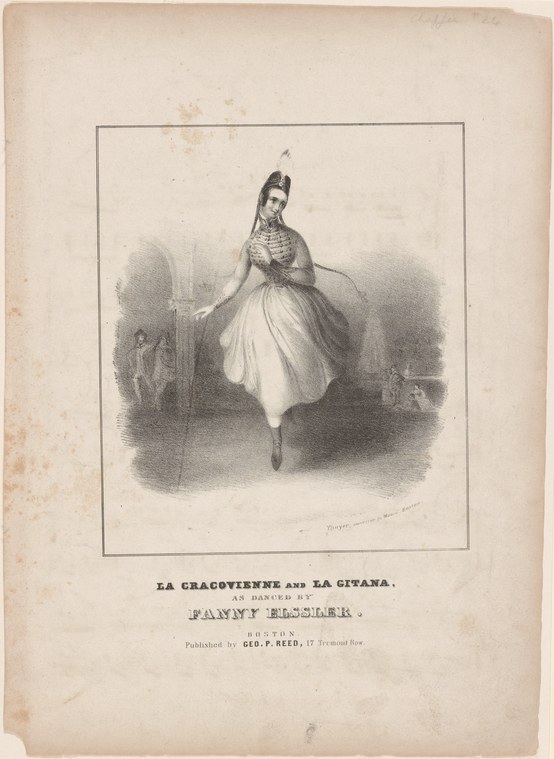
La cracovienne and La gitana, as danced by Fanny Elssler
Unknown artist
- Collection:
- Prints depicting dance
- Source:
- New York Public Library
- Rights:
- Public domain — free to use, share and adapt.
- Recorded as:
- Public Domain
Fanny Elssler was one of the defining figures of Romantic ballet, rivaling Marie Taglioni in fame and influence, yet she is less frequently reproduced and discussed in contemporary ballet history. This print is evidence of her star power and her signature roles—*La Cracovienne* and *La Gitana* were uniquely identified with her and were vehicles for her distinctive blend of technical precision and dramatic characterization. For dance historians and performers, the image documents the silhouette, costume proportions, and postural vocabulary of Romantic-era dancing and offers a window into how a celebrated dancer of the period actually presented herself.
What you are looking at
A solo female dancer in Romantic-era costume occupies the center of this lithographic print, her body angled in profile-three-quarter view. She wears a fitted bodice with decorative detail at the shoulder, a full skirt that falls to mid-calf in pale fabric, and her dark hair is styled up with what appears to be a small ornament or comb. The composition is intimate and focused: the dancer's weight appears to be on one leg, the other extended or about to move, her arms positioned to suggest both the grace and technical control of the era. Behind her, sketched more lightly in charcoal or wash, are two indistinct figures—possibly musicians or spectators—that anchor the scene in a performance space rather than abstract void. The background dissolves into shadow and atmospheric tone, emphasizing the dancer against the pale paper. The entire image is framed in a simple ruled border, standard for theatrical prints of the period.
The dancing
The primary figure is a woman poised in a characteristic Romantic ballet position, her torso lifted and turned, one leg bearing weight while the other prepares movement. Her arms are held with the port de bras typical of ballet vocabulary—rounded, controlled, positioned to frame the body rather than extend dramatically outward. The positioning suggests she is mid-phrase in a solo, balanced between stillness and motion; the artist has caught a moment of apparent suspension rather than violent action. The secondary figures are rendered so faintly that their role cannot be determined with certainty, but they occupy the space of accompaniment rather than participation.
The dance depicted
The image depicts Fanny Elssler, a celebrated dancer of the 1830s–1840s, in two of her signature roles: *La Cracovienne* (a Polish national dance adapted for the ballet stage) and *La Gitana* (a Spanish character dance). The title indicates this print served as theatrical publicity, allowing audiences to recall her specific characterizations. Elssler was known for character dances and dramatic intensity alongside classical technique, and both these roles showcased her ability to blend national idiom with balletic form. The present image captures a moment of technical clarity—a pose that would have been recognizable to contemporary audiences familiar with these specific choreographies.
How it was made
This is a lithograph, a process that allowed artists to draw directly onto stone with a greasy crayon, which was then chemically treated and printed. The technique permitted both precise linear work (visible in the ruled border and facial features) and atmospheric tonal effects (the shadowy background and the lightly indicated figures). Lithography was the dominant medium for theatrical portraiture in the 1830s–1840s because it was faster and cheaper than engraving, allowing rapid production of multiple copies for distribution to the public. The presence of printed text below the image and the publication note indicate this was a commercial print, likely sold individually or collected in theatrical portfolios, reaching a broad audience of theatregoers and dance enthusiasts.
About this work
This is a lithographic portrait of the dancer Fanny Elssler in one of her celebrated roles, produced in the early Romantic era when Elssler dominated European ballet stages. The print served both as a souvenir of live performance and as a marketing document for the theatre, freezing a moment from a known choreography that audiences could recognize and discuss. The work sits at the intersection of dance documentation, theatrical publicity, and the wider print culture of the period—evidence of how Romantic ballet was circulated, consumed, and memorialized in an age before photography. Elssler's international fame meant that versions of prints like this were distributed across Europe and beyond, making her image one of the most widely circulated representations of Romantic dance.
The print belongs to a tradition of theatrical portraiture that had existed since the 17th century but reached new sophistication in the 1830s–1840s with lithography. These images are primary sources for understanding what audiences saw, what costumes and poses were considered beautiful or expressive, and how individual dancers constructed their public personas. Unlike later photographic documentation, this print carries the hand of an artist making interpretive choices—decisions about which moment to capture, how to pose the body, what to emphasize and what to leave in shadow.
How to look at it
Observe the pause the artist has chosen: the dancer is poised in a moment of apparent stillness, weight settled, arms rounded but not extended. This choice—rather than capturing a leap or dramatic gesture—emphasizes technical control and classical poise, which was central to how Romantic dancers presented themselves. Notice the precision of the pose: every line from shoulder to ankle is deliberate and composed. The two background figures, rendered so faintly they are almost abstract, serve to establish that this is a stage, a performance, not a private moment. The lithographic technique allows the artist to render fine detail in the face and costume while using tonal wash to create depth and theatrical atmosphere.
The artist
The artist is not recorded in the catalogue. The print was published by Geo. P. Reed of Boston, suggesting American publication and distribution, though Elssler's fame was international. The style and technique are consistent with the major lithographic printing houses of the 1830s–1840s that specialized in theatrical and operatic portraiture. Without signature or attribution in the visible image, the identity of the artist cannot be established from the print itself, though comparison with other theatrical lithographs of the era might allow attribution to a known hand.
The period
This print was made during the height of Romanticism in ballet (approximately 1830–1850), when dance was increasingly defined by pointe work, ethereal costuming, supernatural narratives, and the cult of the individual dancer's beauty and technical prowess. Fanny Elssler emerged during this period as a rival to Marie Taglioni, offering a different aesthetic: where Taglioni embodied weightless, otherworldly grace, Elssler was known for brilliance, sharp technique, and dramatic characterization, especially in character dances drawn from European folk traditions. The Romantic era saw the globalization of ballet through touring companies; Elssler traveled extensively to the United States and elsewhere, making prints like this essential tools for maintaining her image and fame across geographic distances. Lithography was the dominant medium for dance publicity during this period, and theatrical prints were collected and displayed much as photographs of performers would be in later eras.
Where it lives
The print is held in the New York Public Library's collection of prints depicting dance. It was published by Geo. P. Reed of Boston, indicating American print distribution during the period of Elssler's fame. The catalogue record provides no accession number or date, but the style and printing technique place it solidly in the 1830s–1840s.
Dance in this work
Questions about this work
Who was Fanny Elssler?
Fanny Elssler (1810–1884) was an Austrian ballet dancer who was one of the two dominant figures of Romantic ballet alongside Marie Taglioni. She was celebrated for her technical brilliance, dramatic intensity, and mastery of character dances drawn from European national traditions. She toured extensively, including to the United States, where she achieved celebrity status comparable to major performing artists today.
What were La Cracovienne and La Gitana?
Both were solo roles created for or identified with Elssler. *La Cracovienne* was a Polish national dance adapted for the concert stage, showcasing Elssler's skill in character dance and her connection to Central European tradition. *La Gitana* was a Spanish-themed character piece. Both roles highlighted her ability to blend technical ballet vocabulary with the idioms of folk dance, a signature of her artistic identity.
Why would audiences want a print like this?
Theatrical prints served multiple purposes: as souvenirs of a live performance, as advertisements for future performances or tours, as collectible images of a beloved performer, and as fashion references (audiences paid close attention to costume details). For fans of Elssler, owning a print allowed them to recall and share the experience of seeing her dance, much as photographs and videos serve that function today.
How does this compare to photographs of dancers?
Lithographs like this are interpretive rather than indexical—the artist made choices about pose, expression, and emphasis that a photograph would not. This means the image tells us both about what Elssler actually looked like and performed, and about how artists and audiences of the period thought dance should be represented: graceful, composed, dignified, and frozen in a moment of technical clarity rather than dynamic motion.
More dance artwork





