49 works in this view — arrow keys or swipe to move between them.
Dance in Art
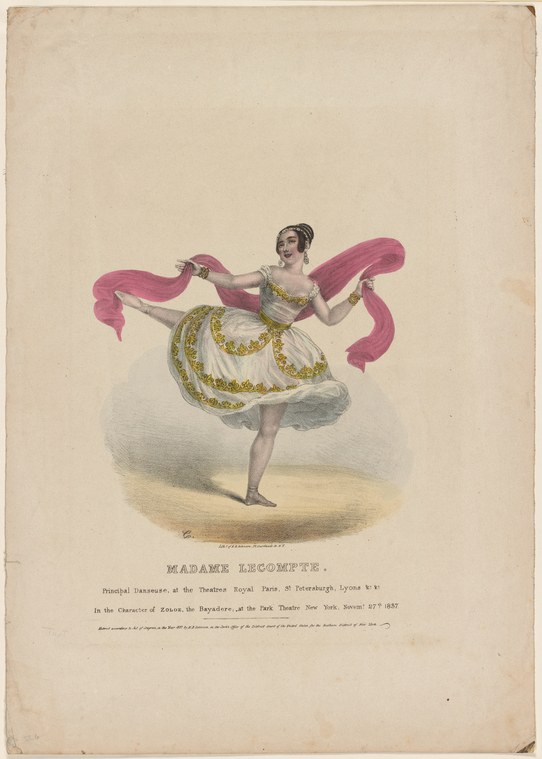
Madame Lecompte, principal danseuse at the Theatres Royal Paris, St. Petersburgh, Lyons &c. &c., in the character of Zoloe, the bayadere, at the Park Theatre New York, Novem'r 27 1837
Unknown artist
- Collection:
- Prints depicting dance
- Source:
- New York Public Library
- Rights:
- Public domain — free to use, share and adapt.
- Recorded as:
- Public Domain
Madame Lecompte is otherwise obscure, but this engraving is a primary document of how ballet was performed and represented in early American theater, and of the Orientalist fantasies that shaped the Romantic ballet repertory. It shows exactly what audiences paid to see: technical virtuosity framed as exotic spectacle, a woman in a short skirt performing ballet vocabulary in a character from no identifiable culture. The print itself is evidence of how theatrical images were manufactured and circulated in the pre-photographic era.
What you are looking at
A woman in early 19th-century theatrical dress stands alone against a plain beige background, caught in a moment of pirouette or balanced turn. She wears a white muslin dress with a very short skirt reaching only to mid-calf, decorated with gold braid or trim arranged in swags and festoons across the skirt. A matching gold-trimmed shawl or drape in pale pink or mauve silk floats around her shoulders and arms, billowing dramatically upward and outward as if caught by the motion of the spin. Her posture is upright and controlled, her gaze directed outward. The figure stands on what appears to be a stage floor rendered in soft ochre, with minimal shadow to suggest depth. The overall effect is one of elegant, contained virtuosity—the kind of moment a celebrated dancer would be portrayed performing at the height of her fame.
The dancing
A single female figure stands in a turned-out position, appearing to balance on one supporting leg while the other is extended. Her arms are raised and extended to manage the flowing pink silk, which seems to wrap around her body as part of the choreography rather than incidentally. Her upper body is upright and her head is held with classical composure. The port de bras (carriage of the arms) and the turned-out position of the legs indicate training in academic dance forms. Her weight appears controlled and her frame elongated, characteristic of a trained theatrical dancer rather than a social dancer.
The dance depicted
This is a portrait of a Romantic-era theatrical dancer, almost certainly engaged in ballet vocabulary—the turned-out positions, the upright carriage, and the lifted quality of the pose all point to the classical ballet tradition. The flowing, short-skirted costume and the dramatic pink silk are consistent with the Romantic ballet aesthetic of the 1830s, when dancers such as Marie Taglioni revolutionized the art form with ethereal, otherworldly movement. The identity of 'Madame Lecompte' remains difficult to verify independently, but the inscription confirms she performed in the character of 'Zoloe, the bayadere'—a common Orientalist character for the period—at the Park Theatre, New York in November 1837. The pirouette or balanced turn shown here was a signature technical feat of the era.
How it was made
This is a hand-colored engraving, identifiable by the fine line-work of the figure and the subtle shading achieved through parallel lines and cross-hatching, particularly visible in the rendering of the floor and background. The color—the white dress, gold trim, and especially the pink silk—has been applied by hand after printing, a common and economical way to produce theatrical portraits for circulation among audiences and in theatrical archives. The technique allowed for relatively rapid reproduction of a performer's image, making such prints affordable souvenirs of celebrated dancers. The precision of the engraved line and the delicate hand-coloring suggest a workshop producing theatrical portraiture for a paying market, likely in New York or imported from London.
About this work
This hand-colored engraving documents Madame Lecompte performing in a character role as a bayadere—an Orientalist fantasy figure—in New York theater in 1837. It belongs to a substantial tradition of Romantic-era theatrical portraiture, capturing a moment of technical display that would have been recognizable to audiences of the period and preserved as a souvenir of her performance. The work is evidence of how extensively ballet culture, and in particular the aesthetics of Continental European Romantic ballet, had penetrated American theatrical life by the 1830s, and how that culture was disseminated through prints.
How to look at it
Observe the exact moment the artist has chosen to freeze: not a static pose but a turn captured mid-motion, with the pink silk still in flight around the dancer's body. This choice—to show movement rather than stillness—was itself a Romantic convention; it suggested the dancer's aliveness and the ethereal, weightless quality the era prized. Notice how the gold-trimmed white dress is rendered in fine detail while the pink silk is looser and more painterly, suggesting different speeds and different meanings. The Orientalist costume (the bayadere character) would have been instantly legible to 1837 audiences as marking the dancer as exotic and transgressive—a fantasized Other rather than a European woman, a conceptual permission for the viewer to enjoy the display of the (barely clothed) body.
The period
This engraving dates to the height of the Romantic ballet era, when the short tutu, pointe work, ethereal costuming, and Orientalist subject matter defined the aesthetic of European and American ballet. Marie Taglioni had danced in La Sylphide in 1832 and was at the height of her fame; her body and her technique had become the standard by which other dancers, including performers like Lecompte, were measured and marketed. The 1830s saw increasing American interest in European ballet, with touring dancers and companies bringing the Romantic aesthetic to cities like New York. Theatrical portraiture in print was a major medium for promoting dancers and for audiences to collect images of their favorite performers. The Park Theatre was one of New York's leading theaters, indicating that Lecompte was a significant draw.
Where it lives
The engraving is held by the New York Public Library in its collection of prints depicting dance. It is a theatrical souvenir product, one of many such images produced for audiences attending performances at major American theaters in the 1830s.
Dance in this work
Questions about this work
Who was Madame Lecompte?
Madame Lecompte was a professional dancer who performed in the character of Zoloe, a bayadere (a fantasy Orientalist character), at the Park Theatre in New York on November 27, 1837. The inscription identifies her as a principal danseuse who had also performed in Paris, St. Petersburg, and Lyon. She is otherwise not well documented, but this engraving preserves evidence of her career and the role she danced.
What is a bayadere?
A bayadere is a generic Orientalist character type in 19th-century ballet, supposedly a Hindu dancing girl. In reality, the character had no historical or ethnographic basis; it was a European fantasy that allowed choreographers to create exotic, sensual ballets far removed from classical mythology. The costume and character gave dancers permission to wear less clothing and to perform movements coded as more erotic than those in classical ballet.
Is this a lithograph or an engraving?
This is an engraving—identifiable by the fine parallel and cross-hatched lines used to create tone and shadow. The color has been applied by hand after printing, a standard production method for theatrical portraiture of the era. Engravings could be printed and reprinted from the same plate, making them economical souvenirs of performances.
Why is the skirt so short?
The short skirt—reaching only to mid-calf—is characteristic of Romantic-era ballet, especially after Marie Taglioni's success in the early 1830s. The short tutu allowed audiences to see the dancer's legs and feet clearly, essential for a form in which footwork and ankle articulation were technically central. The brevity of the skirt also coded the dancer's body as available to the gaze in a way that full-length skirts did not.
More dance artwork





