49 works in this view — arrow keys or swipe to move between them.
Dance in Art
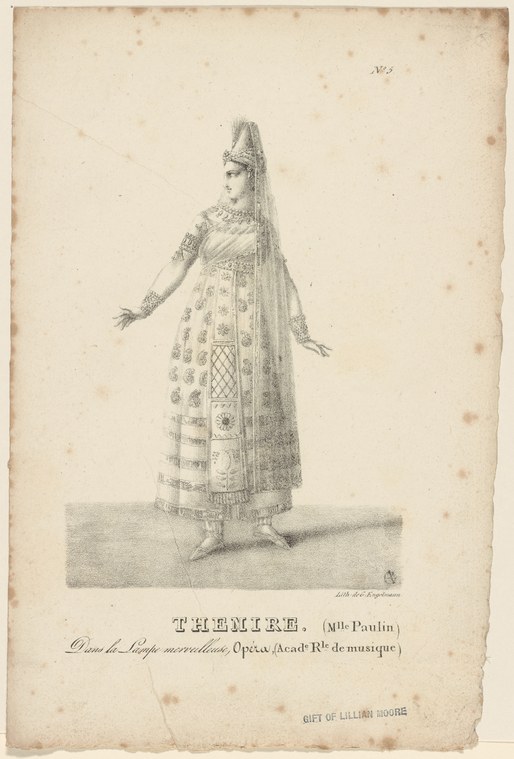
Themire. (Mlle Paulin) dans La lampe merveilleuse, opera (Acade. Rle. de Musique)
Unknown artist
- Collection:
- Prints depicting dance
- Source:
- New York Public Library
- Rights:
- Public domain — free to use, share and adapt.
- Recorded as:
- Public Domain
This print is evidence of the range of roles available to female opera dancers in the early 19th century beyond ballet proper—character roles, orientalist fantasies, and narrative drama that required theatrical presence and costume mastery as much as technical virtuosity. It also documents the commercial practice of distributing costume studies and performer likenesses as a form of theater publicity and fan engagement, a practice that shaped how dance and dancers were understood and consumed by the urban public.
What you are looking at
A single female dancer is shown in a three-quarter standing pose against a plain background, wearing an elaborate costume consistent with early 19th-century French opera. She wears a tall headdress (likely a kokoshnik or similar ornamental cap) and a long, heavily patterned gown with geometric designs across the bodice and skirt. The dress features a fitted corseted top with short sleeves, a cinched waist, and a full skirt decorated with repeating motifs that suggest embroidery or brocade work. The costume appears to reference Russian or Eastern European folk dress, suggesting the role of Themire was exotic or orientalist in character. The dancer stands with her weight evenly distributed, one arm extended gently outward in a welcoming or expressive gesture, the other at her side. Her posture is upright and formal, consistent with the dignified bearing expected of operatic performers. The engraving's fine line work and subtle shading create depth and texture in the fabric, particularly the detailed patterning of the skirt.
The dancing
A single dancer occupies the composition, standing in a relaxed but formal pose typical of costume studies for theatrical portraiture. The weight appears centered, with no suggestion of active movement—this is a presentational stance rather than a moment caught in motion. The extended arm is held at roughly shoulder height in an open, graceful position; the gesture suggests expressivity without balletic codification. The body is straight and dignified, the gaze directed upward and to the side in the contemplative manner conventional to operatic portraiture of the period. There is no visible footwork, pointe work, or dynamic weight transfer; this is an image of costume and bearing rather than technique.
The dance depicted
Themire was a character in *La Lampe merveilleuse* (*The Wonderful Lamp*), an opéra performed at the Académie Royale de Musique (now the Opéra Garnier) in Paris. The work belongs to the tradition of French grand opéra and orientalist fantasy popular in the early 19th century, likely drawing on *Aladdin* narratives. Mlle Paulin's costume—with its patterned gown and Eastern European or Russian headdress—indicates a character role calling for theatrical dance rather than pure ballet technique. The image is a costume study of the kind distributed to document operatic roles and the performers famous for them, serving both as a record of theatrical practice and as promotional material. Without additional documentation, the specific choreography cannot be determined, but the formal stance and expressive arm position suggest a blend of pantomime, character dance, and the decorative movement expected of mid-level operatic roles.
How it was made
This is an engraving, executed in fine lines with careful hatching to suggest form, texture, and shadow. The technique allows precise rendering of costume detail—the geometric patterns of the gown, the articulation of the headdress, the delicate folds of fabric—while maintaining the flat clarity necessary for rapid circulation as a printed document. The signature or mark visible in the lower right suggests a professional print shop production, consistent with the commercial distribution of operatic costume prints in Paris during the 1820s–1840s. Engravings of this type were relatively inexpensive to produce and distribute, making them accessible to theater enthusiasts, other performers, and costume makers seeking reference for historical or exotic dress. The fine technique and careful finish indicate skilled professional work intended for a educated urban audience.
About this work
This engraving documents Mlle Paulin in the role of Themire from *La Lampe merveilleuse*, an opéra performed at Paris's Académie Royale de Musique. It is a costume study and performance record from the era of French grand opéra, when orientalist fantasy and character roles provided opportunities for female performers within the operatic repertory. The image preserves both the appearance of a now-obscure theatrical role and the presentational conventions by which 19th-century opera dancers were publicly represented—not as virtuosos executing difficult technique, but as embodiments of character and exotic costume. The work belongs to a large tradition of operatic portraiture prints that served as both documentation and publicity for performers and their roles.
How to look at it
Attend to the costume's specificity: the tall headdress, the geometric patterning, and the formal drape of the gown all signal a character role distinct from the classical ballet that was developing in parallel. The artist has chosen a moment of stillness and presentation rather than movement—a convention of costume studies that prioritizes legibility of dress and character type over dynamic pose. Notice how the engraver's technique creates texture and weight in the fabric through careful line work, allowing the dress to read as substantial and richly decorated despite being rendered in black and white. The figure's upward gaze and gentle arm extension convey theatrical presence and emotion rather than athletic prowess, suggesting an acting role as much as a dancing one.
The artist
The artist is not recorded. The print appears to be professional work from a Paris printshop active in the 1820s–1840s, likely executed by an artisan engraver rather than a named artist of independent standing. The signature or mark suggests commercial production under a printshop's direction rather than individual artistic authorship. This was standard practice for costume prints and theatrical portraiture of the period, where the prestige attached to the performer and role outweighed the printmaker's individual reputation.
The period
This image dates to the era of French grand opéra and Romantic ballet, when Paris was the undisputed capital of European dance and theater. The 1820s–1840s saw the dominance of large-scale historical and orientalist opéras that combined singing, dancing, and elaborate spectacle. Female opera dancers occupied a complex social and professional position—trained virtuosos but not yet recognized as 'ballerinas' in the fullest sense, which status crystallized only later in the Romantic ballet proper. Costume prints like this one were part of a broader commercial ecosystem of theatrical imagery, including playbills, printed descriptions, and lithographed portraits, that made theater accessible to a paying public and created celebrity around performers. The orientalist fantasy evident in Themire's costume reflects the Romantic fascination with the exotic and distant, a taste that shaped both artistic production and imperial fantasy during this period.
Where it lives
Held in the New York Public Library's collection of prints depicting dance. The print is undated and the artist unattributed, typical of commercial costume studies of the period that prioritized the performer and role above the printmaker's name. The inscription at the lower left identifies both the character (Themire) and the opera (*La Lampe merveilleuse*), along with the performer's stage name (Mlle Paulin), indicating it was intended for public circulation among theater enthusiasts.
Dance in this work
Questions about this work
Who was Mlle Paulin?
The catalogue record provides no biographical information. She is known from this print as a performer in Paris's Académie Royale de Musique, appearing in the role of Themire in *La Lampe merveilleuse*. Many working dancers of this period left minimal documentary trace beyond costume prints and playbills.
What was *La Lampe merveilleuse*?
It was a French opéra performed at the Académie Royale de Musique (now the Opéra Garnier). The title translates to 'The Wonderful Lamp,' suggesting an orientalist fantasy narrative. Many such opéras combined singing, dancing, and spectacular scenery, with female performers taking both principal and supporting roles.
Is this ballet or opera?
It is opera, specifically an opéra performed by a company that included dancers. In early 19th-century Paris, the distinction between 'opera dancer' and 'ballet dancer' was not always sharp—the same performers might work in both contexts, and operatic roles often required dance as well as pantomime and theatrical presence.
Why is the costume so elaborate?
The character Themire appears to be an exotic or foreign character—the headdress and patterning suggest Russian or Eastern European dress. This reflects the Romantic era's fascination with the distant and oriental, a taste that shaped both artistic production and the roles available to female performers.
More dance artwork





