49 works in this view — arrow keys or swipe to move between them.
Dance in Art
Donizetti's "La favorite"
Unknown artist
- Collection:
- Prints depicting dance
- Source:
- New York Public Library
- Rights:
- Public domain — free to use, share and adapt.
- Recorded as:
- Public Domain
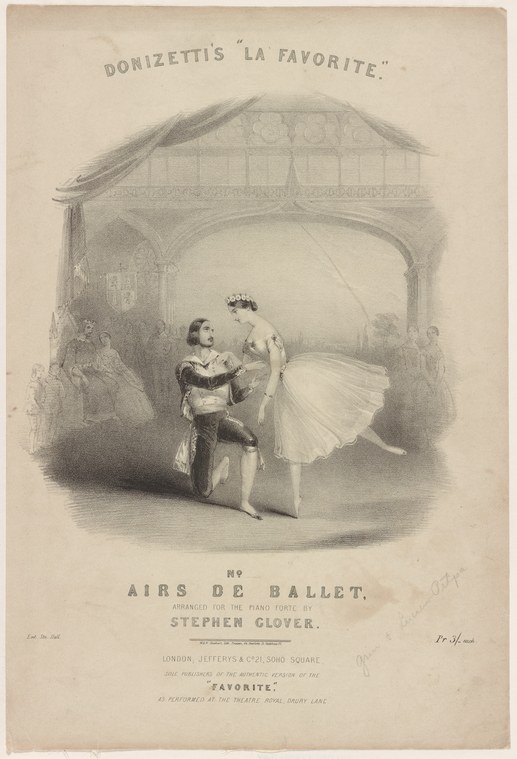
This print is essential documentation of the appearance and staging of Romantic ballet in its canonical moment. It shows with specificity how the female ballet dancer was positioned—literally and symbolically—in grand opera, and it preserves the exact costume silhouette and physical vocabulary that defined the style. For historians of opera, theater design, or ballet's development, it is a primary visual source.
What you are looking at
A man in early 19th-century theatrical dress kneels before a woman in a pale tulle ballet skirt and dark corseted bodice, her figure caught in a moment of classical poise. The setting is a grand interior space defined by vaulted architecture—soaring arches and coffers recede into shadow—that evokes a palace or formal ballroom. The woman's skirt extends from the waist in the characteristic bell shape of Romantic-era ballet, while the man's attention and posture express courtship or supplication. The composition is tightly framed, the figures occupying the foreground while the architectural grandeur creates depth and theatrical scale. The print is rendered in fine tonal gradations, with careful attention to the play of light and shadow across the figures and the ornate setting.
The dancing
The male dancer kneels on one leg, his upper body turned toward the woman with raised arms suggesting admiration or devotion. The woman stands in a classical ballet position with upright carriage, her weight centered and her arms held in a graceful, formal frame—consistent with the port de bras of early 19th-century ballet vocabulary. Her skirt billows symmetrically, creating the visual impression of weightlessness and ethereal presence central to Romantic ballet aesthetics. The spatial relationship between the two—his supplication toward her elevation—reinforces the narrative of courtly love or romantic enchantment.
The dance depicted
This is a scene from Donizetti's opera *La Favorite*, a work first performed in 1840, paired here with music arranged for piano by Stephen Clover. The image depicts a moment of staged dance within operatic narrative—likely the famous ballet divertissement that was a convention of grand opera. The woman's costume and posture conform precisely to the aesthetic of Romantic ballet as it evolved in the 1830s–1840s: the pale tulle skirt, the turned-out leg position, and the elevated, weightless carriage. The scene represents the intersection of ballet and opera narrative, in which a trained dancer would execute vocabulary drawn from the classical school while remaining in character and responding to the dramatic moment.
How it was made
This is a lithographic print, as evidenced by the characteristic tonal qualities, the precise graduation of grays, and the printing conventions visible in the title and publisher information. Lithography allowed for fine detail and subtle shading impossible in wood engraving, and by the 1840s had become the preferred medium for theatrical imagery and opera house memorabilia. The print was produced by Jeffreys & Co. of London, a publisher known for theatrical prints. Its circulation would have been among opera-goers, piano students, and theater enthusiasts—domestic, affluent audiences with access to both live performance and sheet music.
About this work
This lithograph documents a moment from Donizetti's *La Favorite* as it was performed and remembered in 1840s London. It is both a record of a specific opera scene and a window into the visual aesthetics of Romantic ballet at the moment of its full establishment in European theaters. The pairing with piano music arranged for home performance underscores the work's dual life: elite operatic spectacle on stage, domestic amusement in the parlor. The image preserves not only a choreographic moment but also the precise silhouette, posture, and architectural framing through which ballet bodies were understood and celebrated in this era.
How to look at it
Attend to the precise posture of the female dancer—the turnout of the leg, the centering of the spine, the formal positioning of the arms—which encodes the classical ballet technique of the 1840s. The kneeling position of the male dancer was a narrative gesture borrowed from melodrama and courtship ritual, not a position of classical ballet vocabulary. Notice how the architectural setting frames the dancers as precious, elevated objects, elevating the quotidian interior into a space of theatrical grandeur. The moment chosen is one of stillness and formal address, not dynamic movement—a convention of operatic ballet wherein dancers held poses for dramatic effect and to allow the opera singer to command the stage.
The artist
The artist is not recorded. The print was published by Jeffreys & Co., a London publisher active in the mid-19th century specializing in theatrical and musical subjects. The quality of the lithographic execution and the precise delineation of classical ballet form suggest a trained theatrical illustrator working within the conventions of operatic promotion and fan documentation.
The period
Donizetti's *La Favorite* premiered in Paris in 1840 and rapidly entered the repertory of opera houses across Europe, including London. The 1840s marked the height of French grand opera—a form that demanded spectacular staging, star singers, and integrated ballet sequences. This was simultaneously the period in which Romantic ballet reached its aesthetic and technical apex: pointe work was becoming standard, the vocabulary of ethereal femininity was codified, and male dancers were increasingly positioned as supporting actors in a female-centered visual spectacle. The arrangement of operatic music for piano underscores the domestic reach of operatic culture in the Victorian period.
Where it lives
This print is held in the New York Public Library's collection of dance-related prints. It is one of thousands of operatic and theatrical prints produced in the mid-19th century as souvenirs, advertisement, and documentation of stage performance.
Dance in this work
Questions about this work
What is 'La Favorite' and why does it have a ballet scene?
Donizetti's *La Favorite* is a grand opera—a French operatic form that conventions demanded include a substantial ballet divertissement. Grand opera combined elaborate staging, star vocalists, and integrated dance to create total spectacle. The ballet was performed by the corps de ballet and soloists at the opera house while the singers rested or exited.
Why is the male dancer kneeling?
The kneeling position represents courtship or supplication—a narrative gesture drawn from melodrama and social ritual rather than classical ballet technique. It positions him below the female dancer, visually reinforcing the Romantic-era convention that placed the ethereal, weightless female body at the center of spectacle.
What does the tulle skirt tell us?
The pale, full skirt of layered tulle is the signature costume of Romantic ballet (1830s–1860s). It was designed to suggest weightlessness and ethereal femininity, and required specific technical innovations in pointe work and control of the supporting leg. Its length and opacity—coming to mid-calf—distinguish it from the shorter, stiffer tutus of Classical ballet that came later.
Is this a record of an actual performance?
Almost certainly. Opera house prints were typically based on scenes as performed or at least on approved costume designs. However, this image is a lithographic interpretation, not a photograph, so it reflects both the actual performance and the artist's aesthetic choices about how to compose and idealize the moment.
More dance artwork





