49 works in this view — arrow keys or swipe to move between them.
Dance in Art
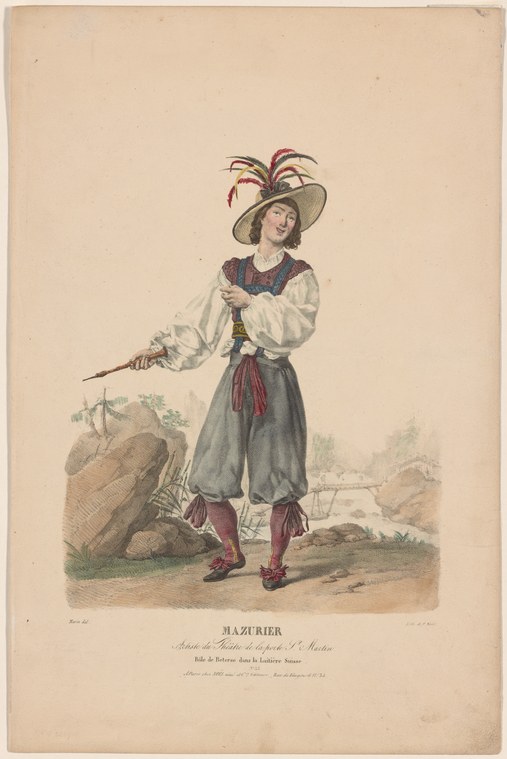
Mazurier artiste du Théâtre de la Porte St. Martin. Rôle de Beterse dans La laitière suisse
Unknown artist
- Collection:
- Prints depicting dance
- Source:
- New York Public Library
- Rights:
- Public domain — free to use, share and adapt.
- Recorded as:
- Public Domain
This print is a rare direct document of early-19th-century French opéra comique dance repertory and costume. The specificity of the role name and venue allows researchers to cross-reference it with playbills and archives; it is therefore a datable witness to how this dancer performed and how the character was conceived. For historians of theater, costume, and the emergence of the professional female performer, it captures the moment when dance began to separate into competing registers—classical ballet in the same theaters, but alongside character and comic roles that drew on different bodies, different vocabularies, and different social meanings.
What you are looking at
A young woman stands alone in a theatrical pose against a distant landscape with rolling hills and a bridge. She wears a Swiss-peasant costume: a white cotton chemise with puffed sleeves, a dark woolen skirt gathered at the waist with a red ribbon, and thick red stockings. Her feet are planted firmly and her body leans slightly forward. She holds a long walking stick or staff in her right hand and gathers fabric in her left. A large straw hat trimmed with red and white feathers sits on her head, and the brim is pulled forward dramatically. The setting is a theatrical interior rendered in pale wash; she stands on rough ground before a painted backdrop. The image is a hand-colored engraving or lithograph with considerable tonal nuance—soft shadows beneath the figure and feathering in the background landscape suggest careful work by the colorist.
The dancing
A single dancer frames the composition, weight balanced on both legs in a stable stance. Her torso inclines forward from the hips in a posture between standing and the early moment of movement—suggestive of a curtsy or the beginning of a character phrase. The arms are asymmetrical: one hand rests on the hip or gathers the skirt, the other extended to hold the staff. The neck is long, the head held upright despite the weight of the hat. No partner or chorus is visible; the focus is entirely on her isolation and her costume.
The dance depicted
The role is *Beterse* in *La laitière suisse* (*The Swiss Milkmaid*), a popular theatrical vehicle of the 19th-century French stage. The title identifies the dancer as Mazurier, likely Alexis Pitou known professionally as Mazurier, who performed at the Théâtre de la Porte-Saint-Martin in Paris. *La laitière suisse* was a comic opera-ballet hybrid that mixed social dance, character pantomime, and folk costume. The stance and costume are consistent with early Romantic theater: a character from humble rural life, romanticized and exoticized for urban audiences. No classical ballet technique is evident; this is character dance or opéra comique repertory, where narrative and local color took precedence over vocabulary.
How it was made
This is a hand-colored engraving or lithograph—likely lithographed, given the soft tonal gradations and the absence of heavy cross-hatching. The image shows the delicate registration typical of colored theatrical prints: the outline is firm and economical, and the pigment (probably watercolor or gouache over the printed surface) is applied in thin, translucent washes to preserve detail. The technique allowed rapid multiplication for sale at theaters and through print dealers, making this an affordable commodity for fans of theater and performers. The presence of hand-coloring indicates it was a mid-range product, more finished than a plain engraving but less costly than a complete oil portrait.
About this work
A theatrical souvenir portrait of a dancer in character costume, printed and hand-colored for circulation in the 1830s or 1840s. The work documents both the performer Mazurier and the Romantic theater's appetite for exotic-peasant spectacle. Such prints served as advertisements, mementos, and tokens of fandom; they were sold at stage doors and in theater lobbies. In the context of dance history, it preserves a moment when character roles and folk costume were becoming formalized into a theatrical language, and when individual performers (especially dancers in comic roles) could achieve sufficient fame to warrant their own printed portraits. The image sits between fine art and commercial ephemera—refined enough to hang in a parlor, popular enough to be treated casually and lost.
How to look at it
Attend to the deliberate artificiality of the pose: the figure is neither purely standing nor moving, but caught in a kind of display posture typical of theatrical portraiture. The staff and gathered skirt suggest narrative—she is a shepherdess or milkmaid—yet the formal frontality and the studio backdrop remind you this is a portrait of a performer, not a scene of actual labor. The hat is oversized and theatrical; no real milkmaid would wear such an ornament. The print thus bridges two registers: it honors the performer as an individual (hence the naming) while also presenting her as a type—a character role in an inventory. The coloring of the stockings in red is particularly significant, as it signals theatricality and legs as a visual subject, consistent with the emerging cult of the female dancer.
The period
This print dates to the era of French Romantic theater (c. 1830–1850), when the Paris stage was divided between the Opéra (for ballet and grand spectacle) and the boulevards and theaters like the Porte-Saint-Martin (for opéra comique, vaudeville, and melodrama). Mazurier was active in this period and was known for comic and character roles—a category of performer distinct from the ballerinas who danced pointe. The Swiss peasant was a stock Romantic figure, following the vogue established by Rousseau's *Julie* and perpetuated in Byron and Scott. The costume and setting are deeply coded: Swiss dress signaled rural innocence, virtue, and *exoticism-at-home*, allowing Paris audiences to consume an imagined pastorality without leaving the theater.
Where it lives
The work is held in the New York Public Library as part of its prints collection, which includes extensive runs of 19th-century theatrical portraiture. Such prints were often issued in series and sold cheaply; their survival in institutional collections is often accidental rather than the result of deliberate preservation, making dated examples particularly valuable for reconstruction of theatrical history.
Dance in this work
Questions about this work
Who was Mazurier?
Alexis Pitou, known as Mazurier (c. 1800–1864), was a French dancer and performer best known for character and comic roles in opéra comique and vaudeville. He was based at the Théâtre de la Porte-Saint-Martin and was celebrated for his physical comedy and mimetic skill rather than classical ballet technique. He had a successful career in Paris and also performed abroad.
What was *La laitière suisse*?
A comic opera-ballet that exploited the Romantic-era taste for Swiss and Alpine imagery. Multiple composers and librettists created versions under this title or closely related ones throughout the 19th century. The piece typically mixed sung dialogue, social dance, and character business, allowing performers like Mazurier to anchor the comic scenes with physical comedy and dance.
How is this different from a ballet print?
Ballet prints of the same era typically show dancers in classical dress (tutus, tights, pointe shoes) and formal positions derived from academic technique. This print shows a character role in a vernacular or folk costume, with a posture and bearing suited to narrative realism rather than abstract display. The distinction mattered: ballet was elite and international; character roles were tied to specific theaters, plots, and national traditions.
Why is the hat so large and feathered?
The hat is a theatrical exaggeration of traditional Swiss women's dress, designed to be visible from the back of a large theater and to signal the character and setting instantly. The oversized proportions and exotic feathers make it clear this is costume, not authenticity—a reminder that Romantic theater's 'Swiss peasantry' was entirely a fantasy for Parisian audiences.
More dance artwork





