49 works in this view — arrow keys or swipe to move between them.
Dance in Art
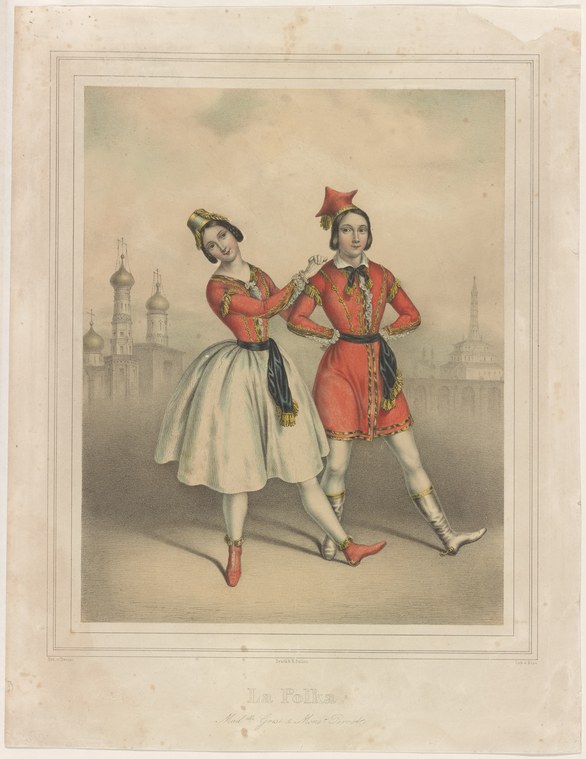
La polka. Madelle. Grisi & Monsr. Perrot
Unknown artist
- Collection:
- Prints depicting dance
- Source:
- New York Public Library
- Rights:
- Public domain — free to use, share and adapt.
- Recorded as:
- Public Domain
This image documents the moment when social dance and theatrical ballet intersected, as the polka craze of the 1840s-50s became material for the stage. It shows how Romantic-era ballet absorbed and repackaged contemporary social dances, using them as vehicles for exotic spectacle and nationalist fantasy. The work is also evidence of the star system in nineteenth-century dance: Grisi and Perrot were the celebrities of their day, and prints of their performances were commodities as sought-after as photographs of stage stars would later become.
What you are looking at
Two dancers in theatrical dress dominate a stage set against a backdrop of Russian Orthodox church spires and architecture. The figure on the left wears a red velvet jacket with gold trim over a white pleated skirt, with a black ribbon at the waist and red heeled shoes, her head tilted in a flirtation pose. The figure on the right, in similar red velvet costume with a distinctive red Phrygian cap, stands with hands on hips in a confident stance. Both dancers are captured mid-performance, their bodies animated and their engagement with each other theatrical. The stage setting suggests a Russian or Eastern European locale, establishing the exoticist context typical of Romantic-era ballet spectacle. The hand-colored print technique brings warmth to the costumes while the architectural backdrop grounds the scene in a specific geographical fantasy.
The dancing
Both dancers stand in upright, energetic poses rather than the ethereal, vertical alignment of classical ballet. The woman's body tilts playfully, her gaze directed toward her partner in a moment of coquettish engagement rather than ethereal abstraction. The man's posture is grounded and masculine, with a wider stance and squared shoulders. Neither figure displays the extreme turnout or lifted port de bras characteristic of academic ballet technique; instead, their carriage suggests the folk-derived, character-based movement of social dance performance.
The dance depicted
This is a theatrical representation of the polka, the Czech social dance that became a sensation across Europe in the 1840s-50s. The title credits performers Mlle Grisi and M. Perrot—likely Carlotta Grisi and Jules Perrot, the renowned Romantic ballet stars—indicating this depicts a staged, theatrical interpretation of the polka rather than ballroom performance. The polka's rapid turning steps, lively character, and appeal to exotic nationalism made it a frequent subject for ballet divertissements. The dancers' costumes and the Russian setting suggest this is a nationalized version of the dance, placing it within the vogue for ballets featuring folk dances of distant territories.
How it was made
This is a hand-colored lithograph, a mass-market print medium that enabled rapid, affordable circulation of images of popular performers and fashionable dance crazes. The subtle tonal gradations in the background architecture and the detail visible in the costumes—the individual pleats of the skirt, the texture of the velvet jacket—demonstrate lithography's capacity for fine rendering. The hand-coloring, applied after printing, gives the work immediacy and warmth, making it a commercial souvenir of a celebrated performance rather than a precious unique object. Such prints were sold to ballet audiences as mementos and to the broader public as fashionable imagery.
About this work
This is a theatrical print documenting a staged polka performance by two of the Romantic era's most celebrated dancers. The work captures a moment when the polka—a new, exhilarating Czech social dance—was being absorbed into the ballet repertory and given exotic, nationalized staging. Rather than a ballroom scene, this shows the polka as spectacle, performed by professionals in character costume on a theatrical stage, for an audience accustomed to the narrative and visual conventions of ballet. The print's circulation as a mass-market commodity reflects the intense public hunger for dance imagery in the mid-nineteenth century, when lithographic technology made such souvenirs affordable and accessible.
How to look at it
Notice the dancers' posture and line, which differ markedly from the lifted, turnout-based verticality of classical ballet technique visible in other prints of the era—these bodies are grounded and energetic rather than ethereal. Observe the moment the artist chose: not the rapid turning steps of the polka itself, but a pause in which the dancers engage each other with mutual awareness and flirtation, emphasizing the social pleasure of the dance rather than its technical demands. The architectural backdrop is key: it establishes this as a theatrical polka performed in character, on a stage, rather than a ballroom scene, marking the boundary between social and theatrical dance.
The period
The polka emerged in Bohemia in the 1830s and became a craze across Europe within a decade, reaching its peak in the 1840s-50s when the work was likely created. The dance represented modernity, energetic sociability, and nationalist sentiment—Bohemian or Eastern European exoticism—at a moment when European ballet was intensely invested in spectacle, folk material, and the performance of distant territories. Carlotta Grisi and Jules Perrot were stars of the Romantic ballet, the era defined by ethereal, technically demanding roles for women and the emergence of the ballerina as celebrity. The inclusion of a polka divertissement in a ballet program would have been both fashionable and lucrative, offering audiences the thrill of a contemporary social craze experienced through the mediation of trained dancers and theatrical design.
Where it lives
The work is held in the New York Public Library's collection of prints depicting dance. It is a commercial theatrical souvenir, one of many such prints produced in the nineteenth century to document celebrated performances and to meet public demand for images of fashionable dancers and dances.
Dance in this work
Questions about this work
Who were Grisi and Perrot?
Carlotta Grisi (1819–1899) and Jules Perrot (1810–1894) were among the most celebrated dancers of the Romantic era. Grisi was known for her virtuosity and dramatic presence; Perrot was a premier danseur and choreographer who created many of the era's most important ballets. Both appeared in major European opera houses and were international celebrities.
What was the polka and why did ballet dancers perform it?
The polka was a lively social dance from Bohemia that became a Europe-wide craze in the 1840s-50s. Ballet choreographers incorporated it as a divertissement—a showpiece number—in full-length ballets, partly to capitalize on its fashionability and partly because its energetic character and nationalist associations fit the era's appetite for exotic spectacle. Audiences loved seeing famous ballet stars perform contemporary popular dances.
How do I know this is a lithograph?
The hand-colored surface, the tonal range in the background, the soft quality of the line, and the overall aesthetic are characteristic of nineteenth-century colored lithography. Unlike engraving or etching, lithography produces a warmer, softer image with subtle gradations of tone, and the hand-coloring after printing gives it the particular luminosity and flatness visible here.
Why is this image significant for dance history?
It documents the moment when social dance and theatrical ballet merged, showing how the stage incorporated and transformed contemporary popular dances. It also demonstrates the star system in nineteenth-century dance: these prints were commodities, and famous dancers' images were actively collected and consumed as fashion and celebrity merchandise.
More dance artwork





