49 works in this view — arrow keys or swipe to move between them.
Dance in Art
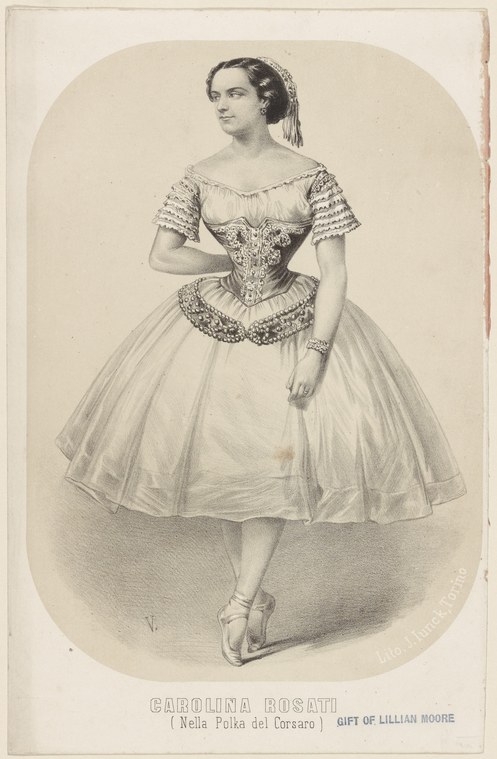
Carolina Rosati (nella polka de Corsaro)
Unknown artist
- Collection:
- Prints depicting dance
- Source:
- New York Public Library
- Rights:
- Public domain — free to use, share and adapt.
- Recorded as:
- Public Domain
Rosati was among the most celebrated ballerinas of her generation, and this print is a primary document of how she was marketed and visualized by her public. The image shows what a mid-century Romantic ballet dancer was expected to embody: not movement or athletic power, but an idealized, refined, almost weightless grace. The presence of pointe shoes and the emphasis on the lower body also mark this as evidence of the technical development of Romantic ballet at a moment when pointe work was becoming the norm.
What you are looking at
A young woman in mid-nineteenth-century theatrical costume stands in a graceful pose against a plain background. She wears a white muslin dress with a fitted, heavily embroidered bodice featuring ornamental braiding, and short puffed sleeves trimmed with decorative border work. The skirt falls to mid-calf in the full, gathered style of the 1840s–50s Romantic era, with the characteristic bell shape achieved through layering. A white lace fichu or collar drapes across her shoulders and chest. Her dark hair is swept back and adorned with a snood or hair net. She stands with her weight on one leg in a refined contrapposto, arms held in a soft, open position at her sides. Her pointe shoes—faintly visible—indicate she is posed as a ballet dancer. The tonal engraving uses fine cross-hatching to render fabric texture and the fall of light across the dress; the vignette oval format frames her as a portrait of a named performer rather than a narrative scene.
The dancing
A single female dancer stands alone in a posed, formal attitude. Her posture is upright and dignified, with the weight balanced and legs aligned in classical ballet stance. The arms hang naturally at the sides in a soft, open position characteristic of Romantic-era portraiture. The angle of the head, turned slightly, and the gentle tilt of the torso suggest a moment of staged repose rather than active motion. The costume and the precise positioning indicate a trained professional dancer and a pose likely taken from theatrical convention rather than from a moment mid-movement.
The dance depicted
This is a portrait of Carolina Rosati, a celebrated Italian prima ballerina of the mid-nineteenth century, depicted in costume from the ballet *Le Corsaire* (The Pirate). The title's parenthetical reference to "Nella Polka del Corsaro" (In the Polka from Le Corsaire) indicates that she performed or was known for a polka within the ballet—a notable detail, as the polka was a contemporary social dance that composers of the period sometimes interpolated into Romantic ballet. The engraving is a record of her theatrical fame and of the Romantic ballet aesthetic at its height: the ethereal white dress, the pointe work, and the emphasis on the dancer's delicate form and refined bearing all align with the conventions of the Paris Opera ballet in the 1840s–50s.
How it was made
This is a steel or copper engraving, likely a commercial theatrical portrait print produced for distribution to audiences and collectors. The technique involves fine parallel lines and cross-hatching to model form and suggest the texture of fabric, lace, and hair. The vignette oval framing was a convention of theatrical portraiture of the period, used to direct focus on the figure and to suit the format to both frames and periodicals. The quality and detail of the work suggest it was produced by a professional engraver, probably based on a painted or photographic portrait. Such prints were circulated widely and relatively affordably, making them accessible to a broad audience interested in opera and ballet.
About this work
This is a mid-nineteenth-century theatrical portrait engraving of Carolina Rosati as a ballerina in *Le Corsaire*, one of the canonical Romantic ballets. The work captures the visual language of mid-century ballet at the moment of its greatest international fame: the ethereal white costume, the emphasis on the dancer's figure and refined deportment, and the romantic idealization of the performer. The print belongs to a widespread commercial practice of circulating portraits of celebrated dancers to their public, and it documents both the celebrity culture of the operatic world and the specific aesthetic values—ethereality, grace, technical refinement—that defined Romantic ballet in the 1840s–50s. The reference to a polka within the ballet also signals the way contemporary social dances were incorporated into theatrical spectacle during this period.
How to look at it
Look at the dress first: the white muslin, the embroidered bodice, the full bell skirt are the visual signature of Romantic ballet, idealized and weightless. Notice the pointe shoes—they are small but deliberate, marking this as a professional dancer and not a mere society woman. Look at the posture: the figure is not in mid-movement but in a posed attitude, the weight settled, the arms soft. This is the theatrical convention of the period—the ballerina as a static, beautiful object to be admired, not an active, dynamic mover. The engraving technique, with its fine parallel lines, creates a silvery, ethereal effect that enhances the sense of lightness and refinement. The oval vignette frame isolates the figure and gives her the status of a named celebrity rather than an anonymous dancer.
The artist
The artist is not recorded. The print was donated to the New York Public Library from the Lillian Moore collection, one of the major research archives of theatrical dance history in the mid-twentieth century. Moore (1906–1984) was a historian and librarian who specialized in ballet and built one of the largest collections of historical dance imagery and texts in North America. The presence of the print in the Moore collection attests to its recognized value as a document of ballet history.
The period
This engraving was made during the height of the Romantic era in ballet, approximately 1840–1860. The white tutu, pointe shoes, and ethereal aesthetic of Romantic ballet had become international conventions, and *Le Corsaire* (first choreographed by Joseph Mazilier in 1856, though elements may predate that premiere) was among the works that codified the genre. Carolina Rosati was a rival and contemporary of other great Romantic ballerinas—among them Carlotta Grisi, Marie Taglioni, and Fanny Cerito—and the print exists within a vast commercial culture of dancer portraiture that served to market individual performers and the ballet itself to a growing urban middle-class audience. The incorporation of a polka into the ballet reflects the period's appetite for contemporary social dances as interpolated spectacles within narrative ballet.
Where it lives
The print is held by the New York Public Library as part of its collection of prints depicting dance. It was given to the library from the Lillian Moore collection, one of the major archives of dance history documentation assembled in the twentieth century. Moore, a dance historian and librarian, was instrumental in preserving and organizing historical materials on ballet and theatrical dance in North America.
Dance in this work
Questions about this work
Who was Carolina Rosati?
Rosati (1826–1905) was an Italian prima ballerina who had an international career spanning the 1840s–70s. She was a celebrated dancer of the Romantic era, a rival to other great ballerinas of the period, and known for both dramatic roles and technical virtuosity. She appeared in the major European ballet centres—Milan, Vienna, Paris, London—and was a exponent of works by Mazilier and other leading choreographers.
What is *Le Corsaire* and what is the polka reference?
The full title references a polka from the ballet *Le Corsaire* (*The Pirate*), a Romantic-era ballet that incorporated contemporary social dances—including polkas, tarantellas, and other national or popular dances—as spectacles within its narrative. The polka was a fashionable social dance of the mid-nineteenth century, and its inclusion in a ballet was a way of bringing contemporary style and topicality into theatrical spectacle.
Why are there so many prints of individual dancers from this period?
Theatrical portraiture was a major commercial genre in the nineteenth century. Dancers, singers, and actors were celebrities, and prints of them in costume were sold to audiences, collected as mementos, and circulated in periodicals. These portraits served to market performers and to allow their public to possess and display images of their favorites.
What do the pointe shoes tell us?
By the mid-nineteenth century, pointe work had become standard in Romantic ballet, and the depiction of a ballerina on pointe (even in a static pose) was a visual marker of classical training and the ballet technique of the period. Pointe shoes had not been universal in earlier eras, so their presence here marks both the historical moment and the dancer's professional status.
More dance artwork





