49 works in this view — arrow keys or swipe to move between them.
Dance in Art
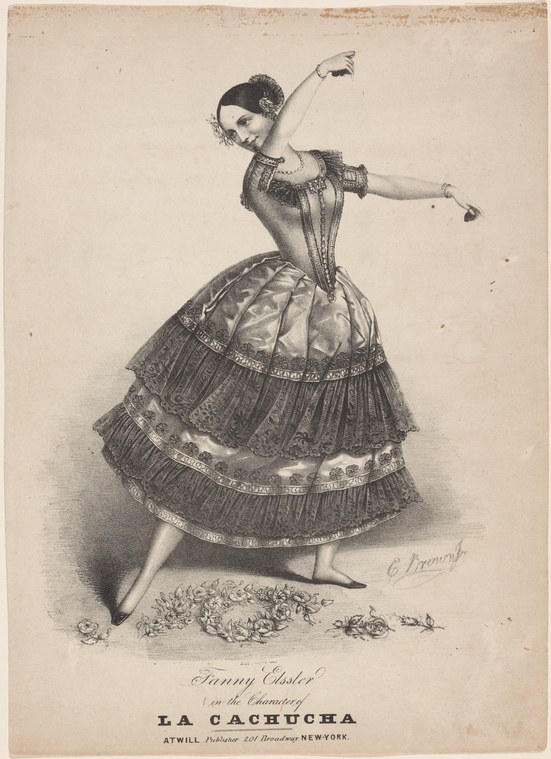
Fanny Elssler in the character of La cachucha
Unknown artist
- Collection:
- Prints depicting dance
- Source:
- New York Public Library
- Rights:
- Public domain — free to use, share and adapt.
- Recorded as:
- Public Domain
Fanny Elssler was one of the most celebrated dancers of her era and arguably the first international dance superstar; her American tours created a cultural phenomenon and influenced the trajectory of 19th-century American theater. The Cachucha was her signature role and this image is an artifact of the commercial mechanics of theatrical celebrity in the pre-photographic era—how dance was remembered, promoted, and circulated to audiences.
What you are looking at
A woman in mid-performance strikes a dramatic pose against a plain background, her body twisted in a complex, dynamic position. She wears a dark, fitted corseted bodice with short puffed sleeves, paired with a spectacular tiered skirt of pale fabric (likely white or cream) decorated with dark ribbons or bands arranged in horizontal stripes. The skirt is voluminous and caught mid-motion, the layers splayed outward to suggest rapid spinning. Her left arm is raised above her head in an elegant line while her right arm extends outward; her body is arched and her head tilted back in what appears to be a moment of peak exertion. Her feet are visible beneath the skirt, one lifted; she wears what appear to be soft ballet-type shoes. At the base of the composition, scattered flowers or floral garland are rendered in light gray, suggesting either a stage floor decoration or a symbolic tribute to the performer. The entire image is rendered in black ink on cream paper with careful stippled shading to suggest form and texture, and bears a signature at lower right.
The dancing
A solitary female dancer is shown in a moment of high virtuosity, her body extended through the coronal plane in a twist that demands both flexibility and core strength. Her free arm gestures are fluid and expressively raised; her weight appears to be supported on one leg with the other lifted, suggesting active movement rather than a static pose. The lift and openness of her torso, the arc through her spine, and the extension of her limbs all suggest a dancer of considerable technical ability executing a turn or spinning figure with theatrical flair.
The dance depicted
This is a portrait of Fanny Elssler, the renowned Austrian ballerina, executing the Cachucha, a Spanish-derived dance that became one of the signature roles of her career. The Cachucha was not classical ballet but rather a character dance—a theatrical interpretation of Spanish folk tradition—which sat at the boundary between ballet and popular entertainment in the 1830s–40s. The dramatic pose, the tiered skirt, the bodice construction, and the flowers at her feet are all consistent with Romantic-era theatrical dance. The image likely documents a specific moment from a celebrated performance, possibly *La Cachucha* or the divertissement within another ballet.
How it was made
This is an engraving or lithographic print on cream laid paper, executed with fine black line-work and careful stippling to create volume and shadow. The technique allowed for rapid commercial reproduction and distribution, which suggests this was a popular theatrical merchandise item—souvenir images of celebrated dancers sold to patrons who wished to remember performances or own images of their favorite artists. The publisher credit at the base (Atwill, Broadway, New York) confirms American commercial production and circulation, indicating the work's audience was primarily mid-19th-century theatergoers in the northeastern United States.
About this work
This engraved or lithographed theatrical portrait captures Fanny Elssler at a peak moment of the Cachucha, the Spanish character dance that made her an international star in the 1830s and 1840s. The image is simultaneously a technical study of the dancer's form and a piece of theatrical promotion—a souvenir print designed for circulation among New York audiences. Elssler's career was one of the great narratives of 19th-century dance: she brought character dances and national traditions into the concert hall, giving them the technical rigor and theatrical presentation of classical ballet while preserving their folk character. This image documents not only a dancer but a historical moment in which the repertoire and social meaning of dance were expanding.
How to look at it
Look first at the moment frozen in time: this is not a pose but a turn, captured at the instant of maximum rotation and extension. The artist has chosen a moment of peak virtuosity—the instant in which the dancer's body is most visibly engaged. Observe the construction of the costume: the tiered skirt is rendered in a way that suggests rapid motion, with each layer of fabric shown at a slightly different angle, as if the layers have not yet finished catching up with the body's rotation. The flowers at the base are a traditional theatrical convention, representing the admiration of the audience. The artist demonstrates knowledge of the body in motion, not merely a posed arrangement—this is how a dancer actually looks when executing a spectacular turn.
The artist
The artist is not recorded in the catalogue. The print is attributed to Atwill, a New York publisher and print seller whose name appears on the inscription. Atwill was active in the mid-19th century and produced theatrical lithographs, ballet prints, and souvenir images for a popular audience. The quality of the engraving and the composition suggest a professional theatrical illustrator working within the well-established genre of celebrity dancer portraiture, a category that flourished in this era.
The period
The 1830s–40s saw a major shift in ballet and theatrical dance. The Romantic ballet was at its height, but it was also beginning to incorporate character dances—Spanish, Italian, Neapolitan, and other folk traditions—as dramatic episodes within longer narrative ballets. Fanny Elssler (1810–84) rose to international fame in part because she excelled in these character roles, breaking from the abstract ethereality of pure classical ballet. Her 1840–42 American tour was a sensation; she danced in Philadelphia, New York, Boston, and Washington, creating a frenzy of popular interest. This image, bearing a New York publisher's name, is a direct artifact of that craze. In the same period, lithography was becoming the dominant technology for reproducing images, and commercial theatrical prints were mass-produced for sale at theaters, print shops, and by itinerant vendors.
Where it lives
This print is held in the New York Public Library's collection of prints depicting dance. It was published by Atwill, a Broadway-based print seller, and was intended for theatrical souvenir trade in mid-19th-century New York. Such prints were common merchandise and were often pasted into albums or kept as mementos of favorite performances.
Dance in this work
Questions about this work
Who was Fanny Elssler?
Fanny Elssler (1810–84) was an Austrian ballerina who became one of the most celebrated dancers of the 19th century. She was known for her technical brilliance in classical ballet and her exceptional performances in character dances, especially the Cachucha. She partnered with Maria Taglioni as the rival star of the Romantic ballet era, but where Taglioni embodied the ethereal, Elssler brought dramatic intensity and earthiness to the stage.
What is the Cachucha?
The Cachucha is a Spanish dance, originally a folk form but adapted for theatrical performance. In Elssler's hands, it became a virtuosic showcase—a character dance combining the technique of classical ballet with the flavor of Spanish tradition. It typically features rapid turns, sharp articulation, and energetic footwork. For Elssler, it was the role that defined her career and made her reputation.
Why would theaters sell these prints?
Theatrical souvenir prints were a major part of how 19th-century performers built celebrity and how audiences remembered performances. Before photography became widespread, these lithographed and engraved images were the primary way fans could possess an image of their favorite dancers. They were sold at the theater, in print shops, and by street vendors, and often pasted into scrapbooks or albums alongside similar images of other performers and theatrical events.
Is this a realistic depiction of how the dance was performed?
Yes and no. The pose is clearly exaggerated for theatrical effect—no dancer could hold this exact position in performance. But the artist has captured something essential about the movement: the sense of rotation, the openness of the body, the extension and control required. This is a stylized but knowledgeable representation, not a fantasy.
More dance artwork





