49 works in this view — arrow keys or swipe to move between them.
Dance in Art
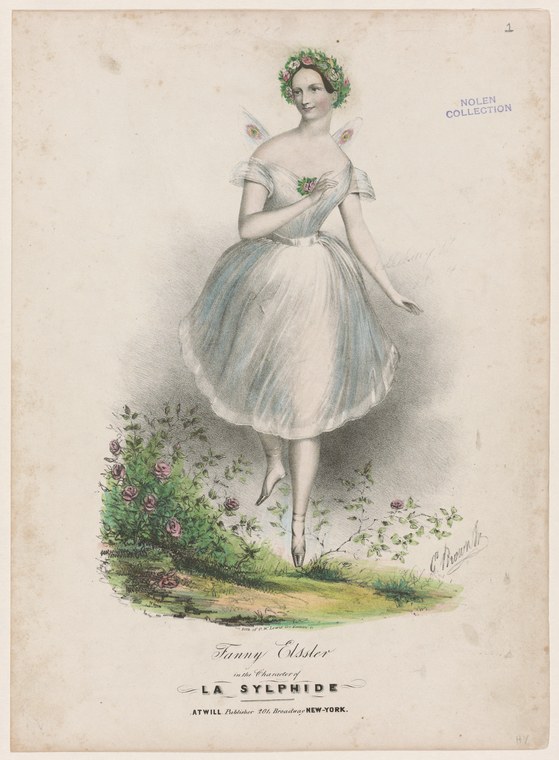
Fanny Elssler in the character of La sylphide
Unknown artist
- Collection:
- Prints depicting dance
- Source:
- New York Public Library
- Rights:
- Public domain — free to use, share and adapt.
- Recorded as:
- Public Domain
Elssler was among the most technically gifted and commercially successful dancers of her time, and La Sylphide was one of her most famous roles. This print is a primary document of how Romantic ballet was visualised and circulated to audiences, and it preserves a record of a performance style that exists only in images, notation, and written accounts. For historians of dance and visual culture, such prints are essential evidence of how Romantic ballet technique and aesthetics were understood and marketed.
What you are looking at
A young woman in a pale tulle skirt stands alone in a sylvan setting, posed in an attitude of ethereal stillness. She wears an off-shoulder white dress with short puffed sleeves, a wreath of green leaves and small flowers crowning her head, and holds a single stem in one hand while her other arm crosses her body. Her posture suggests suspension between rest and flight—her weight appears light, her frame delicate. Behind her, a low flowering shrub (possibly a rhododendron or similar bloom in pink and purple) grounds the composition; soft grass and indistinct foliage complete a romantic garden or woodland setting. The figure is rendered in careful pencil with hand-coloured accents—the flowers tinted pink and green, the sky left pale. The image has the quality of a theatrical portrait: the dancer is presented as a character rather than a named performer, yet the inscription below identifies her as Fanny Elssler in the role of La Sylphide.
The dancing
A single dancer in an almost motionless pose, her weight settled but her frame alert. Her arms are neither fully extended nor held close—one hand rests near her body, the other extended downward to hold a flower stem, creating an asymmetrical line that suggests ease rather than formal alignment. Her head tilts slightly, her gaze soft and directed neither toward the viewer nor fully away. There is no active footwork visible; the emphasis is on port de bras and a stillness that reads as watchfulness rather than rest.
The dance depicted
This is a portrait of Fanny Elssler as the Sylphide, the eponymous spirit-dancer from the Romantic ballet La Sylphide (choreography by Philippe Taglioni, 1832). The Sylphide became one of the defining roles of the Romantic era, demanding a technique of elevation, ethereal port de corps, and the ability to embody otherworldly grace. Elssler's interpretation made the role famous across Europe and America, and this print documents how the role was visualised and sold to audiences. The pose here—suspended, delicate, neither fully grounded nor fully airborne—captures the essential quality of Romantic ballet technique: the illusion of weightlessness and supernatural presence.
How it was made
This is a hand-coloured lithographic or engraved print (the technique cannot be definitively determined from the image alone, but the style and line quality suggest lithography). The artist has combined monochromatic line work with selective watercolour tinting—the flowers, wreath, and grass are carefully tinted, while much of the figure remains in soft graphite. This mixed technique was standard for theatrical prints of the 1830s–1840s: economical enough to produce in quantity, yet refined enough for sale to theatregoers and collectors. The selective colour draws the eye to the floral setting and Elssler's costume while allowing the figure itself to read as a drawn portrait rather than a fully painted ideal.
About this work
This is a theatrical character print of Fanny Elssler performing as the Sylphide, a role that defined the Romantic ballet and made Elssler one of the most celebrated dancers of her era. The work documents not the performance itself but its image—how the role was visualised, marketed, and circulated in print culture. It is one of thousands of such prints produced in the 1830s–1840s, yet it captures something essential about Romantic ballet: the emphasis on the ethereal body, the supernatural narrative, and the cult of the individual dancer-celebrity. The inscription at the bottom identifies both dancer and character, anchoring the image in theatre history while the composition—the solitary figure in nature—embodies the Romantic period's preoccupation with the lonely, magical, or otherworldly.
How to look at it
Attend to the artist's choice to show the Sylphide not in action but in stillness—a moment of watchfulness in the garden rather than a leap or turn. Note how this poses a technical challenge for the printmaker: how to convey the Sylphide's otherworldliness not through dynamic movement but through pose, costume, and setting. The wreath and the pale tulle skirt are rendered with particular care; these are the immediate signs of the character and the role. The soft colouring and the solitary figure in the natural setting embody Romantic aesthetics—nature as the realm of the supernatural, the dancer as a visitor to the mortal world.
The artist
The artist is not recorded in the catalogue, though the style and publication details point to a professional theatrical print-maker of the 1830s–1840s, likely working in Europe or the United States. The signature or monogram on the image, if present, is not legible in the reproduction. Such prints were typically produced by specialist engravers and lithographers who worked from sketches made at performances or from dancers' photographs and studio portraits. The print was published by Atwill of New York, suggesting it was issued for the American market, possibly during or after Elssler's famous American tour (1840–1842).
The period
This print dates to the height of the Romantic ballet era (c. 1830–1850), when ballet became increasingly focused on supernatural narratives and the technical and theatrical capacities of the individual dancer—especially the female dancer en travesti or as a spirit, sylph, or exotic other. La Sylphide (1832) was one of the foundational works of this movement. Fanny Elssler was the greatest technical rival to Marie Taglioni, and her international tours (particularly to the United States and Spain) made ballet a mass-market entertainment. The visual culture of Romantic ballet—lithographic character prints, photographs, engravings—became a major form of theatrical promotion and fan culture, anticipating the celebrity imagery of later centuries.
Where it lives
This print is held in the New York Public Library's collection of prints depicting dance. It was published by Atwill of New York, a commercial theatrical publisher. The inscription "NOLEN COLLECTION" in the upper right indicates it was part of a collector's holdings, suggesting it circulated as a collectible item among theatre enthusiasts and dancers.
Dance in this work
Questions about this work
Who was Fanny Elssler?
Fanny Elssler (1810–1884) was an Austrian dancer and one of the two greatest ballerinas of the Romantic era (the other being Marie Taglioni). She was celebrated for her technical brilliance, especially in allegro movement and terre-à-terre technique, and for her dramatic presence. She performed across Europe and made a famous tour of the United States (1840–1842) that made ballet a major form of popular entertainment.
What is La Sylphide?
La Sylphide is a Romantic ballet created in 1832 by Philippe Taglioni for his daughter Marie Taglioni, though Fanny Elssler also famously danced the role. The story concerns a mortal man who falls in love with a sylph (a supernatural spirit of the air) and is destroyed by the enchantment. The role became emblematic of Romantic ballet: ethereal, technically demanding, and dependent on the dancer's ability to embody otherworldly grace.
What was the theatrical character print used for?
Theatrical character prints were one of the primary forms of theatrical promotion and fan culture in the 19th century. They were sold at theatres, in print shops, and by mail; they served as souvenirs of performances and as collectible images of celebrated dancers and roles. They were cheaper and more widely circulated than paintings, making them a mass medium of theatrical celebrity.
Why is the Sylphide shown alone in nature rather than dancing?
The Romantic ballet often emphasised the supernatural and the otherworldly through narrative and atmosphere rather than visible technique. By showing the Sylphide in a garden, alone and watchful, the print captures the character's mystical essence and her liminal status—she is a creature of nature, not of human society. This was consistent with how the role was understood and marketed to audiences.
More dance artwork





