49 works in this view — arrow keys or swipe to move between them.
Dance in Art
Augusta Maywood
Unknown artist
- Collection:
- Prints depicting dance
- Source:
- New York Public Library
- Rights:
- Public domain — free to use, share and adapt.
- Recorded as:
- Public Domain
Romantic ballet survives now chiefly through notation, written description, and visual records such as this—no film exists. Portraits like this one, when paired with a named performer and date, are crucial evidence for understanding the physical reality of the dance: the body shape, the line of the arm, the costume detail, and the aesthetic standard the performer aspired to achieve. This image is one of thousands of theatrical prints produced in this era, yet each one preserves a moment in the history of performance and taste.
What you are looking at
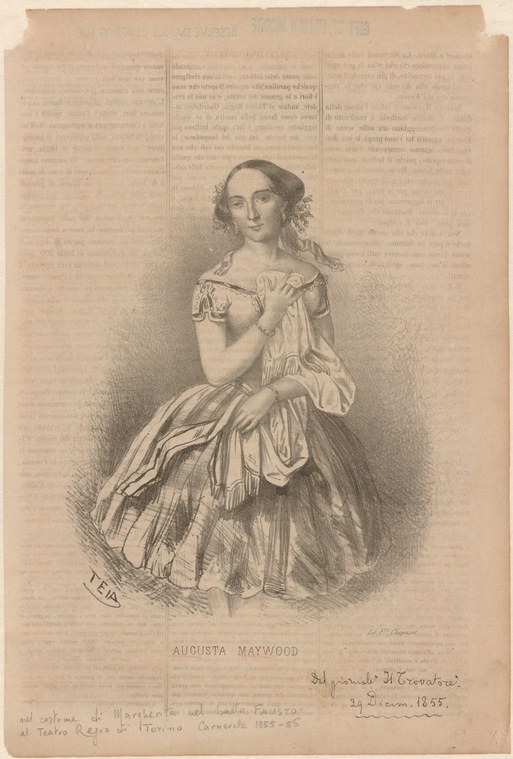
A three-quarter-length portrait of a young woman in Romantic-era theatrical dress, rendered in delicate pencil or engraving technique. She wears an off-shoulder white muslin dress with billowing sleeves and a full skirt caught mid-movement, its folds suggesting active pose rather than static repose. Her hair is dark and arranged in a fashion of the 1840s–50s, with what may be a small ornament or curl visible. The figure is positioned against a plain background with atmospheric shading that gives volume to her form. The signature 'TER' appears at lower left. Handwritten notes in the lower margin identify the subject and provide a date of 1855, along with notation of a theatrical performance.
The dancing
The dancer is caught in a moment of gentle movement or pause, with her weight shifted slightly forward and her upper body angled in a graceful contrapposto. Her arms hang naturally, with the right hand raised to approximately waist height in a gesture suggesting either preparation or the moment just following a movement phrase. The posture conveys the elongated spine and lifted carriage of classical training, and the silhouette of the skirt—gathered and lifted at the sides—is consistent with the romantic tutu of the period, suggesting the dancer may be en demi-pointe or lightly balanced.
The dance depicted
This is a portrait of a professional theatrical dancer, most likely in the Romantic ballet idiom that dominated European stages in the 1840s–50s. The costume—the short tutu, off-shoulder bodice, and ethereal white muslin—and the elevated, refined bearing are hallmarks of the Romantic ballet aesthetic exemplified by dancers such as Marie Taglioni. The image likely documents a specific performer in a celebrated role, or records the appearance and costuming conventions of that era's ballet. Without additional documentary evidence, the specific ballet cannot be identified, but the style and date are consistent with the height of Romantic ballet practice.
How it was made
This appears to be an engraving or lithographic print, possibly hand-finished or touched with wash, characteristic of theatrical portraiture of the mid-19th century. The technique—fine cross-hatching and carefully graded tones—was well-suited to the reproduction and circulation of performers' likenesses in periodicals, playbills, and collected sets of theatrical celebrities. The delicacy of the line-work and the atmospheric treatment of the background indicate skilled execution, typical of commercial theatrical print production in Paris or London, which were the centers of such imagery. The signature suggests an identified artist, though attribution would require cross-reference with period theatrical print publishers.
About this work
This is a mid-19th-century theatrical portrait documenting the Romantic ballet era, when ballet was the dominant theatrical dance form in Europe and dancers—especially female dancers—were celebrated stars. The work captures not only the physical appearance and costuming of a professional ballet dancer but also the aesthetic ideals of the period: ethereal grace, elongated lines, and the specific silhouette created by the romantic tutu and pointe work. The inscription identifies both the dancer and the date of documentation, making this a primary historical record of how performers of this era were visualized and marketed. As a portrait type, it belongs to a vast production of theatrical prints that documented and circulated the images of celebrated dancers across Europe.
How to look at it
Attend to the silhouette and the weight distribution: the way the skirt catches and lifts tells you about the level of the dancer's elevation and the readiness of her movement. Notice the elongation of the neck and the carriage of the shoulders—this is not a relaxed portrait pose but a performance stance. The handwritten inscriptions and the signature technique of the print-maker place this work firmly within a tradition of celebrity documentation; the image records not only what this dancer looked like but how she and her era wanted to be seen and remembered.
The artist
The print is signed 'TER,' likely a theatrical print maker or lithographer of the mid-19th century. The initials and the professional quality of the work suggest a commercial artist working for the theatrical print market, possibly associated with Paris publishers who specialized in portraits of opera and ballet performers. Many such prints were unsigned or bore only initials; definitive artist identification would require archival research in theatrical print catalogues of the period.
The period
The 1840s and 1850s were the height of the Romantic era in ballet, centered on Paris and the Théâtre de l'Académie Royale de Musique (the Opéra). This was the age of Marie Taglioni, Fanny Essler, Fanny Cerrito, and Carlotta Grisi—internationally celebrated prima ballerinas whose likenesses were reproduced and sold across Europe. The era saw the full establishment of the romantic tutu, pointe work as standard technique, and the narrative ballet centered on supernatural and exotic themes. Simultaneously, lithographic and engraving technology enabled mass production of theatrical portraits, which were collected, framed, and displayed in homes and theaters. The inscription date of 1855 places this work at the tail end of the Romantic period, on the cusp of the shift toward ballet d'action and the grand spectacles of the Second Empire.
Where it lives
This work is held in the New York Public Library's collection of prints depicting dance, part of a much larger archive of theatrical portraiture and dance documentation. The holding context suggests the work has been catalogued as a cultural and performance artifact, grouped with similar prints of performers and dances rather than by artist or conventional print classification.
Dance in this work
Questions about this work
Who was Augusta Maywood?
Augusta Maywood (1825–1876) was an American-born ballet dancer who became an international star during the Romantic era. She was among the first American dancers to achieve prominence in Europe, and performed at major opera houses including those in Paris, Vienna, and London. She was celebrated for her technical virtuosity and her roles in Romantic ballets, and later became a ballet master and choreographer. By 1855, the date of this portrait, she had retired from the Paris Opéra but remained active in theatrical circles.
What is the romantic tutu?
The romantic tutu is the mid-length, full skirt worn in Romantic ballet—typically between knee and mid-calf—made of layers of white (or pale) tulle or muslin. It replaced the earlier longer skirts and created the distinctive silhouette of 1840s–50s ballet. The voluminous skirt allowed display of the dancer's legs and footwork while preserving the ethereal, otherworldly aesthetic the era prized. It is distinct from the later, shorter classical tutu that emerged in the late 19th century.
What does the notation mean?
The handwritten note at the bottom records Augusta Maywood's appearance in a performance at the Teatro Regio in Turin in December 1855, likely in a Romantic ballet or perhaps in a revival of an earlier work. This dating and documentation places the print as a contemporary record, created around the time of this documented performance or shortly after, rather than as a retrospective work.
More dance artwork





