49 works in this view — arrow keys or swipe to move between them.
Dance in Art
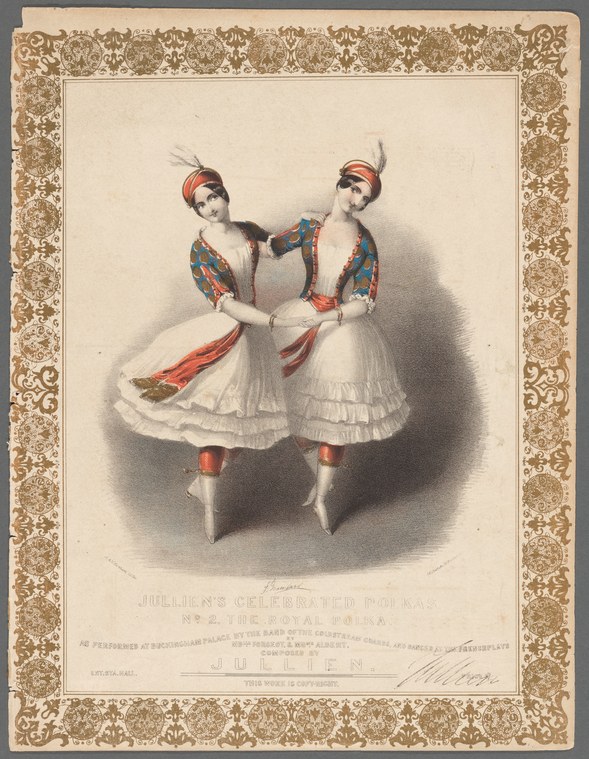
Jullien's celebrated polkas, no. 2, the royal polka, as performed at Buckingham Palace by the band of the Coldstream Guards, and danced at the French plays by Mdlle. Forgeot, & Mdlle. Albert; composed by Jullien
Unknown artist
- Collection:
- Prints depicting dance
- Source:
- New York Public Library
- Rights:
- Public domain — free to use, share and adapt.
- Recorded as:
- Public Domain
This print reveals the permeability between ballroom and stage in the 1840s, a moment when the polka—a newly fashionable social dance—was immediately incorporated into theatrical ballets and performed by celebrated professional dancers. It also documents the work of two named female dancers who would otherwise be largely invisible to history, and shows how lithographic prints functioned as both souvenirs of specific performances and as fashion plates that circulated dancers' images among the theatre-going public.
What you are looking at
Two female dancers in classical theatrical costume face each other in a symmetrical pose against a neutral ground. Each wears a white tiered skirt of the kind associated with 1840s Romantic ballet, a fitted corseted bodice with short sleeves decorated in contrasting patterned fabric (deep blue or teal with ornamental detail), and a wrapped sash or scarf in red silk that drapes diagonally across the body. Both wear feathered headdresses or turbans in red and gold. The figures stand on pointe or nearly so, their bodies angled toward one another in a moment of mutual regard or greeting. The lighting is soft and even, characteristic of theatrical portraiture, with subtle shading that defines the volume of the skirts and suggests a stage spotlight. A decorative gold and cream border frames the entire composition, typical of mid-nineteenth-century theatrical prints meant for display or souvenir collection.
The dancing
The two dancers mirror each other across a vertical axis, creating a balanced, formal composition. Each figure stands with one arm extended toward the other's waist or side in a gesture of closeness or connection; the opposite arm hangs or rests naturally. The posture is upright and dignified rather than dynamic—this is a moment of pause or salutation rather than the height of movement. The weight appears to be on or very near the ball of the foot, consistent with ballet training. The overall frame is closed and intimate, suggesting either a pas de deux moment or a formal acknowledgment between characters.
The dance depicted
This is a theatrical ballet image, almost certainly depicting a pas de deux or duet moment from the Romantic era of ballet. The title attributes the work to dancers Mlle. Forgeot and Mlle. Albert performing at the French plays, and states that the polka was composed by Jullien for performance at Buckingham Palace by the Coldstream Guards band. This creates a puzzle: polkas are social dances, yet the image shows ballet dancers in Romantic costume. The resolution likely lies in the mid-nineteenth-century theatrical practice of interpolating fashionable social dances—here a polka—into ballet narratives. The dancers' deportment and costume align precisely with 1840s Romantic ballet conventions. This appears to be a commemorative print of a specific performance or pas de deux, not a representation of social polka dancing as such.
How it was made
This is a hand-colored lithographic print, characteristic of the medium used for theatrical portraiture and dance illustration in the 1840s–1860s. The base image was drawn on stone in fine detail, then printed and carefully colored by hand in the workshop—a labor-intensive but economical process that allowed multiple copies for sale to theatre-goers and collectors. The decorative border was printed with the image. Lithography's soft tonal range and capacity for detail made it ideal for capturing the texture of fabric, the definition of the face, and the nuance of stage lighting. The presence of a signature at the lower right (barely legible in reproduction) suggests the print was issued as a commercial product, likely sold in the theatre lobbies or through print shops, making it accessible to a broad middle-class audience interested in theatre and fashion.
About this work
This hand-colored lithograph documents a moment from a mid-nineteenth-century theatrical performance at the French Theatre in London, featuring dancers Mlle. Forgeot and Mlle. Albert in a pas de deux set to Jullien's 'Royal Polka,' a composition commissioned for the Coldstream Guards' band at Buckingham Palace. The work is a hybrid genre piece, merging the fashionable ballroom polka of the 1840s with the formal conventions of Romantic ballet. It belongs in a dance history collection as evidence of how contemporary music and dance forms were rapidly assimilated into theatrical spectacle, and how commercial print culture documented and promoted specific performers and choreographic moments to an eager public. The image preserves a record of both the costume and the bodily practice of mid-nineteenth-century theatrical dance.
How to look at it
Attend to the formal symmetry and stillness of the pose: this is not a moment of dynamic motion but of tableau and greeting, the kind of staged 'picture' that punctuated Romantic ballet performances and allowed the audience to admire the dancers' forms and costumes. Note the Romantic-era details—the white tulle skirt with its signature tiers, the corseted bodice, the feathered headdress—which would have signaled to contemporary viewers that this was a theatrical, not a social, dance. The facing pose and the hand gesture between the dancers suggest intimacy or alliance, characteristic of pas de deux moments in which two dancers acknowledged each other as partners. The soft modeling and theatrical lighting are hallmarks of how lithography captured the experience of stage performance for audiences who could not attend the theatre.
The artist
The artist is not identified in the catalogue record, which is common for mid-nineteenth-century theatrical prints. The work was produced as a commercial print, likely by a London or Paris publishing house specializing in theatrical portraiture. The hand-coloring suggests a workshop operation with multiple hands involved in production. The decorative border and layout are consistent with the aesthetic conventions of prints issued by theatrical publishers in the 1840s–1850s.
The period
The 1840s saw the height of Romantic ballet in Western Europe, with works like Giselle (1841) and La Sylphide establishing the aesthetics of ethereal femininity, pointe work, and supernatural narrative that dominate the image. Simultaneously, the polka—a Bohemian couples' dance—swept through European ballrooms and popular culture with extraordinary speed after c. 1840, reaching London and Paris by the mid-1840s. Theatrical composers and choreographers rapidly adapted fashionable social dances into ballet narratives. Lithographic printing technology, fully mature by this date, made theatrical portraiture an affordable and widely circulated form of advertisement and souvenir. The print's decorative border and hand coloring place it in the luxury end of theatrical print production, suggesting it was marketed to affluent patrons.
Where it lives
This print is held in the New York Public Library's Prints depicting dance collection, part of the Library's broader documentation of dance history in visual culture. It is a commercial theatrical souvenir, one of numerous prints issued to commemorate notable performances and dancers in the mid-nineteenth-century London and Paris theatre.
Dance in this work
Questions about this work
Why does a ballet print mention a polka?
The polka was a fashionable new social dance in the 1840s, and theatrical choreographers frequently incorporated contemporary ballroom dances into ballet narratives as novelty attractions. This print documents a theatrical performance in which a polka by the composer Jullien was set to ballet and danced by professional performers in Romantic costume.
Who were Forgeot and Albert?
They were professional ballet dancers performing in London's French Theatre in the mid-nineteenth century. Beyond their appearances in theatrical prints and playbills, little biographical information survives, which is typical for performers of the era who did not achieve international fame.
What does 'at Buckingham Palace' mean?
Jullien's polka was composed for performance by the Coldstream Guards band at Buckingham Palace, likely for a royal event or ball. The same composition was later adapted into a theatrical ballet and performed at the French Theatre by Forgeot and Albert.
How was this print made and sold?
This is a hand-colored lithograph, a printing technology that allowed multiple copies to be produced from a stone plate and then individually colored by hand. Prints like this were sold in theatre lobbies, by print sellers, and through subscription, making them affordable souvenirs of celebrated performances.
More dance artwork





