49 works in this view — arrow keys or swipe to move between them.
Dance in Art
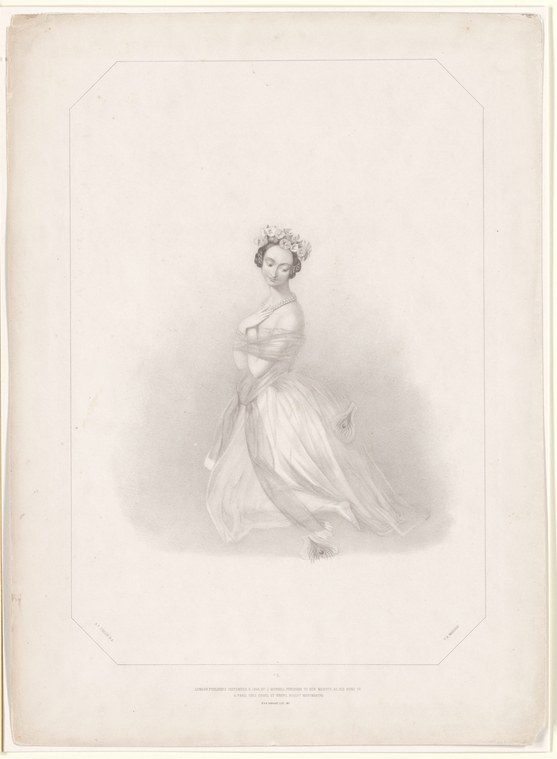
Souvenir d'adieu de Marie Taglioni
Unknown artist
- Collection:
- Prints depicting dance
- Source:
- New York Public Library
- Rights:
- Public domain — free to use, share and adapt.
- Recorded as:
- Public Domain
Marie Taglioni was perhaps the most influential ballerina of the 19th century, and prints like this disseminated her image and the aesthetic she embodied across Europe and beyond. This particular souvenir documents both a specific historical moment in dance and the visual conventions through which the Romantic ballet dancer was understood and memorialized by her public. For dancers and historians, it offers insight into how Taglioni's fame was manufactured and sustained through circulation of her likeness.
What you are looking at
A single female dancer is portrayed in a three-quarter view against a plain background, her body turned to show the line of her figure. She wears a fitted off-shoulder bodice and a full-length skirt of diaphanous material that sweeps around her in soft folds, suggesting movement or a poised moment mid-motion. Her hair is arranged up with flowers or ornaments, and her arms are positioned with grace—one raised, one at her side. The drawing is executed in graphite with subtle shading that creates volume and delicacy in both her dress and the surrounding space. The composition is intimate and focused: no setting, no other figures, no narrative beyond the pure presentation of a dancer's form and the elegant line of her port de bras.
The dancing
The dancer's weight appears to be settled on one leg, with the other subtly suggested beneath her skirt, a posture of calm readiness rather than mid-leap. Her frame is upright and elongated, characteristic of early 19th-century academic training. One arm is raised in a graceful curve at shoulder height; the other hangs with a gentle bend, creating a sense of balance and control. Her torso remains vertical while her skirt allows the viewer to imagine the movement that has just happened or is about to unfold. The overall impression is of stillness within motion—a dancer caught between steps, or posed for portraiture.
The dance depicted
This appears to be a portrait of a Romantic-era ballet dancer, almost certainly a study for a souvenir or commemorative print. The title identifies it as a farewell souvenir of Marie Taglioni, the Swedish-born Italian dancer who revolutionized ballet in the 1830s–1840s. Taglioni was famous for her ethereal technique, her use of pointe work, and her signature role in *La Sylphide* (1832). The costume—the off-shoulder bodice and gathered skirt—is consistent with the Romantic tutu of that period, and the delicate rendering of the fabric reflects the lightness and otherworldliness for which Taglioni was celebrated. The absence of narrative action is typical of ballet prints made as mementos or promotional materials, intended to preserve the memory of a celebrated performer.
How it was made
This is a lithograph or engraving in graphite on paper, executed in a tonal style that builds form through careful shading rather than line. The soft gradation from dark to light suggests the volume of the dancer's body and the transparency of her skirt; the technique allows for a subtle, almost photographic rendering of fabric and flesh. This was a favored medium for theatrical prints and souvenir engravings in the early 19th century, enabling wide circulation and relatively affordable reproduction. The quality of the work and its careful finish suggest it was made by a professional printmaker, likely for a publisher specializing in theatrical portraiture.
About this work
This is a commemorative engraving or lithograph of Marie Taglioni, the epoch-defining Romantic ballerina, captured in a moment of poised grace. The print serves both as a portrait of a celebrated performer and as a document of the Romantic ballet aesthetic—the ethereal costuming, the vertical line, the emphasis on elevation and weightlessness. The title *Souvenir d'adieu* (farewell souvenir) suggests it was made either to mark the end of a performance run, a farewell tour, or a retirement, a common practice in 19th-century theatrical culture. The work captures not a specific choreography but the ideal of the Romantic dancer—a figure suspended between the earthly and the ethereal, rendered with technical precision and emotional reserve.
How to look at it
Focus on the artist's choice of pose: the dancer is not in mid-leap or mid-action, but in a moment of composed stillness that nonetheless communicates grace, control, and potential. Notice how the skirt, rendered in careful gradations of tone, seems to float around her—this speaks to the Romantic preference for ethereality and weightlessness. The background is entirely plain and shadowless, a convention that isolates the dancer and makes her the sole subject of regard. Look at the arm positions: raised but not dramatically so, held with a gentle curve that suggests balletic training rather than naturalism. This is a portrait mode adapted to dance—the subject is a person, but the image is organized around the ideals of her art.
The artist
The artist is not recorded in the available catalogue information. However, the technical quality of the print—the assured handling of light and shadow, the sensitive rendering of fabric—suggests a trained printmaker working in the commercial theatrical portrait industry of early 19th-century Europe. Such works were often produced collaboratively, with a dancer or her representation sketched or painted by one artist and then transferred to stone or plate by a specialized printmaker. Attribution would require consultation with print archives or Taglioni scholarship.
The period
This print dates from the height of the Romantic ballet era, roughly the 1830s–1840s, when ballet was undergoing fundamental transformation. The Romantic movement in dance privileged otherworldliness, melancholy, and the ethereal female body; Taglioni embodied these ideals and became the template for the Romantic ballerina. Printmaking flourished as a technology during this period, allowing theatrical producers to market their stars and for audiences to collect and display images of celebrated performers. Lithography in particular had recently become a practical medium, enabling the soft tonal effects visible in this work. Theatrical portraiture occupied a significant space in 19th-century visual culture, bridging fine art and popular entertainment.
Where it lives
This work is held in the New York Public Library's print collection, a major archive of theatrical and cultural imagery from the 19th and early 20th centuries. It is catalogued as a dance-related print but lacks a full record of medium, date, and artist—common for works whose primary interest is historical and documentary rather than fine artistic achievement.
Dance in this work
Questions about this work
Who was Marie Taglioni?
Marie Taglioni (1804–1884) was a Swedish-born Italian dancer who became the most celebrated ballerina of the early 19th century. She revolutionized ballet technique and aesthetics, pioneering the use of pointe shoes and creating a new ideal of the ethereal, weightless dancer. Her most famous role was the Sylphide in *La Sylphide* (1832), and she performed across Europe and Russia to enormous acclaim.
What does 'Souvenir d'adieu' mean?
*Souvenir d'adieu* is French for 'farewell souvenir.' Such prints were made to commemorate a performer's final appearance, a farewell tour, or retirement. They were sold to audiences as mementos and helped sustain a performer's public image after their departure from the stage.
What is the Romantic tutu?
The Romantic tutu is the full-length or mid-calf skirt worn by Romantic-era ballerinas (1830s–1850s), as opposed to the shorter, stiffer tutus that came later. It was typically made of layers of soft tulle or gauze, which created an ethereal, floating effect when the dancer moved. The design reflected the Romantic movement's aesthetic of otherworldliness and weightlessness.
Why is this print valuable to dance historians?
Prints like this document both the physical appearance of celebrated dancers and the visual conventions through which 19th-century audiences understood and remembered them. They also reveal how ballet stars were marketed and how their images were circulated to create and sustain fame—an early example of theatrical celebrity culture.
More dance artwork





