49 works in this view — arrow keys or swipe to move between them.
Dance in Art
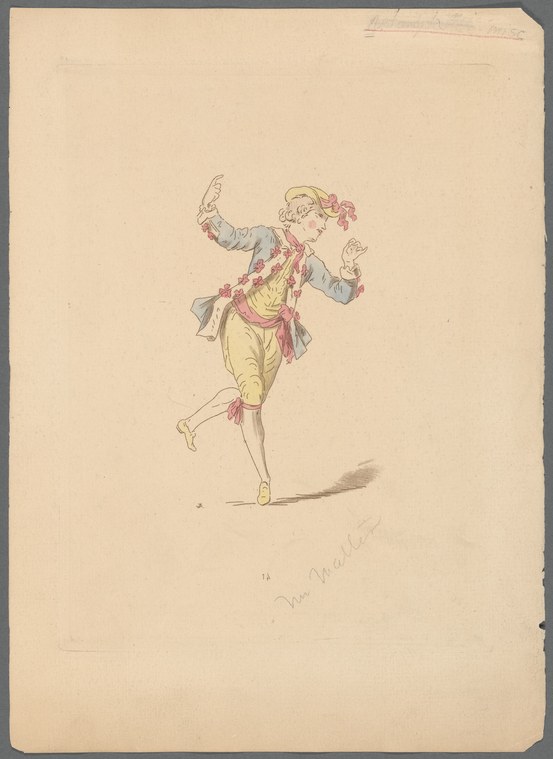
Male dancer in rustic costume
Unknown artist
- Collection:
- Prints depicting dance
- Source:
- New York Public Library
- Rights:
- Public domain — free to use, share and adapt.
- Recorded as:
- Public Domain
This drawing preserves a visual record of early 19th-century character dance costume and male theatrical movement at a moment when dance was becoming a vehicle for storytelling and comic character work. It shows a professional dancer captured at a moment of animated, playful movement—evidence of how performers conveyed personality and narrative through their bodies. For anyone studying the history of male roles in ballet, the development of character dance, or the visual culture of the theatrical period, this image provides a direct and detailed record.
What you are looking at
A single male dancer in a rustic or peasant costume stands in a three-quarter pose against a blank ground. He wears a blue-grey jacket or coat with pink ribbon trim, pale yellow breeches, and pink-trimmed leg wrappings or stockings. His hair is styled up with pink ornamentation. He is captured mid-movement, balanced on one leg with the other lifted behind him, one arm raised and bent, the other extended forward in a gesture that suggests both playfulness and theatrical exuberance. The pose is animated and full of character, with his body weight shifted dynamically. A light wash of shadow beneath his standing foot anchors the figure. The drawing technique—likely watercolor or gouache over ink—is delicate and economical, with soft coloring that emphasizes the costume's decorative elements over anatomical detail.
The dancing
A single dancer captured mid-leap or step, balanced on one supporting leg while the other is extended behind in an attitude-like position. His arms are held in a theatrical frame: one raised and bent at the elbow with fingers extended, the other arm forward with palm turned outward. The posture suggests a moment of sprightly, joyful movement rather than technical ballet form—his stance is looser, more gestural. His head is upright and animated, tilted slightly, contributing to an overall impression of character dancing rather than classical technique.
The dance depicted
This appears to be a character or character-comic dance of the late 18th or early 19th century type, possibly from pantomime or theatrical entertainment. The rustic costume and pink-trimmed details, combined with the playful leaping pose, suggest a peasant or comic male role—the type of figure common in ballet d'action, comic opera, or pantomime of the Regency and early Romantic periods. The gesture and athletic leap suggest a dancer trained in theatrical movement who was expected to convey personality and narrative through physical comedy rather than pure classical line. Without an inscription, a signature, or contextual documentation, the specific character cannot be identified with certainty, but the figure appears to represent a type of comic or rustic male role familiar from early 19th-century theatrical dance.
How it was made
This is a watercolor or gouache drawing over ink on paper, likely a costume or character study. The technique suggests it was produced as a record for theatrical use—possibly a costume design, a dancer's portrait for publicity or rehearsal reference, or a study by an artist documenting theatrical fashions. The delicate hand-coloring and economical linework are consistent with early 19th-century theatrical illustration practice. Such drawings were often bound in albums or portfolios and circulated among theater companies, dancers, and patrons; this object's inclusion in a prints collection suggests it was treated as a print or distributed work rather than a unique artist's sketch.
About this work
This is a character study of a male dancer in a rustic costume captured at a moment of sprightly theatrical movement. The figure's pose—balanced on one leg with the other extended, arms held in a playful gesture—suggests a dancer of the early Romantic period performing a character role in ballet d'action or pantomime. The pink-trimmed costume, the animated gesture, and the informal but theatrical bearing all point to a comic or peasant character type common in early 19th-century dance. The work belongs in a dance gallery as a record of how male dancers of this period were costumed, posed, and expected to convey character through physical exuberance rather than classical restraint. It documents a moment when theatrical dance was moving toward narrative-driven ballet and away from purely courtly display.
How to look at it
Notice the moment chosen: not a still pose, but a dancer caught mid-leap, weight flying forward and upward. The artist has frozen him at the most animated, expressive moment—the moment when personality reads most clearly. Pay attention to how the pink ribbons and trim catch the eye and emphasize movement: they draw your gaze toward the extended leg and raised arm, making the silhouette vivid even though the body itself is economically drawn. The blank ground places all emphasis on the figure's silhouette and gesture, a convention of theatrical portraiture that was standard for costume studies and promotional prints of the period.
The period
This work dates stylistically to the late 18th or early 19th century, an era when ballet was transforming from abstract court spectacle into narrative-driven d'action. Male dancers of this period were increasingly expected to perform character roles—comic peasants, clowns, soldiers—alongside classical technique. The costume style and theatrical presentation suggest the Regency or early Romantic period (roughly 1810–1830), when dance in London and on the continent was heavily influenced by French practices. The figure's pose and gesture are entirely consistent with the spirited, character-driven male roles that appear in surviving written accounts and prints from this period. Costume albums and theatrical portrait collections like this one were important tools for documenting performance practice and disseminating fashion to provincial theaters and companies.
Where it lives
This work is held in the New York Public Library's collection of prints depicting dance. It appears to be a costume study or theatrical character portrait of the type circulated among dancers, choreographers, and theater companies in the early 19th century. Such drawings were often bound into albums or portfolios that functioned as reference material and records of performance practice.
Dance in this work
Questions about this work
What kind of dance is this?
This appears to be a character or comic male role from early 19th-century theatrical dance, likely from ballet d'action (narrative ballet) or pantomime. The rustic costume, playful pose, and animated gesture suggest a peasant or comic character type rather than a classical male role. The dancer is shown mid-leap in a moment of exuberant, theatrical movement designed to convey personality and narrative rather than pure classical technique.
Who was this dancer?
The figure is not identified in the catalogue record, and there is no inscription or signature visible in the image. This may be a generic character type or a study for costume and movement reference rather than a portrait of a named dancer. Without additional documentation, the dancer's identity cannot be established.
What is the pink trim for?
The pink ribbons and trim are decorative costume elements common in theatrical dress of the period, particularly for comic or rustic male roles. They serve both to distinguish the character and to make the silhouette more vivid and readable from a distance—an important consideration in theater design. The trim also emphasizes movement: your eye follows it as the dancer moves, making the action more visible and theatrical.
When was this made?
The style is consistent with early 19th-century theatrical illustration, likely between 1800 and 1830. The costume fashion, the technique (watercolor over ink), and the theatrical conventions visible in the pose all point to the Regency or early Romantic period. No date is recorded in the catalogue.
More dance artwork





