49 works in this view — arrow keys or swipe to move between them.
Dance in Art
Romantic era ballerina in a landscape
Unknown artist
- Collection:
- Prints depicting dance
- Source:
- New York Public Library
- Rights:
- Public domain — free to use, share and adapt.
- Recorded as:
- Public Domain
Romantic-era ballet portraits like this one are primary documents of how dancers worked and how their art was understood and valued by contemporary audiences. The image preserves not only the costume and technique of the period but also the ideological content of Romantic ballet—its focus on the female body as ethereal and otherworldly, its investment in the technical mastery required to appear weightless, and its circulation as a collectible commodity. For dance historians, such prints are essential evidence of performance practice and public reception that surviving written records alone cannot fully convey.
What you are looking at
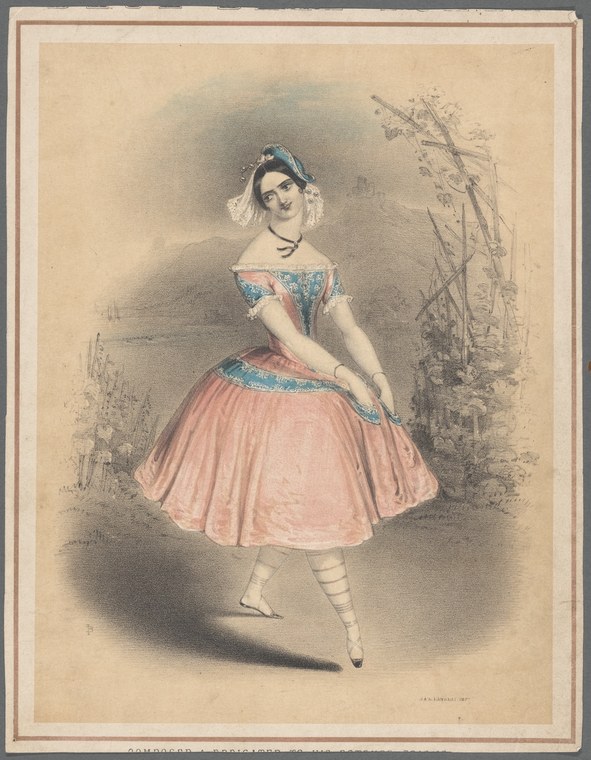
A young woman in Romantic-era dress stands alone in a landscape, posed in a graceful contrapposto stance that suggests arrested motion mid-performance. She wears an off-the-shoulder white bodice with blue trim and a voluminous pink skirt that falls to mid-calf, paired with white tights and pale pointe shoes. Her dark hair is crowned with a small tiara or ornament and framed by a delicate white lace collar or headdress. The figure is centered in the composition against a softly rendered background of distant trees or garden scenery executed in pale wash. The lighting is diffuse and romantic, creating a halo effect around the figure through subtle shading. Her right arm extends gracefully downward while her left arm curves gently at her side, and her weight is transferred to her back leg, creating the impression of a sustained arabesque or attitude position rather than a static pose.
The dancing
The dancer's body demonstrates a clear understanding of ballet technique: her torso is upright and elongated, her legs are turned out from the hip, and her supporting leg is straight with a slight forward tilt of the pelvis that characterizes the Romantic period's aesthetic. The extended leg creates a clean line from hip through foot. Her arms are held in a soft, rounded position typical of port de bras of the era—not rigid but sustained with apparent ease. The pointe shoes are clearly visible and properly fitted. Her gaze is lifted and directed away from the viewer, emphasizing the ethereal, otherworldly quality valued in Romantic ballet performance.
The dance depicted
This is a portrait of a Romantic-era ballerina, most likely from the 1840s–1850s. The pose combines elements of the arabesque and attitude—foundational positions in classical ballet—held with the characteristic lightness and elongation that defined the Romantic ballet vocabulary. The costume, particularly the short tutu and pointe work, identifies this as theatrical ballet of the Romantic period rather than earlier or later styles. The image captures the era's fascination with the ethereal and otherworldly qualities of the female dancer, a central preoccupation of Romantic choreography. Without inscription or identifying information, the specific dancer and ballet cannot be determined, though the costume and style suggest a soloist of significant rank.
How it was made
This is a hand-colored lithograph or engraving, identifiable by its linear structure, the characteristic way shading is achieved through parallel lines and wash, and the subtle color application suggesting a printing medium rather than direct painting. The technique allowed for multiple impressions and wide circulation among the theater-going public and ballet enthusiasts of the period. Lithographic printing was the dominant medium for dance portraiture and theatrical imagery in the 19th century, and the delicate handling of the figure and landscape suggests a skilled practitioner working with a commercial printing house's resources. The soft atmospheric effects and careful modeling of the figure indicate this was a high-quality production, likely a popular print meant for framing in homes or theaters.
About this work
This is a Romantic-era ballet portrait—a genre that flourished in the 1840s and 1850s as a means of immortalizing celebrated dancers and promoting ballet as an art form worthy of serious appreciation. The anonymous subject is captured in a signature pose of Romantic ballet: elongated, weightless, and idealized, poised on pointe in a landscape that emphasizes her ethereal distance from the everyday world. The hand-colored lithograph or engraving technique allowed such portraits to reach far beyond theater audiences, making them collectible objects for a growing middle-class public invested in ballet culture.
The work exemplifies how 19th-century dance was mediated through print culture. By freezing the dancer in a moment of perfect technique and grace, the image transforms ephemeral live performance into a permanent image suitable for study and admiration. The landscape setting and the dancer's upward gaze situate her in a Romantic fantasy world rather than on the stage, a common convention that elevated ballet to the realm of poetry and dream.
How to look at it
Attend to the dancer's feet and the precise positioning of her legs: the visible pointe shoes and the clear turnout and extension demonstrate the technical demands of the style. Notice how the artist has rendered the pose as effortless and graceful despite its difficulty—a key convention of Romantic ballet, where the illusion of weightlessness was paramount. The soft landscape background and the dancer's upward, inward gaze are equally important: they situate her outside the ordinary world, in a realm of fantasy and poetry. The color palette—the pale pink skirt, white bodice, and flesh tones—creates a delicate, ethereal effect that reinforces the Romantic ideal of the dancer as an otherworldly being.
The period
The 1840s–1850s were the height of Romantic ballet in Europe. Marie Taglioni's triumph in *La Sylphide* (1832) had established the Romantic aesthetic—ethereal, otherworldly female dancers on pointe, costumed in white muslin, performing in landscapes and supernatural settings. This aesthetic dominated European ballet for two decades. Simultaneously, lithographic printing had become the dominant medium for theatrical publicity and celebrity portraiture, allowing dancers' images to circulate widely beyond the theater itself. The combination of technical innovation in printing and the Romantic movement's investment in the idealized female form created an explosion of ballet portraiture aimed at both the theater-going public and the growing middle class. Such prints were affordable, collectible, and served as both souvenirs of performances and representations of the dancer as a figure of cultural importance.
Where it lives
The print is held by the New York Public Library as part of its Prints depicting dance collection, a repository of 19th- and early 20th-century theatrical and dance imagery that captures the public face of performance culture during the development of modern dance and ballet.
Dance in this work
Questions about this work
How do I know this is a real dancer and not an idealized fantasy figure?
The specific costume details, pointe shoes, and technical precision of the pose suggest this is a portrait of an actual performer rather than a generic representation. However, like all Romantic-era dance portraiture, the image idealized and spiritualized the dancer, removing her from the theater and the everyday world. The distinction between document and fantasy was deliberately blurred in this period.
Why is she dancing in a landscape?
The landscape setting was a standard convention of Romantic ballet portraiture, reflecting the themes of the ballets themselves, which often placed ethereal female spirits in supernatural natural settings. It also elevated the dancer by removing her from the commercial theater and situating her in a realm of poetic fantasy.
Can you identify which dancer this is?
Without an inscription or identifying information visible in the print, the specific dancer cannot be determined. The costume and style are consistent with any number of celebrated Romantic-era ballerinas who performed between roughly 1835 and 1860.
More dance artwork





