49 works in this view — arrow keys or swipe to move between them.
Dance in Art
Le dieu et la bayadère
Unknown artist
- Collection:
- Prints depicting dance
- Source:
- New York Public Library
- Rights:
- Public domain — free to use, share and adapt.
- Recorded as:
- Public Domain
This engraving documents a crucial moment in European dance history when Orientalism and Romanticism converged in the figure of the bayadère. For dance historians, it is a valuable record of actual costuming and the specific balletic pose considered emblematic of the Romantic ideal. For anyone studying how non-Western dance was appropriated, aestheticized, and erased in nineteenth-century theatrical practice, this image is primary evidence of how the bayadère was reimagined as a European classical dancer rather than represented in any authentic vocabulary of Indian dance.
What you are looking at
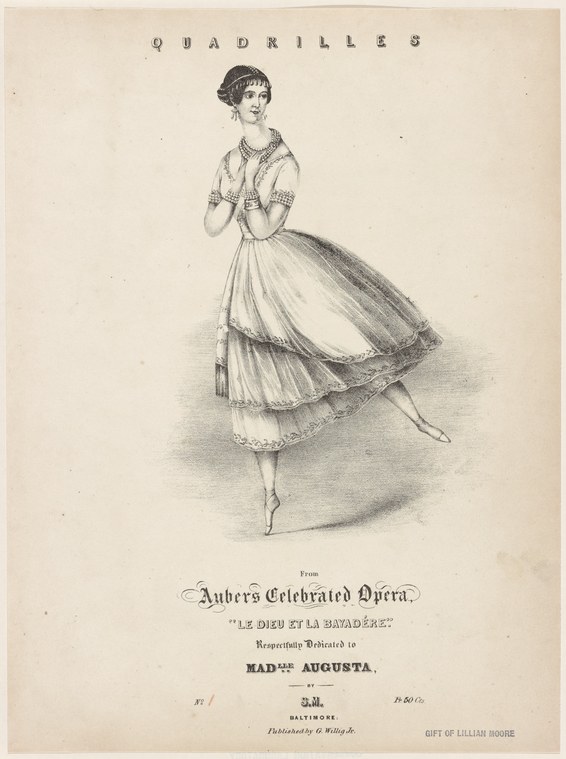
A single female dancer in a romantic period costume stands in a pose of classical elevation. She wears a fitted bodice with short puffed sleeves trimmed with bands at the forearms, a corseted waist, and a voluminous skirt composed of multiple layers of gauzy white fabric that falls to mid-calf. The skirt is caught in movement, with shadow suggesting depth and dimensionality to the layered tiers. She stands on one pointed foot in a balletic attitude, the other leg extended behind her with the knee bent. Her upper body is upright with arms held in a graceful position, and her face is turned slightly upward in a refined, composed expression. The figure is rendered as an engraved line drawing with fine cross-hatching to create tone and shadow, set against a plain background. The title and attribution appear below the figure in ornamental script.
The dancing
The dancer is isolated, shown in a single continuous pose. Her weight rests on the ball of one foot, with the supporting leg evidently straight and strong beneath her corseted frame. The other leg extends backward with the knee bent in what would later be called a developpé or attitude en arrière—a position requiring considerable strength and control. Her arms are held softly and with classical proportion, framing her upper body. The pose conveys both the physical demand of the movement and an ideal of effortless grace characteristic of the period's ballet aesthetic.
The dance depicted
This is a representation of Romantic ballet, most likely from the 1830s-1850s based on the costume and pose. The image depicts a moment from *Le Dieu et la Bayadère* (*The God and the Bayadere*), a work featuring the South Asian temple dancer figure—the bayadère—that captivated European audiences of the Romantic era. The engraving appears to have been created to document or promote a specific production, likely after a Paris premiere. The pose and costume align with the vocabulary of contemporary ballet: the pointed foot, the ethereal weightlessness of the layered skirt, and the balletic arm position all reflect European classical technique rather than any authentic Indian dance vocabulary, though the title invokes the bayadère tradition.
How it was made
This is a steel or copper engraving, a fine-line technique that allowed for precise rendering of detail and rapid reproduction for commercial distribution. The artist has used cross-hatching and fine parallel lines to suggest volume in the skirt and shadow beneath the figure. Engravings of this type were printed and hand-colored, or occasionally distributed as single prints in black and white. The technical finish and the care devoted to anatomical accuracy suggest this was intended for a educated, relatively affluent audience—likely theatergoers, dance enthusiasts, and print collectors—rather than a mass popular audience. The inscription notes that this depicts a dancer named Mademoiselle Augusta and that the print was published by N. Mendal in Baltimore, suggesting American distribution of European dance imagery.
About this work
This is an engraved portrait of a Romantic-era ballet dancer, identified through the inscription as Mademoiselle Augusta, performing in or associated with the ballet *Le Dieu et la Bayadère*. The work dates to the heyday of Romantic ballet, when European audiences were fascinated by exoticized figures—particularly the figure of the bayadère, a South Asian temple dancer—reimagined through the lens of classical European ballet technique. The image captures a moment of balletic poise, emphasizing the lightness and ethereal quality prized in Romantic dance. It belongs to a significant tradition of theatrical prints that documented and promoted famous dancers and productions, making dance visible to audiences beyond the theater itself. The American publisher's mark indicates how transatlantic the circulation of dance imagery had become by the mid-nineteenth century.
How to look at it
Observe the moment the artist has chosen: not a moment of action or transition, but a moment of sustained, difficult balance. The dancer is held in a pose that requires constant, invisible effort—the foot is pointed, the supporting leg is working, the body is aligned. The artist has emphasized this through the clarity and precision of the line work: every detail of the corseted torso, the careful arrangement of the arms, the articulation of the foot. The voluminous, layered skirt is rendered with particular care, with shadow and line work suggesting its weight and movement even in stillness. This is how Romantic ballet presented the female body: as an achievement of control, lightness, and beauty, all at once.
The artist
The artist is not recorded. The print was published by N. Mendal in Baltimore, indicating an American publisher and distributor of European theatrical imagery. The work is part of a broader commercial print culture that grew up around Romantic ballet in the 1830s-1850s, in which dozens of engravers produced images of celebrated dancers and celebrated scenes from popular ballets. These prints were sold individually and bound into collections, creating a mass market for dance imagery that reached beyond theater attendance.
The period
The 1830s-1850s were the height of the Romantic ballet era in Europe. *La Sylphide* (1832), *Giselle* (1841), and *La Bayadère* (1877 in St. Petersburg, though versions appeared in Paris earlier) established a vocabulary of otherworldly, weightless femininity that became the template for ballet. Simultaneously, European audiences were captivated by Orientalist imagery, fueled by colonial encounters, travel literature, and theatrical exoticism. The bayadère figure—the temple dancer from South Asia—appeared frequently in European ballet and theater as a marker of luxury, sensuality, and cultural otherness, though always filtered through the pointe shoes and ethereal skirts of European Romanticism. This engraving sits at the intersection: a European classical dancer in an exotic role, performing for audiences who understood the pose as the ultimate expression of contemporary femininity and artistic refinement.
Where it lives
The print is held in the New York Public Library's collection of prints depicting dance. The inscription notes that it represents a dance from Auber's celebrated opera *Le Dieu et la Bayadère* (or a ballet of the same name), with the role performed by a dancer identified as Mademoiselle Augusta, and was published by N. Mendal in Baltimore. It is catalogued as part of a broader collection of theatrical and dance prints.
Dance in this work
Questions about this work
Who was Mademoiselle Augusta?
The catalogue record does not provide biographical information beyond what appears in the inscription. She was a dancer associated with productions of works featuring the bayadère character in the mid-nineteenth century, known well enough to have been the subject of a commercial engraving. Further research would require consulting specialized dance history sources or nineteenth-century theater records.
What is a bayadère?
In South Asian practice, a bayadère (from the Portuguese *bailadeira*, female dancer) was a temple dancer or courtesan-dancer. In European theatrical imagination of the nineteenth century, the bayadère became a stock exotic character: sensual, skilled, dangerous. European ballet reimagined her as a classical pointe dancer in a tutu, erasing all vocabulary and context of actual Indian dance while using her figure as a marker of Orientalist fantasy.
How was this print made and used?
This is an engraving, made by incising lines into a metal plate that was then inked and printed. The technique allowed for fine detail and high edition runs. Such prints were sold individually or collected in albums by theater patrons, dance enthusiasts, and print collectors. They served as mementos of celebrated dancers and performances, extending the audience for dance beyond the theater itself.
What does the pose tell us about Romantic ballet technique?
The pose—standing on one pointed foot with the other leg extended behind in a bent-knee position—demonstrates the core values of Romantic ballet: apparent weightlessness, vertical alignment, and technical precision. It emphasizes the pointe shoe and the extended line of the leg, vocabulary that was new and striking in the 1830s-1840s. The effortlessness of the pose (as presented to the viewer) masks the considerable strength required to sustain it.
More dance artwork





