49 works in this view — arrow keys or swipe to move between them.
Dance in Art
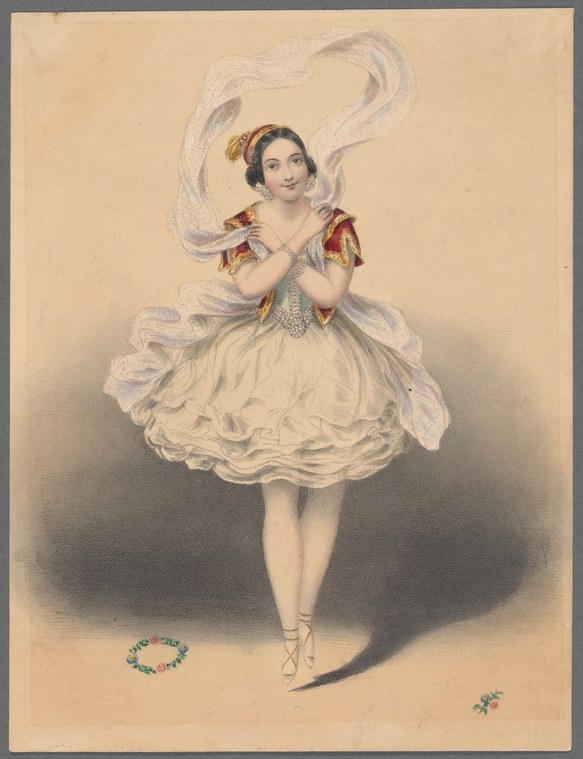
Romantic era ballerina in Greek (?) costume with swirling scarf
Unknown artist
- Collection:
- Prints depicting dance
- Source:
- New York Public Library
- Rights:
- Public domain — free to use, share and adapt.
- Recorded as:
- Public Domain
This print is a primary record of how the Romantic ballet was visualized and marketed to the public in the mid-nineteenth century—not as documentation of a specific performance, but as an ideal type that could be reproduced, collected, and admired. For dance historians, such imagery reveals the aesthetic priorities, the costume conventions, and the gendered spectacle central to Romantic ballet culture.
What you are looking at
A young woman in Romantic-era theatrical dress stands alone against a soft, shadowed background, caught in a moment of pirouette or sustained turn. She wears a short tulle skirt arranged in layers that billow outward from the motion, revealing her legs and feet in pointed ballet slippers. Her bodice is fitted in pale silk or satin with short sleeves trimmed in gold and crimson ribbon. She has dark hair drawn up under a small decorative headpiece, and her gaze is directed downward in the contemplative manner typical of mid-nineteenth-century ballet imagery. Most striking is the long, diaphanous scarf that streams upward behind and around her in graceful curves—whether rendered by the artist as part of the costume or as a visual effect of motion is deliberately ambiguous. Two small floral wreaths appear in the foreground, one at bottom left and one at bottom right, suggesting a garden setting or perhaps decorative props associated with the ballet's narrative. The artist has used soft shading to suggest depth and atmosphere, with the figure emerging luminously from darker tones.
The dancing
The dancer's weight is concentrated on one supporting leg, the other extended or folded beneath her in a position suggesting active rotation. Her arms are held in a classical frame—one raised, one at her side—consistent with the carriage of Romantic-era ballet technique. The torso is upright and the head graceful, tilted slightly in profile. Her posture and the placement of her feet in ballet slippers indicate training in turnout and control. No other dancers are present; this is a solo portrait of a female soloist at a moment of choreographic display.
The dance depicted
This is almost certainly a Romantic-era ballet dancer, likely depicting a scene from a ballet such as La Sylphide, Giselle, or one of the sylph or spirit ballets that dominated European stages in the 1830s–1850s. The costume—short tulle skirt, fitted bodice, pointe shoes, and headpiece—is canonical to this period and genre. The ethereal scarf may reference the famous scarf motif from La Sylphide (1832), though it appears here as a flowing accessory rather than a plot device. The pose and the garden setting with floral wreaths suggest a moment of supernatural or romantic transcendence typical of the Romantic ballet narrative. Without an inscription or title, the specific ballet cannot be confirmed, but the visual language is unmistakably that of the Romantic ballet idiom as circulated in prints and popular imagery.
How it was made
The work is a hand-colored lithograph or engraving, executed with soft tonal effects achieved through careful layering of color and fine linear shading. The medium allowed for wide circulation to middle-class audiences and theater enthusiasts; such prints were sold as souvenirs and collected in albums. The hand-coloring—applied to the face, bodice trim, and skirt with precision—suggests production by a professional print house, probably in Paris or London. The technique's softness and the delicate rendering of the scarf and tulle indicate a skilled practitioner working from knowledge of actual ballet costume and stage lighting effects.
About this work
This is a portrait print of a Romantic-era ballet soloist, rendered in a medium optimized for mass circulation to theaters and drawing rooms. The figure's pose, dress, and the ethereal scarf all point to the Romantic ballet tradition of the 1830s–1850s, when short tutus, supernatural narratives, and the cult of the ballerina transformed European theatrical dance. The image captures not a documented performance but a type—the Romantic heroine as ideal, preserved in a popular print for audiences who had seen such dancers on stage or aspired to.
The work belongs to a vast archive of nineteenth-century dance imagery that shaped how the public understood ballet: as a female art form, as spectacle, and as a vehicle for beauty and transcendence. These prints were essential to the machinery of fame and desire around individual dancers; they circulated farther and lasted longer than the performances themselves.
How to look at it
Attend to the moment the artist has chosen: not a leap or a dramatic gesture, but a moment of sustained, centered rotation—a pirouette or attitude held in profile. The pose emphasizes balance, verticality, and the long line of the body, all hallmarks of Romantic ballet technique. The soft, upward drift of the scarf, rendered as if caught by the motion or by stage lighting, is the work's most romantic conceit—a visual device that suggests immateriality and grace. The flowers at her feet and the neutral, twilit background locate her in a liminal space, neither firmly on the stage nor in a naturalistic landscape. This was the standard vocabulary for selling Romantic ballet to the Victorian public.
The period
The image dates to the heyday of Romantic ballet in Europe, when ballerinas such as Marie Taglioni, Carlotta Grisi, and Lucile Grahn became international celebrities. The 1830s–1850s saw the full flowering of the Romantic movement in ballet: narratives of sylphs, spirits, and doomed heroines; the adoption of the pointe shoe as standard; and the development of the short, layered tulle skirt (the tutu) as the defining costume. This was also the golden age of the theatrical print, when hand-colored lithographs and engravings were the primary means of circulating images of celebrated dancers to audiences across Europe and North America. The production and consumption of such prints was integral to the star system and to the marketing of ballet as entertainment.
Where it lives
The work is held in the New York Public Library's Prints collection, a major archive of theatrical imagery and popular prints from the nineteenth and early twentieth centuries. It is catalogued generically as a dance print, without attribution or precise date, reflecting the common anonymity and mass production of such materials.
Dance in this work
Questions about this work
What ballet is this from?
The print does not name a specific ballet. The costume and pose are consistent with major Romantic ballets of the 1830s–1850s, such as La Sylphide or Giselle, but without a caption or inscription, the ballet cannot be identified with certainty. The image represents a type rather than a documented moment.
Who was the dancer?
The print does not identify the dancer. It was common for such theatrical prints to be published either as generic types or with the name of a celebrated dancer added later. The style and quality suggest it may depict or be modeled on a famous soloist of the period, but this cannot be confirmed from the image alone.
Why the scarf?
The scarf was a common accessory in Romantic ballet costume and gained particular prominence in La Sylphide (1832), where it was integral to the plot. Even when not essential to the narrative, such flowing fabrics were valued for their visual poetry—they extended the line of the dancer's body and created an effect of ethereality and motion that was central to the Romantic aesthetic.
What technique was used to make this print?
This appears to be a hand-colored lithograph or engraving, printed in black line and then colored by hand with watercolor or gouache. Such prints were produced by theatrical print houses in Paris, London, and other major cities and sold to the public as souvenirs, theatrical publicity, or collectibles. Hand-coloring allowed for careful attention to costume detail and a soft, luminous effect.
More dance artwork





