49 works in this view — arrow keys or swipe to move between them.
Dance in Art
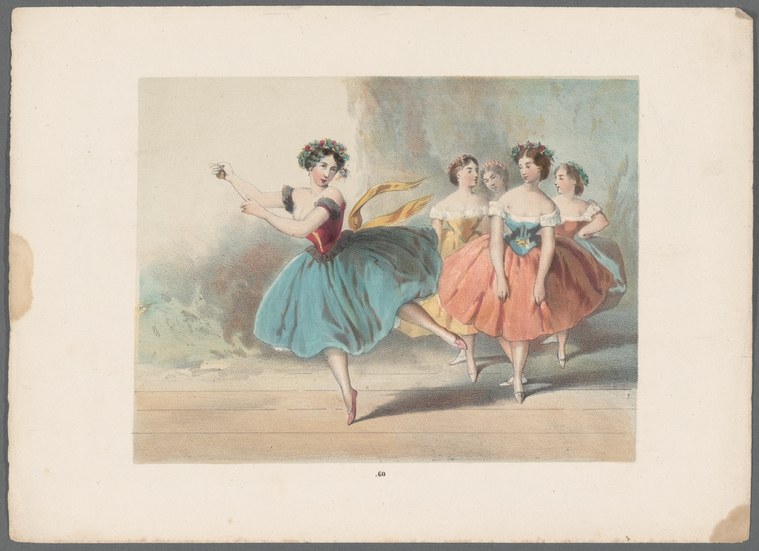
Ballerina dancing with castanets onstage, four other women at right
Unknown artist
- Collection:
- Prints depicting dance
- Source:
- New York Public Library
- Rights:
- Public domain — free to use, share and adapt.
- Recorded as:
- Public Domain
The print documents a crucial moment in ballet history: the integration of Spanish and Iberian character movement into the classical ballet vocabulary during the Romantic era. For dancers and choreographers, it shows how castanets and Spanish styling were adapted to the pointe-work and extension of ballet technique. For historians, it is evidence of how 'national character' was visualized and marketed in commercial theatrical prints—a major source of how audiences understood and remembered dance.
What you are looking at
A theatrical stage scene in which a principal ballerina, costumed in a burgundy bodice and billowing turquoise skirt, performs with castanets held aloft in both hands. She is caught mid-movement in an energetic pose, one leg extended in a high développé or attitude, her body leaning back with considerable extension. Behind her stand four other female dancers in coral-pink and white dresses, arranged in a loose group and posed as if watching or waiting to join. The stage appears to be a painted interior or ballroom setting rendered in soft grays and neutral tones, with minimal scenery. The lighting is warm and diffuse, casting soft shadows that suggest stage illumination. The composition emphasizes the soloist's dynamism against the relative stillness of the ensemble.
The dancing
The principal dancer is en pointe or demi-pointe, with her weight clearly shifted to demonstrate virtuosic control and extension. Her castanets are held at shoulder height, arms extended in a pose that suggests Spanish or Iberian-influenced movement. Her torso shows considerable arch and elegance—classical ballet posture with the head held proudly. The four background dancers adopt posed, observant stances typical of ensemble work, their arms at rest or gently placed, their bodies upright and formal. The soloist dominates through dynamic gesture and spatial placement; the ensemble defines the theatrical frame.
The dance depicted
This is a theatrical ballet scene depicting a character or principal dancer performing a Spanish-inflected solo, likely a divertissement or character variation. The use of castanets, the flamenco-adjacent styling of the corps (coral skirts, the soloist's vivid color palette), and the theatrical stage setting suggest a 19th-century Romantic or late-Romantic ballet in which Spanish or Iberian character dance was incorporated as a specialty number. The pose and extension are entirely consistent with Romantic ballet technique, though the castanets indicate a fusion of classical ballet with Spanish or Andalusian movement vocabulary. This was a common format in Romantic-era ballets such as *Don Quixote* variations or similar works that included national character dances.
How it was made
This is a hand-colored lithograph or engraving, rendered with delicate watercolor or gouache washes that build soft color. The technique allowed for fine detail in the dancers' faces and elegant line-work in their limbs and drapery, while the hand-coloring adds warmth and visual appeal. The pale cream paper and restrained palette suggest this was a commercial print intended for a broad theatrical audience—likely a souvenir of a celebrated performance or a dance manual illustration. The quality of execution indicates professional production, consistent with 19th-century theatrical prints distributed in Europe and North America.
About this work
This is a theatrical ballet print documenting a Spanish character variation as it would have appeared on stage in the Romantic or late-Romantic era. The work captures a specific moment of virtuosity—the soloist's high extension and confident command of the stage—and records the costume and character type that would have been familiar to contemporary audiences. It belongs to a rich tradition of dance prints that served both as theatrical souvenirs and as documents of performance practice, allowing viewers who had seen the ballet to remember it, and those who had not to imagine it. The emphasis on the soloist's technical achievement and theatrical presence makes it a valuable record of how ballet and character dance were understood and celebrated in the 19th century.
How to look at it
Attend to the moment the artist chose to freeze: the peak of the soloist's extension, when her leg is highest and her control is most evident. This is the apex of the phrase, the moment of greatest visual drama. Notice how the artist has used the castle's background and the standing ensemble to frame and emphasize the soloist's achievement; she is isolated in space and movement, made the undeniable center. The hand-coloring distinguishes her costume (burgundy and turquoise) from the ensemble's coral and white, further emphasizing hierarchy and focus. The castanets, held aloft, are a signature element of the character type and would have been instantly recognizable to a 19th-century viewer as marking a Spanish variation.
The period
This print dates to the 19th century, when the Romantic ballet was at its height (1830s–1870s) and character dances from across Europe were being incorporated into classical ballet as diversions and showcases for principal dancers. Spanish and Iberian character dance enjoyed particular popularity in ballet during this period, appearing in works like *Don Quixote*, *La Esmeralda*, and various divertissements. The technology of lithography and hand-coloring made theatrical prints affordable and collectible, and dance prints were widely distributed and consumed by middle-class audiences. This print reflects the 19th-century fascination with exoticism and national character types as entertainment.
Where it lives
This work is part of the New York Public Library's collection of prints depicting dance, a major archive of 19th and early 20th-century theatrical imagery. Such prints were created as commercial products and widely distributed; the NYPL collection preserves hundreds of similar items documenting ballets, opera-ballets, and theatrical dance as it was performed and remembered.
Dance in this work
Questions about this work
What are the castanets and why is the dancer using them in a ballet?
Castanets are percussion instruments associated with Spanish and flamenco dance. In 19th-century Romantic ballet, character dances and national variations (solos showcasing a specific country or ethnic style) were popular diversions. A Spanish or Spanish-inflected variation would naturally include castanets as a marker of authenticity and exoticism. The dancer here is performing a character solo within a larger ballet—a common format in works like *Don Quixote*.
Is this a real performance or an idealized scene?
It is likely both. The print probably documents a specific celebrated performance or performer, but the artist has composed and idealized the moment to emphasize the soloist's elegance, extension, and theatrical command. The soft, flattering lighting and the graceful arrangement of the ensemble reflect 19th-century conventions of theatrical portraiture, which aimed to preserve the beauty and impression of a live performance rather than document it with photographic realism.
How do I know this is from the 19th century?
The styling—the tutus, the pointe work, the gas-lit theatrical setting, the color palette and hand-coloring technique—all point to the 19th century. The technology of hand-colored lithography was standard for theatrical prints from roughly 1820 to 1890. The Romantic ballet aesthetic (the graceful extension, the ethereal poses, the narrative emphasis on the soloist) is consistent with works from the 1830s–1870s.
More dance artwork





